
The Battle of Hatten-Rittershoffen and the Men Who Held the Line
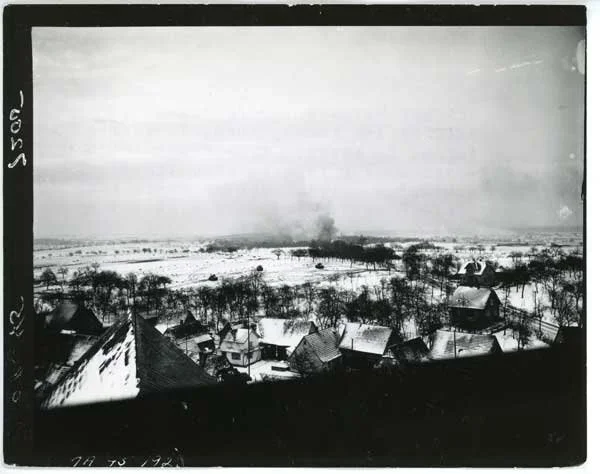
A view of Hatten © National Archives
This week I have been writing up individual soldier stories for a project with the Rainbow Division Veterans Foundation and Collectif Hatten Demain, in support of the initiative to preserve the Hatten battlefield, currently under threat of development. It has me deep inside the Battle of Hatten-Rittershoffen again, one of the most significant and least-known fights of the Second World War.
As a narrative historian, the men of the 42nd Infantry Division have been my central work for many years, and working with the Rainbow Division Veterans Foundation is always a pleasure.
…………………………
They had been in France for exactly four weeks.
Most had never seen combat. On the morning of January 9, 1945, the men of the 1st Battalion, 242nd Infantry Regiment, 42nd "Rainbow" Infantry Division, woke up in the Alsatian village of Hatten to find war coming straight at them.
The terrain was snow-covered farm fields stretched in every direction. The January sky sat low and grey over the plain. The village itself, a farming community of about 1,500 residents, was quiet under the weight of long years of annexation by Germany.
It would not be quiet for long.
What Was Coming
Operation Nordwind, Hitler's last major offensive on the Western Front, had launched on New Year's Eve 1944. Designed to relieve pressure on the collapsing Ardennes offensive and, if possible, retake Strasbourg, it drove German forces into the Alsatian plain in force. What stood in the way, along a dangerously extended line, were the green troops of Task Force Linden, comprised of the three infantry regiments of the 42nd "Rainbow" Division, who had been rushed to France without their artillery or supporting units.
The village of Hatten sat along the old Maginot Line fortifications running through northern Alsace. The Americans occupied its pillboxes and casemates, strung minefields and barbed wire along the avenues of approach, and waited. In early January, more than seven hundred eighty men of the 1st Battalion, 242nd Infantry, under Lieutenant Colonel Edwin Rusteberg, began occupying Hatten. A mile to the west, the 2nd Battalion held Rittershoffen.
They had been ordered to hold at all costs. And they would do just that.
When the American front had approached Hatten in November 1944, the residents had been urged to evacuate. They refused. They had already lived through the forced evacuation of 1939, already spent years displaced from their homes, and they were not willing to go again. They stayed. And the battle came to them anyway.
On the other side, the XXXIX Panzer Corps had assembled a formidable force: elements of the 21st Panzer Division and the 25th Panzergrenadier Division, supported by the combat-tested paratroopers of the 20th Fallschirmjäger Regiment. These were not second-line troops. These were some of the best soldiers the German army still had. Among the armor rolling toward Hatten were Flammpanzers, flame-throwing tanks built specifically to burn men out of fortified positions, capable of firing sixty to seventy bursts of liquid fire at close range.
Captain William Corson commanded Company A of the 1st Battalion. He would later write that the briefing his green, inexperienced troops received before the battle described Hatten as a small, quiet town, with nothing more than small German patrols in the area.
The Morning of January 9th
In the early hours before dawn, German infantry crept up to a Maginot pillbox on the edge of Hatten and found the Americans inside asleep. The entire crew was captured without a shot fired. Then the shooting erupted all along the line.
At 5:00 a.m., the full attack began. White-clad infantry moved behind white-painted Panzer tanks across the snow-covered fields. They were nearly invisible until they were close enough to kill.
The 57mm anti-tank guns of the 242nd's anti-tank company engaged. Two of three platoons were overrun within hours. In the northern portion of the village, B Company found itself under assault by eighteen tanks and twenty personnel carriers. The tanks used direct fire and the Flammpanzers to burn the GIs out of their fortifications, pouring fire through every aperture, setting hay in barns alight, driving men from positions they had been ordered to hold. B Company's commander surrendered.
By noon, the Germans held parts of Hatten. The fight had become something else entirely. Cooks and headquarters personnel were pulled from their posts and sent to man machine guns alongside riflemen. Anti-tank mines were laid across the streets in front of advancing German tanks. Every building was a calculation: fortress or deathtrap, depending on which side reached it first.
When the battalion command post was forced to relocate under direct tank fire, it moved two buildings to the west, only to be attacked there immediately by a Mark V tank. Private Vito Bertoldo, a cook concussed from a tank round that had hit his position, took control of a machine gun and held off the attacking German infantry alone for long enough to let the command post reestablish. He strapped the machine gun to a table for stability. He moved into the street, in full view of the enemy, and fought there for almost twelve hours. He killed forty of the enemy. He would fight for forty-eight hours total. He would receive the Medal of Honor.
After the war, Bertoldo told newspapers: all I did was try to protect some other American soldiers from being killed. At no time did I have in mind that I was trying to win something.
The Civilians
When the Germans first encircled the American positions at Hatten, the American command ordered the village's town crier to walk the streets and warn every household: take shelter in your cellars and do not come out.
Marguerite Heyoppe Kraemer was twenty years old and the eldest of ten children when the battle came. Her family lived in the forester's house at the edge of Hatten. Her father, the forest warden, had refused to wear the German uniform and fight for a country that was not his. He deserted and joined the Americans. The Gestapo came looking for him. His wife and ten children sheltered underground, listening to the war move through the streets above them, while their father was a wanted man somewhere in the fighting outside.
Marguerite later wrote about it in a memoir called La Tartine de beurre, The Butter Sandwich, one of the few firsthand civilian accounts of what those days felt like from inside the village. She described it as the daily combat of a family fighting to survive in the middle of hell. Decades later, in her late nineties, she was interviewed about it on French radio, still remembering. Her book was later adapted into a film, shot entirely by volunteers in the village where it happened.
The civilians of Hatten and Rittershoffen who stayed went underground and remained there. They were in their cellars when the tanks rolled through their streets. They were in their cellars when the Flammpanzers set the barns on fire. They were in their cellars while the dead, soldiers on both sides and their neighbors, lay in the streets above them.
The cows in their stalls bellowed without anyone to tend them. The cadavers of animals rotted and infected the air. The wounded could not be evacuated on foot because both villages were under continuous artillery fire. A Stuart light tank from the 94th Cavalry Reconnaissance Squadron made thirteen trips back and forth from the village, each time loaded with wounded men, carrying them out to the relative safety of the Haguenau Forest.
Inside the buildings still standing, the fighting was closer than anyone outside could imagine. It was not uncommon for American soldiers to occupy the upper floor of a house while German soldiers were in the cellar below. The infantry reported firing mortars at ranges of seventy-five to one hundred and fifty yards. They fired forty rounds of bazooka rockets in five minutes.
A tank engagement in those streets looked like this, from an American after-action report: a German tank would move up a wreck-strewn street, climbing over piles of rock and timber. An American tank would move to meet it. The German tank would stop just short of a corner, and the American would wait just around it. And so they would sit. Each trying to maneuver for a shot without being hit, blowing holes through the walls of houses to fire through, each maneuvering around the other's position in a slow, lethal maneuver surrounded by rubble.
The church in Rittershoffen became a German strongpoint. The Americans brought up a self-propelled 155mm gun and fired directly into it. The gun had to withdraw under anti-tank fire before the job was done.
On the night of January 17 to 18, a brief lull allowed both sides to evacuate their wounded. Some of the villagers managed to escape.
When the Germans finally retook the village, they sent men with horses and carts to collect the dead, civilian and military alike. The frozen bodies were thrown like sacks onto the carts. The work was extremely dangerous because of mines and booby traps the retreating forces had left behind. The Gestapo arrived looking for inhabitants who had collaborated with the Americans.
What the Germans Said
Hans von Luck, commanding the 125th Panzergrenadier Regiment of the 21st Panzer Division, later called the fighting around Rittershoffen one of the hardest and most costly battles that ever raged. The Americans, he said, defended themselves with guns, pistols, bazookas, and knives, house by house, so that the attack had to be broken off.
A German soldier named Hans Weiss was nineteen years old during his first combat at Hatten. He was gravely wounded and lost his sight. He wrote about it years later to urge younger generations to work for peace and reconciliation.
The green American infantry had not moved. Not one man, Rusteberg later said, left Hatten until relieved.
They held at all cost.
For the 1st Battalion, the cost was significant.
What Was Left
When Allied forces fully secured the area, the burned-out husks of dozens of American Sherman tanks lay scattered across the fields, alongside roughly sixty German armored vehicles. Both Hatten and Rittershoffen had nearly all of their structures damaged or destroyed. Of Hatten's approximately three hundred fifty houses, almost none stood undamaged. At least one hundred twenty-three civilians from the two villages were dead. Hundreds more were wounded. Their homes were gone.
Rusteberg's battalion had entered Hatten on January 9 with thirty-three officers and seven hundred forty-eight enlisted men. It came out with eleven officers and two hundred fifty-three men.
The rest were dead, wounded, or in German captivity.
And none of them were green after the battle.
The Ground Is Still There
The fields where the 1st Battalion, 242nd Infantry held their position on January 9, 1945 are still there, and the Maginot casemates still bear the scars of tank and artillery fire.
In 2024, a proposal emerged to build a forty-hectare industrial park on the battlefield site, a geothermal energy and lithium extraction complex scheduled for 2026. A local collective, Collectif Hatten Demain, has been fighting it, seeking historic monument classification for the casemates and the battlefield itself to prevent construction. Their petition frames the stakes plainly: more than two thousand soldiers became casualties on these fields, and at least one hundred twenty-three civilians died. The villages were annihilated.
The community has not stopped telling its story. Marguerite Kraemer's memoir was adapted into a film, shot by volunteers in the village in 2022 and 2023, and premiered in Hatten's village hall in November 2023. In February 2024, the Maison Rurale de l'Outre-Forêt mounted an exhibition from the book and film, with readings from Marguerite's account and demonstrations of wartime survival. The same community now fighting to protect the battlefield is the one that has been keeping its memory alive.
The stories of the soldiers who fought here, American and German, and the Alsatian civilians who sheltered underground while the battle moved through their homes above them, are part of what I am writing for the Rainbow Division Veterans Foundation. They belong to the historical record of this place. And the historical record, and the men who bled for it, and died for it, deserve to remain visible, on the ground where it happened.
Memory, as one member of Collectif Hatten Demain put it, should not be concreted over beneath factories.
…………………………
The Men of Hatten
In conjunction with this initiative, I have written portraits of ten soldiers of the 1st Battalion, 242nd Infantry Regiment, 42nd "Rainbow" Division:
Lieutenant Colonel Edwin Rusteberg, commanding officer
MSG Vito R. Bertoldo, Medal of Honor recipient
PFC Glenn E. Schmidt, prisoner at Stalag IX-B Staff
SGT Graydon E. Waters, missing in action
PFC Donald Segel, prisoner of war
2LT Richard H. Wells, killed in action
1LT Danny R. McBride, prisoner at Oflag XIII-B
PFC Sidney L. Erdman, missing in action
PFC Lawrence E. Brucker, missing in action
SSG Sol Feingold, who recovered the lost Presidential Unit Citation paperwork in 1995
If you are connected to any of these men, or have stories of others who fought at Hatten or Rittershoffen, I would love to hear from you.
…………………………
For more about Hatten-Rittershoffen, read Patrick Chaisson’s detailed tactical account over at Warfare History Network.
Erin Faith Allen is an investigative war historian and the founder of Fortitude Research, specializing in WWII archival research, wartime reconstruction, Holocaust documentation, and the recovery of women's wartime histories. She is a leading authority on the 42nd "Rainbow" Infantry Division, inluding their liberation of Dachau concentration camp. Her family-commissioned book, One Day Over the Rhine, was published in 2026.
All original photographs and written work published on this site are copyright Erin Faith Allen. Historical and archival images are used where they exist in the public domain.
```