
Camp Gruber: Where the Rainbow Was Rebuilt
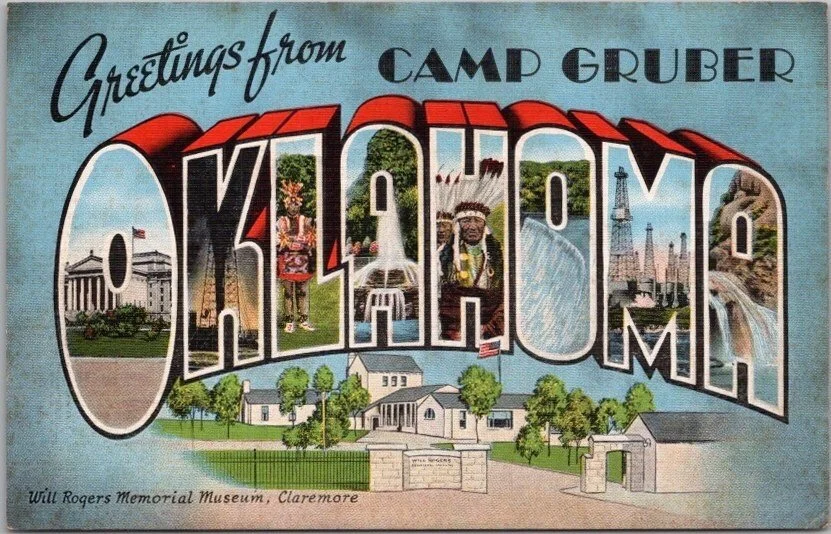
Vintage postcard from Camp Gruber.
Before the 42nd Rainbow Division held the line at Hatten, before it crossed the Rhine, before it entered Dachau, it was in Oklahoma.
On July 14, 1943, the Rainbow Division was reactivated at Camp Gruber, Oklahoma. The men who would become the WWII Rainbow assembled in the hills, in a training facility built almost entirely from scratch in the preceding year, on land that had been Cherokee Nation territory until federal condemnation made room for the war machine.
This is where strangers became soldiers, and the legendary Rainbow Division of WWI was rebuilt, and where a division that would fight its way across France and Germany began to understand its legacy and its destiny.
………………..
Camp Gruber is located near Braggs, Oklahoma in the Cookson Hills, about 14 miles southeast of Muskogee, Oklahoma. It was named after Brigadier General Edmund L. Gruber, a noted artillery officer and the original composer of the U.S. Field Artillery March, the source for the Army's official song, "The Army Goes Rolling Along."
Construction of Camp Gruber began in February 1942 and was completed by May 1942 using a workforce of 12,000 working around the clock to complete approximately 2,000 buildings on the site. The contract called for the construction of barracks, hospitals, administration buildings, a bakery, chapels, a laundry, mess halls, recreation buildings, storage warehouses, theaters, guard houses, motor repair shops, and officers' quarters.
Gruber was a small city built in ninety days to train men for war.
………………..
Unlike its WWI predecessor, the WWII Rainbow Division was composed primarily of draftees rather than National Guard units, though it proudly carried forward the Rainbow name and fighting spirit.
The first Rainbow had been assembled from existing National Guard units with their own histories and identities. The second Rainbow was built from men who arrived as civilians: coal miners and truck drivers and farm boys and office workers, and had to be made into infantry together, from scratch, in the blasts of winter wind and blistering Oklahoma sun.
North of the cantonment were grenade courts, bayonet courts, and obstacle courses, one of which strongly resembled the roads, fields, fences, and hedgerows that troops would later see in Europe, so at the time of their training, they had no idea where they would end up fighting. More than 44,868 troops either served at or trained at the camp, which also employed four thousand civilian workers and incarcerated three thousand German prisoners of war in a facility separate from the main base.
………………..
Muskogee residents opened their homes to the soldiers at Camp Gruber, inviting them to Sunday dinner after church and to Christmas and other holiday celebrations. To the people of the Three Forks region, the World War II fighters were not nameless, faceless individuals. They had sat across the dinner table from them and had danced with them at the USO. The men who trained at Gruber were connected to those Oklahoma families through meals shared and Sunday afternoons and the ordinary human hospitality that sustains people who are a long way from home and about to be sent further.
Those same families watched the division leave Gruber in November 1944. Task Force Linden departed from New York Harbor on November 25, 1944, and arrived at Marseille, France on December 8, 1944.
The Oklahoma hills were behind them, and their unknown theater of war lay ahead.
………………..
Though the original buildings from that era were torn down and repurposed, Camp Gruber still exists. In 1967 the Oklahoma Military Department, Oklahoma Army National Guard, acquired the site to establish Camp Gruber as a state-operated training area. It is an active training facility today, carrying the same name it carried when the Rainbow was rebuilt there in the summer and fall of 1943.
The men who trained there and then crossed the Atlantic and the Rhine made their own versions of history that can be found in the archive: in the personnel files, unit histories, and morning reports that begin, for the WWII Rainbow, in the Oklahoma Cookson Hills.
Erin Faith Allen is an investigative war historian and the founder of Fortitude Research, specializing in WWII archival research, wartime reconstruction, Holocaust documentation, and the recovery of women's wartime histories. She is a leading authority on the 42nd "Rainbow" Infantry Division, inluding their liberation of Dachau concentration camp. Her family-commissioned book, One Day Over the Rhine, was published in 2026.
All original photographs and written work published on this site are copyright Erin Faith Allen. Historical and archival images are used where they exist in the public domain.
```