
The 42nd ‘Rainbow’ Division Was Not at the Battle of the Bulge
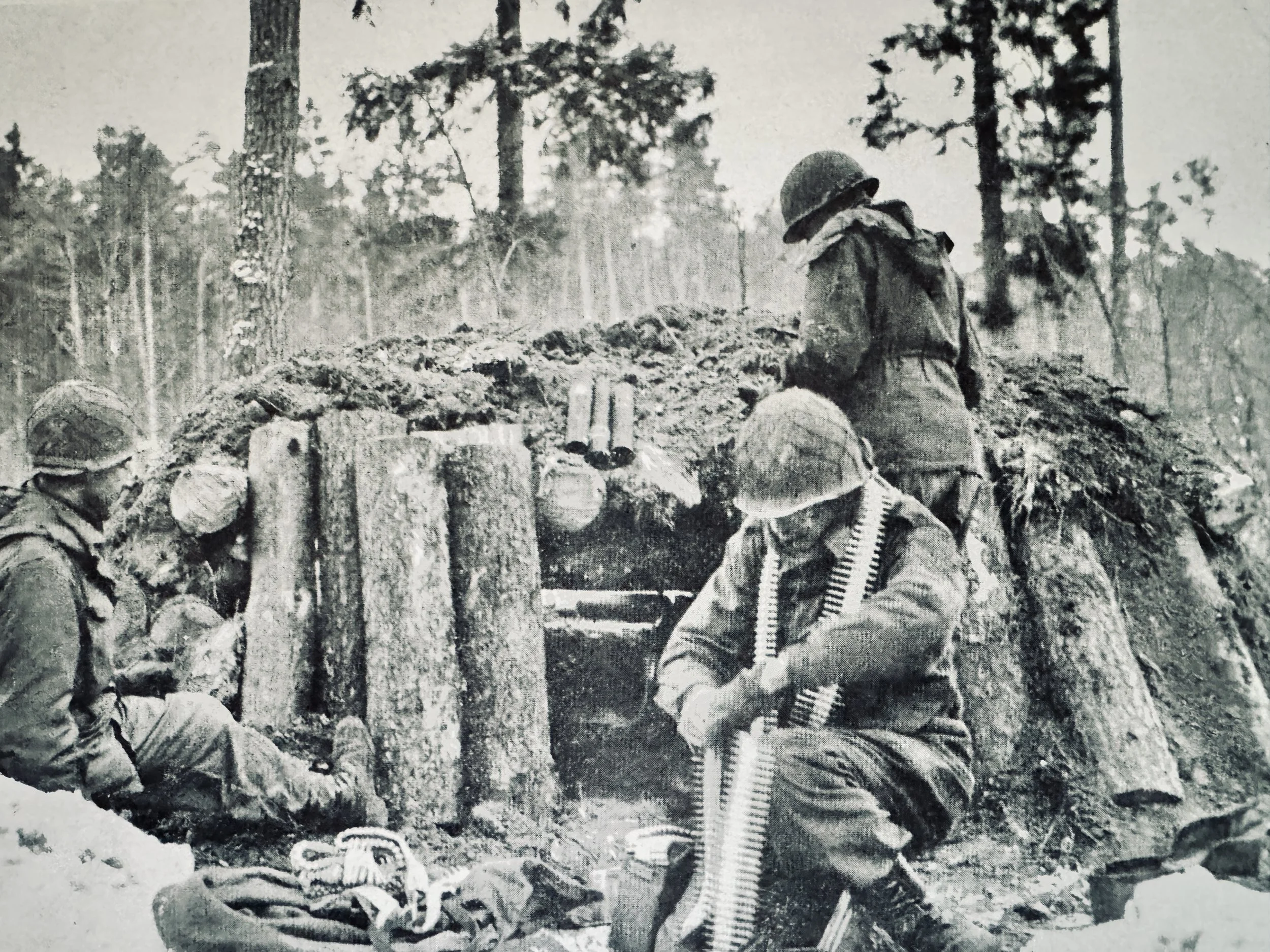
Men of the Rainbow Division at a machine gun emplacement. Signal Corps, National Archives.
The confusion happens often, and it happens with the best of intentions.
A family is trying to honor a grandfather. A journalist is reaching for context. A veteran, decades removed from the frozen winter of 1944, uses the shorthand that everyone recognizes. The Battle of the Bulge. The famous one. The one that was in Band of Brothers.
The 42nd ‘Rainbow’ Infantry Division was not there.
This is not just a minor point of clarification, but a matter of impactful and accurate history. And it is an important distinction, because the battle the Rainbow Division actually fought was its own fierce and significant thing, and it deserves to be called by its name.
…………………
The facts are documented in the division's own history and in the official U.S. Army record.
Task Force Linden, the infantry component of the 42nd Division, arrived in Marseille, France, on December 8 and 9, 1944. Three infantry regiments, the 222nd, 232nd, and 242nd, had been hurried to France ahead of the division's full complement of artillery and support units, stripped down and rushed forward because the situation in Europe was deteriorating fast. They expected a quiet sector, with time to find their footing before the serious fighting began.
On December 18 and 19, with the Battle of the Bulge now exploding to the north, Task Force Linden was assigned to the Third Army and departed Marseille by truck and boxcar toward an assembly area near Bensdorf, France. For a brief moment, the trajectory of the Rainbow Division pointed toward the Ardennes.
Then the orders changed.
En route, Task Force Linden was reassigned to the Seventh Army and redirected southeast to relieve elements of the 36th Infantry Division near Strasbourg. They turned around. They went to Alsace. Two days before Christmas the Rainbow infantrymen arrived in the vicinity of Strasbourg and moved into defensive positions along a nineteen-mile front on the Rhine.
They never got close to Belgium, and they never got close to Luxembourg. The Ardennes was hundreds of miles away and belonged to a different army. The 42nd Division's war began in Alsace, in northeastern France, along the Rhine, and it was about to begin in earnest.
…………………
What began on New Year's Eve was Operation Nordwind.
German Army Group G under Generaloberst Johannes Blaskowitz launched a major offensive against the thinly stretched U.S. Seventh Army in Alsace on December 31, 1944. It was Hitler's last major offensive on the Western Front, deliberately timed to exploit the pressure the Battle of the Bulge was already placing on Allied resources. The Seventh Army had sent troops and supplies north to reinforce the Ardennes fighting, leaving its lines dangerously thin. The Germans intended to cut off and destroy substantial American and French forces and to threaten Strasbourg.
Task Force Linden was pulled from Rhine observation duties and sent north to plug the gaps. What followed was not a quiet introduction to combat. It was three weeks of desperate defensive fighting in bitter cold, deep snow, and frozen foxholes, against German panzer and SS units that had been fighting for years.
The places where the 42nd fought are not famous the way Bastogne is famous. But they were real and they were brutal and the men who survived them did not forget them.
Gambsheim, where German paratroopers and panzer forces crossed the Rhine on January 5 and clashed with Rainbow infantry stretched far beyond what any regiment should be asked to hold. Hatten and Rittershoffen, where two weeks of close urban combat left Germans and Americans occupying different ends of the same villages while civilians sheltered in cellars beneath them, and where Colonel Hans von Luck of the 21st Panzer Division later said the fighting had been one of the hardest and most costly battles that ever raged. The Moder River line, where the division held. The Ohlungen Forest on January 24 and 25, where the 222nd Infantry Regiment defended a front of 7,500 yards, three times the normal frontage for a regiment in defense, in darkness and fog, listening to the sounds of the enemy assembling in the trees.
At Hatten, a soldier named Vito Bertoldo held the battalion command post alone for forty-eight hours, against German tanks, machine gun fire, and panzer grenadiers, until reinforcements arrived. He received the Medal of Honor. He was a Rainbow Division soldier, he was not at the Battle of the Bulge.
…………………
In some cases, the conflation of the Bulge and Nordwind happens for a reason, and the reason is not always carelessness, or the simple fact that this war is a whole language within itself to study, learn, and master.
It is the weight of fame.
The Battle of the Bulge has been documented, memorialized, dramatized, and commemorated in ways that Operation Nordwind has not. The National WWII Museum has noted that despite roughly 40,000 German and American casualties, Nordwind has been sparsely covered compared to the Ardennes fighting. The Army's own campaign star for the period is titled Ardennes-Alsace, a single designation that covers both operations under one ribbon, which has not helped descendants distinguish between them. Some have even called Nordwind the other Battle of the Bulge, a phrase that is well-intentioned but compounds the confusion it means to resolve.
When a family says their grandfather fought in the Battle of the Bulge, they are often reaching for the largest available frame for what they know was a significant and terrible experience. They are not wrong that the experience was significant and terrible. They are wrong about which battle it was.
And the distinction matters more than it might seem. Because when you place a Rainbow Division soldier at the Battle of the Bulge, you are not simply attaching him to a more famous engagement. You are erasing the specific ground he actually stood on. You are replacing Gambsheim with Bastogne, the Rhine with the Ardennes, the Seventh Army with the First and Third. You are giving him a different war. And in doing so, you lose the actual story, which was its own fierce and costly and ultimately victorious thing.
The Rainbow Division held Alsace. It stopped the last major German offensive on the Western Front. It did this as a task force without its full artillery or support units, with infantry who had never seen combat, against elite German panzer and SS formations. It took fifty percent casualties among its riflemen in a single month of fighting. Then it reorganized, crossed the Siegfried Line, drove through Germany, liberated Dachau, and captured Munich.
That is where the documentation trail leads us, that is what the Division did, and that is where they were.
Not the Bulge.
Nordwind.
Erin Faith Allen is an investigative war historian and the founder of Fortitude Research, specializing in WWII archival research, wartime reconstruction, Holocaust documentation, and the recovery of women's wartime histories. She is a leading authority on the 42nd "Rainbow" Infantry Division, inluding their liberation of Dachau concentration camp. Her family-commissioned book, One Day Over the Rhine, was published in 2026.
All original photographs and written work published on this site are copyright Erin Faith Allen. Historical and archival images are used where they exist in the public domain.
```