
The Forest and Gunskirchen Concentration Camp
The ticket machines at Wien Westbahnhof station don't have an English option. In spite of my guessing game and randomly pushing buttons, I have no luck, and the help desks are still shuttered. The station is deserted. I find a man with scruffy grey hair marching toward a train platform and ask for his help. He kindly explains that my ticket can be purchased on the train. He barely speaks English but manages to communicate his love for American music: his favorite band is Creedence Clearwater, he says, as he mimics smoking a joint with his rough worker's fingers.
Before boarding, I proudly speak my first complete sentence in German: "Ein wasser mit gas, bitte", or, one sparkling water, please. Is that even proper sentence construction? I don't know. But my triumph is superseded by the teenager behind the register. He responds with equal pride in nearly accent-free English: "Have a good one!" and hands over my receipt.
I find a carriage, sit down, and look out the window at Austria going by. It is still dark, though a tinge of grey is beginning to burst through the inky morning sky. I am going to find a place that most people have never heard of, to honor a man I never met, for a friend who deserves to know what his father did.
.................
I get off the train in Wels without a clue about where to go next except a vague idea that Gunskirchen is ten miles or so down the road. In the train station, heads turn. I am that sore-thumb American. The village square is quiet, deserted even. I walk over to a taxi parked on the side of the square and try my best to fill him in on the details: I'm seeking an obscure former Nazi concentration camp. It's just forest now, and I don't know where exactly, but it's near the village of Gunskirchen. He calls the office, and they send an English-speaking driver, Rene, to scoop me up. He makes several calls to his colleagues to find out the general direction, and away we go.
Ten or fifteen minutes on a highway. Through the fog, the villages and fields are barely visible.
I ask Rene, "What is the German word for fog?"
"Nebel," he replies.
"Oh yes, of course! I knew that!" I excitedly proclaim.
Nacht und Nebel, or Night and Fog, was Hitler's plan for a very specific type of prisoner the regime condemned to simply disappear without a trace. No paper trail. Nothing. Just vanish so that their families would never find them, and their lives would disappear off the map of humanity. Just like that. Nacht und Nebel.
The truth is, whether they were under that specific program or not, uncountable numbers of humans disappeared in that war, into night and fog. Just like that. Poof.
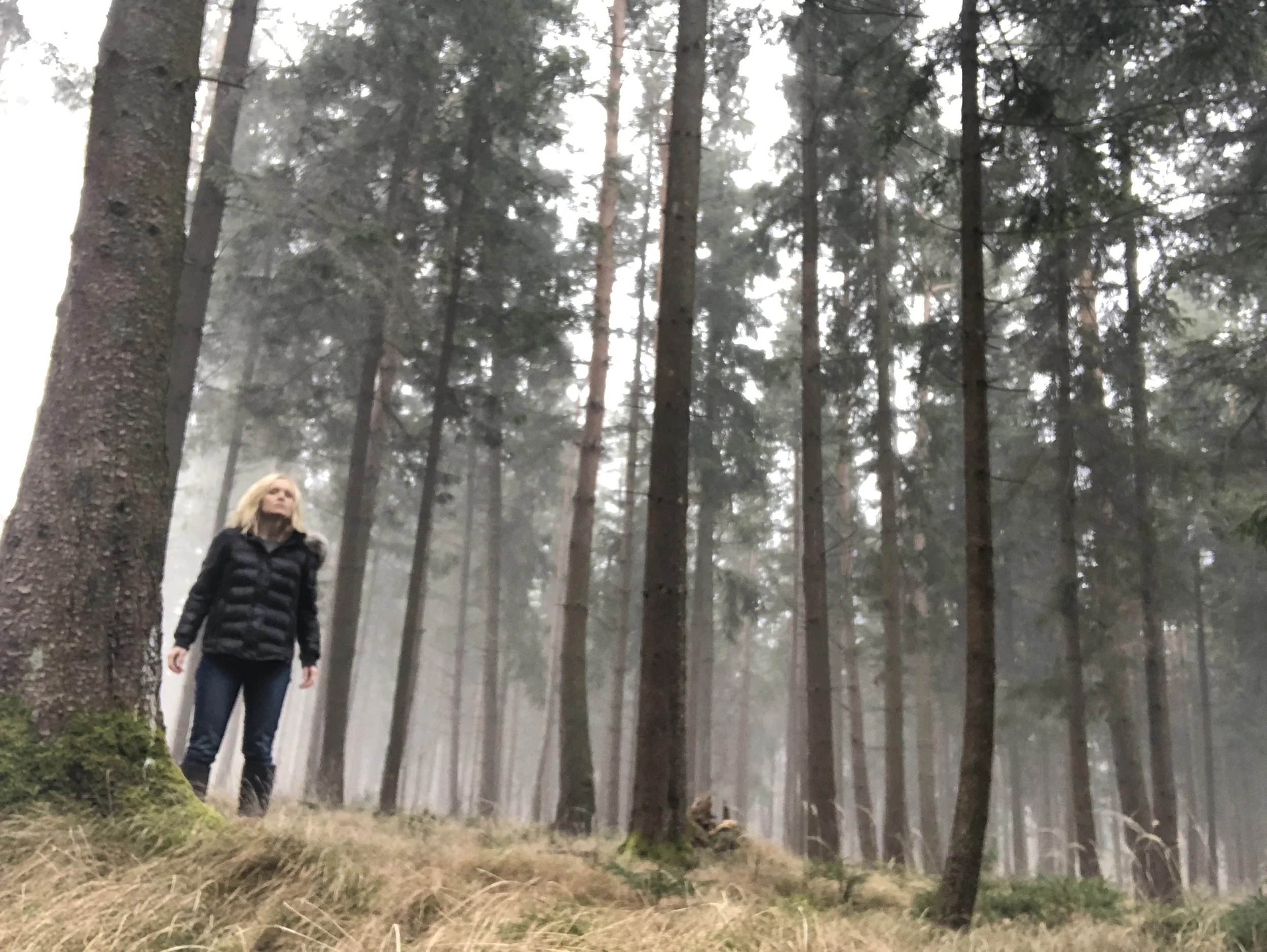
A left turn into the fog-drenched woods. A modest monument. We are here.
I leave all of my belongings except my camera in the car with Rene and step out of the black sedan into Gunskirchen Lager. Right foot, left foot. Outside. I breathe. And move into the woods.
The chill is wet, soaking through my layers of clothing and straight to the bone. The stillness. The trees. There is nothing left of this onetime makeshift prison, nothing but trees, moss, and fog to mark the lost turf of torture. If you listen closely, the faintest traces of whispers might be heard, laced with the screams of mostly forgotten men held captive behind six-foot fences.
.................
When they knew the Allies were coming, the Nazis fled this camp and its thousands of dying prisoners, locking the gates behind them. The first group of American liberators, a reconnaissance unit in Patton's 3rd Army, 71st Division, shot the locks off. The machine gunner who performed this necessary, symbolic action of liberation was Bill Parks.
Bill Parks was the father of an old friend of mine, Steven, a man who holds a special place in my heart. When I began researching Bill, Steven knew almost nothing of his father's service, only that he had liberated a camp. During all the decades afterward, Bill didn't talk about the war, but he did agree to participate in a taped interview for the Shoah Foundation. He just sat there, talking. When asked about Gunskirchen, mostly he just wept.
Learning about his father's role in liberating the men inside Gunskirchen was healing for Steven. In his words: "My father was one tough sonofabitch keeping all of that inside of him for all those years, and knowing what I now know explains a lot."
Thanks to a wide swath of articles written by and about one of Bill's comrades, Mason "Mickey" Dorsey, it is easy to understand the sight that greeted the 71st Division. In one of these articles, I found Mickey's description of machine gunner Bill Parks shooting the locks off the camp so the unit could enter this hell on earth in the middle of the Austrian forest.
I exchanged a few emails with Mickey. He told me that he remembered Bill Parks well and that they were good friends during the war. Mickey's charismatic spirit was contagious. He went through the war with five fingers total, a result of being born with congenital defects. His smile and can-do energy permeate all the articles written about him and all of his personal appearances dotting the internet. Having seen pictures of Bill and Mickey in the prime years of their youth, wearing their army uniforms in Europe, it isn't hard to imagine them in their green vehicles, rolling down this tree-lined road, decked out in US Army gear.
I'm just not so sure they had those legendary GI smiles on their faces in this particular place.
.................
On the way back to the Wels train station, I chat with Rene. His father had fought for the Germans and been pro-Anschluss, the annexation of Austria into Nazi Germany in 1938, because there was no work or money for the family, and Hitler brought work. Like so many, he believed in Hitler because things seemed to get better.
"It was a very bad time," Rene says, "but now is good time for a very long time, I hope." He flips down his visor and shows me pictures of his grandchildren. "I am Opa. You understand?" His bright blue eyes are very serious in that moment.
Communicating as best we can through his decent English and my extremely limited German, he promises to send photos and information about his father.
.................
A few weeks later, he does.
Story of Rene's Father, Rudolf
He didn't talk much about the war, and I understood why.
But a few small stories: he was in France, in a plane as a radioman. He said he crash-landed once due to enemy fire. After that, he took some new driving tests and was sent to Russia, where he drove some heavy machines.
Later, he was taken as a POW when he was in a battle. Then, during the gathering of firewood, he ran off and escaped. After a few days, he found the German troops again, subsequently ending up back in Germany.
I don't know any more.
.................
Just after visiting Gunskirchen, I discover that Mickey Dorsey had passed away just thirty-one days before.
A couple of weeks later, I learn that my friend Steven has also passed away.
So, as it turns out, I did this for Steven, too.
Or maybe he was with me.
Perhaps that was the extra nudge I felt that morning, at that ungodly hour when I woke up to catch the train.
This piece was originally written for The In Between, published in 2018. It was my earliest public record of work I had been carrying privately for years, and written at the beginning of what has since developed into a decade of intensive historical research. The core experience described here is real and remains unchanged. The original writing has been reshaped in the years since, informed by wisdom I have gained.
Erin Faith Allen is an investigative war historian and the founder of Fortitude Research, specializing in WWII archival research, wartime reconstruction, Holocaust documentation, and the recovery of women's wartime histories. She is a leading authority on the 42nd "Rainbow" Infantry Division, inluding their liberation of Dachau concentration camp. Her family-commissioned book, One Day Over the Rhine, was published in 2026.
All original photographs and written work published on this site are copyright Erin Faith Allen. Historical and archival images are used where they exist in the public domain.
```