
The Last Doolittle Raider and the Man Who Waved Them Off
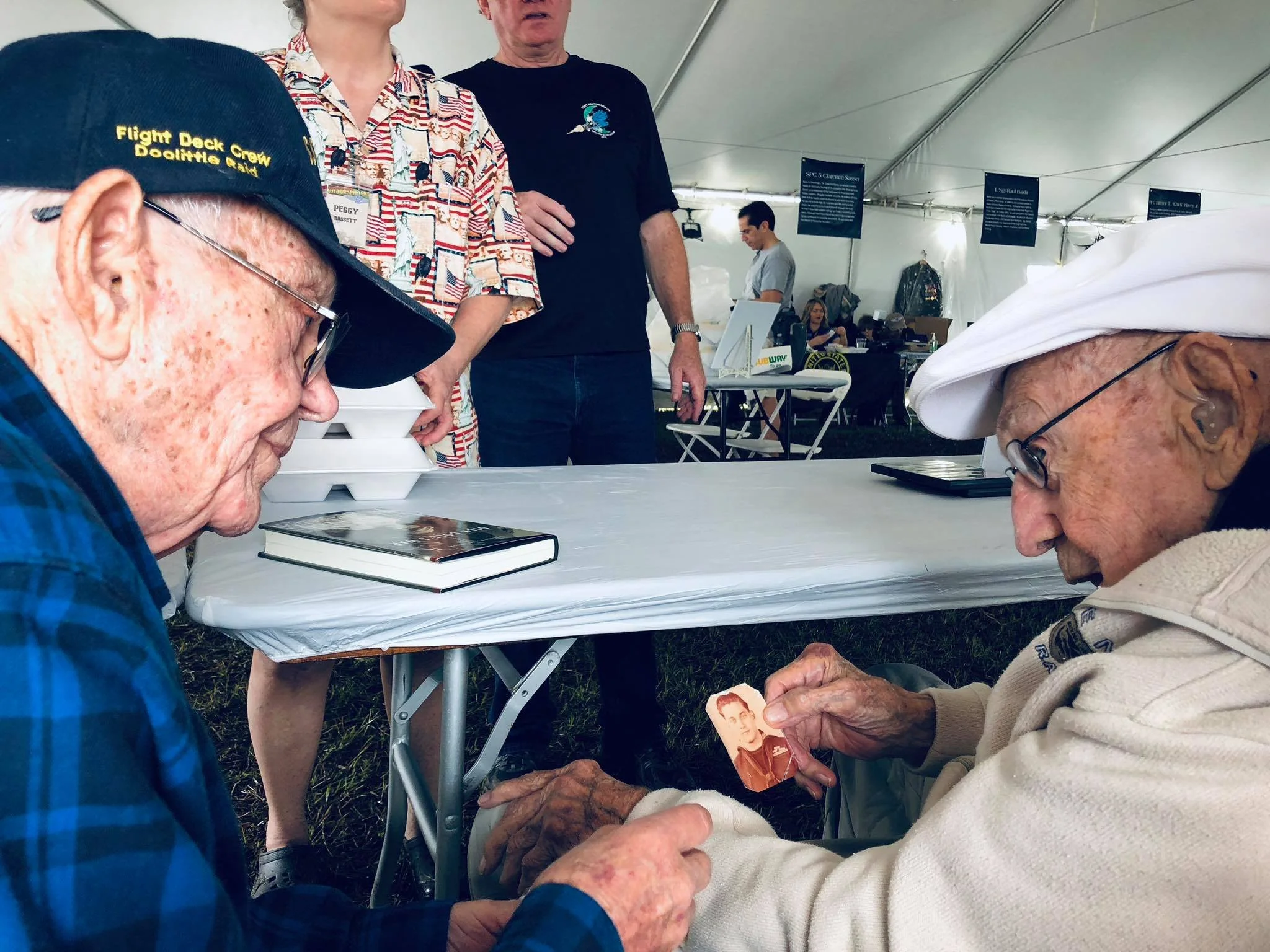
James Jones and Dick Cole of the Doolittle Raiders. 2018. © Erin Faith Allen
I was standing in the right place at the right time.
That is the only way to explain what happened on an October afternoon in 2018, inside a tent at an airshow, when a 94-year-old man walked up to a 103-year-old man, reached into his wallet, and pulled out a photograph he had been carrying for seventy-six years.
Lieutenant Colonel Dick Cole was Jimmy Doolittle's co-pilot.
On April 18, 1942, Cole sat in the lead B-25 Mitchell bomber as it lifted off the deck of the USS Hornet, the first of sixteen aircraft to launch that morning in what would become one of the most audacious operations of the Second World War: The Doolittle Raid. Launched from a carrier four hundred miles off the coast of Japan, the planes flew low over Tokyo and bombed the Japanese mainland for the first time in the war.
It was not supposed to be survivable. Most of the crews ditched in China. Some were captured and some were executed. Doolittle himself believed he would face a court martial when he got home. Instead he received the Medal of Honor.
Dick Cole lived to be 103 years old and was the last surviving member of the Doolittle Raiders. He passed on April 9, 2019, six months after the afternoon I am describing.
James Jones was on the flight deck of the USS Hornet the morning the Raiders launched.
He was first flight deck crew. He was there when the planes were being positioned, when the engines were running, when the ship was pitching in rough seas and the deck crew understood that these men were going somewhere they might not come back from. As the planes prepared to launch, Jones gave them the signal: two thumbs up, a wave, the wordless send-off of one man to another at the edge of something enormous.
I watched him walk up to Cole inside that tent.
He said: Do you remember me? I'm so happy to see you. I just want to show you what I looked like back then, when I gave you guys the two thumbs up, he gestured with both thumbs and smiled, and waved you off the deck.
Then he reached into his wallet and pulled out a photograph.
It was wallet-worn, its corners softened by decades of carrying. In it, a young dark-haired sailor in uniform looked directly into the camera, not knowing that seventy-six years later he would pull this photograph from his wallet and hold it out in his palm for the man who had been sitting in the lead plane when he waved them off.
Cole leaned in and took the photograph. He looked at it and smiled.
I'm so happy to still be alive, I heard Jones say.
Me too, said the Lieutenant Colonel.
I have spent years in the company of veterans, in archives and living rooms and military cemeteries and concentration camps, asking questions and listening to answers and trying to stay present in moments that history will eventually flatten into dates and unit designations and casualty figures.
I know what it feels like to be in a room where history is still alive in the bodies of the people who made it.
This was one of those moments.
This was two men who had been present at the same moment eighty years earlier, one in the air, one on the deck below, finding each other again on an October afternoon in a tent at an airshow, with a wallet photograph between them as proof of how young they had once been.
Erin Faith Allen is an investigative war historian and the founder of Fortitude Research, specializing in WWII archival research, wartime reconstruction, Holocaust documentation, and the recovery of women's wartime histories. She is a leading authority on the 42nd "Rainbow" Infantry Division, inluding their liberation of Dachau concentration camp. Her family-commissioned book, One Day Over the Rhine, was published in 2026.
All original photographs and written work published on this site are copyright Erin Faith Allen. Historical and archival images are used where they exist in the public domain.
```