
The Inheritance of War
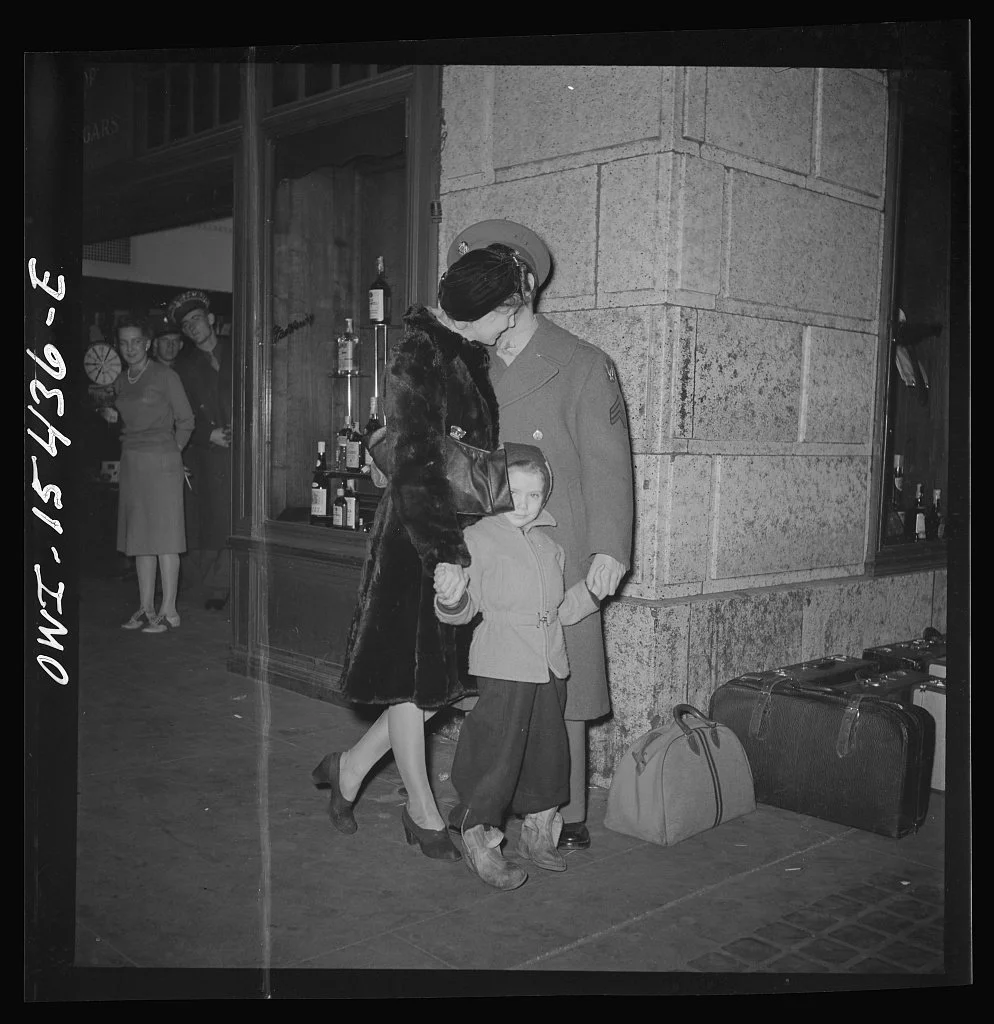
Office of War Information photograph collection (Library of Congress)
What WWII veterans could not say, what their children learned not to ask, and what the archive can finally return.
In all the family stories that I have dealt with, there is inevitably a silence somewhere.
At times it circles around one name, for example, an uncle who made it back home but was then never mentioned again, or a woman in a photograph whose identity no one is able to determine, or a death described in such a vague way that the description itself turns into a kind of question.
At times the silence extends over a wider area; a veteran's whole experience of war remains only in the name of a country, in a few harmless anecdotes told at the dinner table after a drink or two at a certain time of year, or in the basic fact that he even returned from the war at all. All the rest is kept behind a boundary which his family comes to learn not to cross.
There is no need to point out, or teach, that boundary since the children discover it themselves.
They pick up on the fact that a question is answered too hastily, and they see it in the expression of a father who leaves the room as soon as the war comes on television, or a mother who scrambles to change the subject. They realize that one version of the past belongs to the family, and that another version exists in some way just out of reach.
Silence has a form, and that form is paradoxical emptiness which fills the air in the home, everywhere.
It does not serve as proof of trauma, it is not a diagnosis, and on its own it can't tell us either what happened or why a person decided not to speak. If you find yourself feeling uncertain or conflicted about the silences in your family's history, know that this is a natural response, and many others share those same questions or doubts. Feeling unsettled by what is unknown or left unsaid is itself a part of so many family stories.
The silence in and of itself is data.
The men who came back from World War II found that their country needed them to get back to their civil lives. They were expected to find employment, marry or return to their wives, have children, buy houses, and be full citizens. The transition from soldier to husband and father was seen as a return to normal life, as if normal life were something a man could just walk back into.
The country was not entirely ignorant of the psychological harm war had caused. When the congressional hearings took place which resulted in the National Mental Health Act of 1946, Representative Walter Judd cautioned about men who returned with wounds that were not visible. According to him, the most tragic losses were “the men whose spirits had been broken”.
Although there was some recognition, there was very little communication and no full understanding that could reach an ordinary American household.
The Army referred to it as combat exhaustion, while previous generations had termed it shell shock. Families tended to attribute it to nerves, to a bad temper, to drinking, to unpleasant dreams, or simply to the way their husband had changed after the war. Whenever a clinical term was available it did not really help a wife to understand why her husband would patrol the house at night or why a child came to learn not to wake his father by touching him.
Silence was the sole means that many veterans had of holding in everything they had experienced in combat.
The silence was not uniform. People thought they were acting in their families' best interests and therefore did not want their wives to learn what they had seen or their children to know what human beings had done to one another. While some may go over their memories with the men who had been with them, they would not do so with anyone who had not been present. Others felt shame, guilt, or bewilderment at having survived when so many others had not. There was also a group who had no intention of turning the deaths of their friends into stories appropriate for telling at a civilian table.
Others had no reason at all to speak. Since all the men of that generation had been there, they knew clearly what they had come across, and war veterans have said to me that they just wanted to get on with their lives and put it behind them.
It was not the case that all silence hid psychological injury, and veterans were not all traumatized in the same manner. A great many veterans talked openly about what they had gone through. Some continued to tell their stories for the rest of their lives. Many of them only mentioned the amusing aspects. Others did not begin to speak about the war until old age, when the free time available after retirement, the presence of a mature family, the approach of illness and death, the friendly atmosphere at reunions, or the loss of old comrades brought the war back to mind.
The fact that a man speaks and shares his memories does not show that he was not hurt; on the other hand, silence does not prove that he is broken.
What makes a man's war unspoken is the state that existed within him during his silence and the effect that this had on the atmosphere surrounding him.
I have received the same story from more than one child of veterans of the 42nd "Rainbow" Infantry Division, the same account. A young child comes across an envelope containing wartime photographs among their father's possessions. The envelope contained photos taken either by him or by his fellow GIs at Dachau during or right after the liberation. The photographs depicted the bodies of the prisoners as they were found by the Americans.
The child, impressed by the horrible and violent nature of the photographs, went to their father, who was a veteran, and asked him what the photographs were.
The reply was both swift and severe; the photographs were taken away,, and the questions were halted, met with either silence or anger. The child found out later that the pictures had been destroyed.
It is possible that the veteran took the photographs initially because he needed evidence to prove to himself that what he had seen was real, or because he thought that the rest of the world would need such proof and the camera provided him with some physical evidence to put between himself and a reality which his mind could not completely absorb.
Many years later, when his child came into possession of the photographs, they were no longer confined to the envelope or to the corners of memory which had been carefully watched over; it was at that moment that Dachau entered the room and in response to his child's question the images were drawn from the past and brought back into the present tense.
It is possible that the photographs were destroyed in an effort to protect the child from the contents of them. They might also have been destroyed out of panic, because of the shame of having pictures of the dead, from horror at seeing the dead again, or as a desperate action to erase the route by which the memory had come back. The photographs could have been torn up, burned or got rid of, but in the end what the man had seen could not be.
Maybe the photographs were the only aspect of the memory that he could still control.
In all the cases, the child of the man who had liberated Dachau had two pieces of information: that something terrible had taken place and that it was dangerous to ask about it.
The images were gone, but the force that caused their disappearance stayed behind. Although the veteran thought he had shut the door on Dachau, for the child the atmosphere at that moment of closure became part of the family's story.
A child doesn't have to understand where a parent's fear comes from to adapt to it, since she picks up on the conditions of her home and notices changes in her parent's voice and posture. She learns when to be quiet, when to disappear, when to act in a useful way, and which questions lead to an answer that brings the conversation to an end.
It is a form of learning that does not require anyone to teach it consciously; instead, it is acquired by sensing patterns and responses within the atmosphere of a home.
The psychologist Dan Bar-On, in his discussion of Holocaust survivors and their children, referred to what he termed the "double wall". Although the history of families made up of Holocaust survivors is unique and must never be simply treated as if it were the experience of combat veterans, his account of the family silence does have value. "The survivors constructed an emotional wall" between themselves and the past, Bar-On explained, and their children then felt this wall and erected another one next to it.
The parent is unable to speak, so the child stops asking, and as a result the quietness takes on a structured form.
A structure of this kind can persist long after the original event has occurred. It shows up in family rules, in habits of care, in emotional distance, in anger no one is allowed to challenge, and in the intense protection of an invisible and unspeakable story that no one else in the family actually knows. It can also lead to the opposite effect: a child or a grandchild who decides to discover everything, who collects every photograph and document, who puts every question to the archives and to historians, and who reads every book. They are the ones who will not permit another name to disappear.
No matter how it is handled, silence travels. It is carried through relationships, behavior, atmosphere, and the stories a family tells about itself. It moves through what is repeated and what is avoided. Whether it is combat-related or the various forms of severe trauma that a collective of civilians may experience in a war situation, the silence perpetuates itself through the family line.
The complexity of the scientific literature on intergenerational trauma is greater than the language commonly used implies. Reviews compiled by the National Center for PTSD have discovered a significant link between parental PTSD and distress or behavioural problems in children; yet researchers have not found a single inevitable pattern of transmission. Some studies point to anxiety, depression, neglect, attachment difficulties, or increased vulnerability among the descendants, while others report a high degree of resilience and find no obvious clinical difference.
We cannot use research to diagnose the dead, nor can we explain every anxious grandchild by referring to a conflict that took place before she was born. A grandchild does not in any literal sense inherit his grandfather's memory.
However, she could inherit a family which had been organized around it.
That's where the archive proves to be useful.
The first thing I usually hear when I speak with a family who has contacted me for assistance is that he/she never talked about the war, but the documents that I put together do speak.
No single record can account for a human being, but together the records can reconstruct the circumstances of the experience. Although the archive won't explain why a man was silent, it will show me what took place before the silence began.
Historical research must not be used to impose a psychological conclusion on someone unable to reach their own conclusions, but it can offer background information about the behaviors and absences a family has experienced. It can show that the father who was described as cold and unreachable had been wounded while beside men who died from their wounds; that the grandfather who could not stand the winter had fought in fields that were frozen, or had been freezing in foxholes surrounded by exploding shells; or that the man who refused entirely to talk about his war had lost three men from his squad in an ambush.
The unknown takes on definite form; it becomes a date, a road, a field, a hospital, a list of names. It has weather, distance, sequence, and consequences. Once the documents have filled in the blank spaces of silence, the family need no longer construct its understanding on the basis of emptiness.
That is the output of the research.
It will not be able to recover all that a person had refused or was unable to say, nor can it mends every wound that developed in the silence, but it can reconstruct the man or woman behind it, having stood in a certain place under certain circumstances and having gone through choices that were, or were not, open to them.
Silence forms part of the historical record; I never attempt to pry into it or to draw conclusions that the evidence doesn't allow. At every stage, I respect each family's privacy and emotional boundaries and treat their stories with care. Instead, I work around the edges of what is known, focusing on what families have chosen to preserve and what the documents can reveal, while always honoring the limits that families wish to set.
I then hand the story back to the family; the silence might still be there, but it is no longer empty.
Erin Faith Allen is an investigative war historian and the founder of Fortitude Research, specializing in WWII archival research, wartime reconstruction, Holocaust documentation, and the recovery of women's wartime histories. She is a leading authority on the 42nd "Rainbow" Infantry Division, inluding their liberation of Dachau concentration camp. Her family-commissioned book, One Day Over the Rhine, was published in 2026.
All original photographs and written work published on this site are copyright Erin Faith Allen. Historical and archival images are used where they exist in the public domain.
```