
Left to Silence: Violence Against Women in War
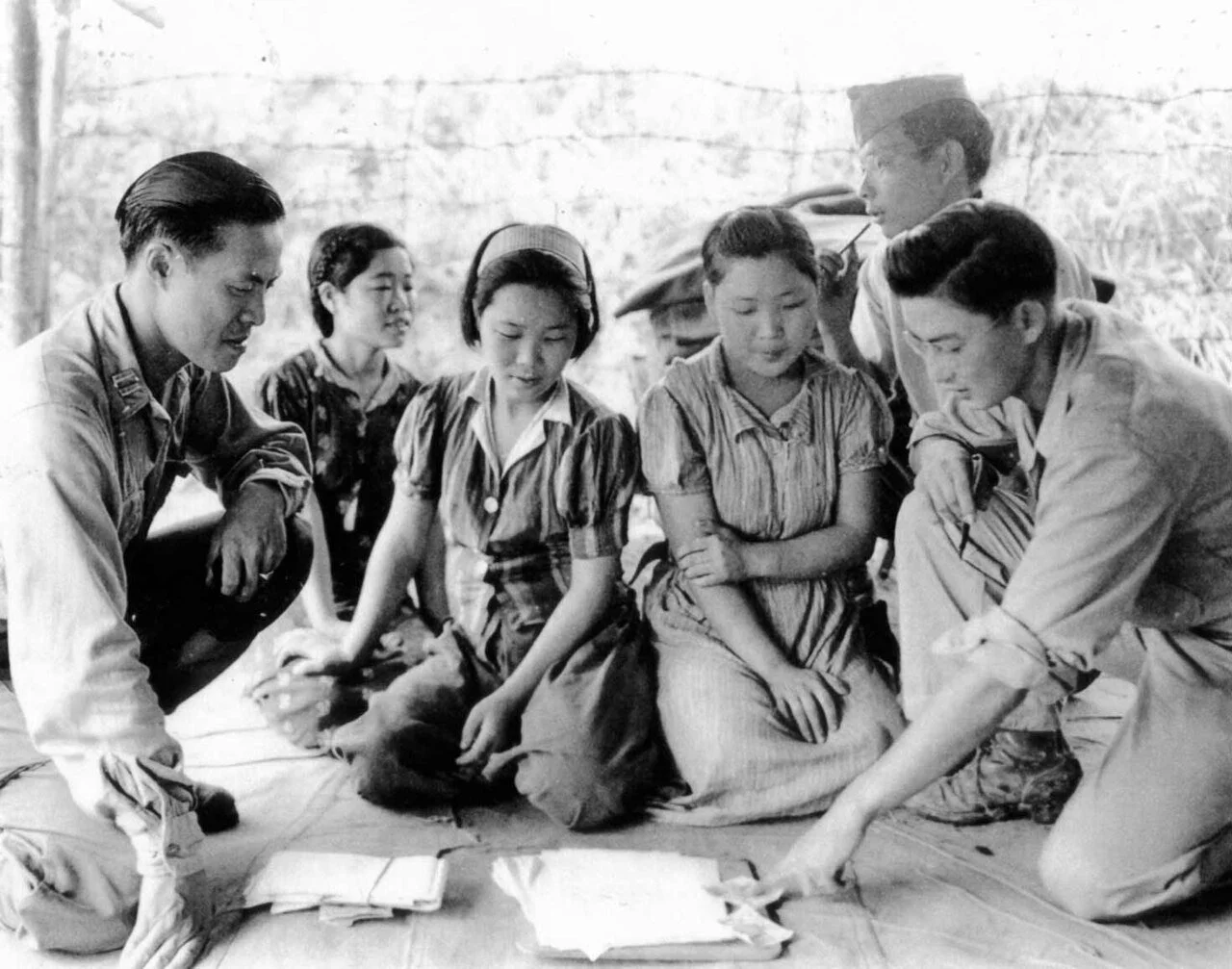
Three Korean “comfort girls” (captured in Burma), photographed while being interrogated by Capt. Won Loy Chan (San Francisco, California), Tech. Sgt. Robert Honda (Hawaii) and Sgt. Hirabayashi (Seattle, Washington), all of the G-2 Myitkyina Task Force of the U.S. Army; photo dated August 14, 1944
Laws of War: Part Four
Nobody wants to have this conversation.
I fell into researching this silenced aspect of war the day I held a photocopy of a veteran's memoir in my hands, written on ordinary lined paper in the shaky hand of a man at the end of his life. His war stories included a section about the women he had ordered to remove their clothes for him in a newly conquered country, taking their choice and their voice from them. Decades after the war, he wrote the women he had assaulted into his memoir in his own hand, with no sign of self-reflection or regret, as if he were reliving the glory of it all, his right to take as a victor.
An ordinary man, writing an ordinary war memoir. Holding it in my hands. This discovery was jarring for me. And that was that. My years of learning about sexual violence in war began, and the silence around it became impossible to overlook.
It was also the beginning of learning that this topic, when brought into any conversation, makes everyone uncomfortable.
That discomfort only keeps the silence in motion.
……
In the summer of 1945, the four victorious powers sat down in London to write the law that would try the men of the Third Reich. They named it the Charter of the International Military Tribunal. Article 6 is where they named the crimes the court would be allowed to try.
Subsection (b) is a list:
Murder of civilians in occupied territory.
Ill-treatment of prisoners of war.
Killing of hostages.
Plunder of public property.
The wanton destruction of cities and towns.
Run your finger down the list, and you touch almost every crime of the Second World War.
Rape is not on the list.
One statute did name it: Control Council Law No. 10, the wider law behind the American-led Nuremberg trials from 1946 to 1949, listed rape outright, in its definition of crimes against humanity.
It was there, in the statute, but a word in a statute is not the same thing as a prosecution. The court went after the designers of the murderous Reich: the doctors, the SS command, the men who built the machine. Sexual violence as a weapon never entered the courtroom, and its omission is glaring.
It was not an oversight. The men who wrote the Charter knew what the German army had done across the territory it occupied. They knew what the Japanese had done at Nanjing, and what the Red Army had done across Eastern Europe and Germany. They knew what the other Allies had done as well. Every army in that war knew, and the law still left it out.
In December 1937, the Imperial Japanese Army captured Nanjing, the capital of the Republic of China. Over the next six weeks, the soldiers killed somewhere between one hundred thousand and three hundred thousand people. No one knows the exact number, because the army burned the records along with the bodies.
They raped as they killed. Tens of thousands of women and girls, in the open, across the city. The world gave it a name: the Rape of Nanking. Then the world kept moving, and even the bluntness of the name for this atrocity did not bring justice.
General Matsui Iwane commanded the army that took the city. The Tokyo tribunal tried him, convicted him, and hanged him in 1948, with the massacre at the center of the case. But it was folded into the general charge of atrocity. It was never tried as a crime in its own right; the women were context.
A second crime spread through the Japanese territories, and the Japanese army ran it on paper, with regulations and timetables. Starting in the 1930s and through the war, the Imperial Army built a network of what it called comfort stations. They were houses where women were held as sexual slaves for the soldiers.
The women came from Korea, China, the Philippines, Indonesia, from every part of the occupied map. Some were taken from their lives through a lie about factory work. Some were sold out of their family's poverty. Some were simply seized.
They were called ianfu. Comfort women. A clean and gentle phrase laid over what was done to them. These women were not called before the Tokyo tribunal as witnesses, nor were they given a category, or a crime with a name. The law that tried the other cruelties of war passed them by, and they carried what had been done to them alone.
Kim Hak-sun carried her silence for forty years. When the war was over, she did what almost all of them did. She survived, and her survival called for silence in a culture that handed her the shame to hold. On the fourteenth of August 1991, as an old woman, she sat down in Seoul and said it all out loud as the first to put her name and her face to what had been done to the women. Within months she had sued the Japanese government, and the silence behind her broke open. The others came forward, hundreds of them, from Korea, China, the Philippines, and beyond. Kim Hak-sun died in 1997, and did not live to see the reckoning she started.
……
When you stand on the killing grounds in Latvia, you feel it in the atmosphere, and it is still in the air: the wrongness of earth that holds too much, and the hostile hush of a place that has been emptied against its will. On the thirtieth of November and the eighth of December 1941, roughly twenty-five thousand Jews, almost all from the Riga ghetto, were marched ten kilometers to pits already dug in the Rumbula forest, made to undress in the cold, and shot at the lip of the trenches. Friedrich Jeckeln, the Higher SS and Police Leader who ran the killing, had a name for his method. He called it Sardinenpackung, sardine packing: the next to die made to lie down alive on the bodies of the freshly dead, so no space would be wasted, and shot where they lay. The Soviets hanged Jeckeln in Riga in 1946. Viktors Arājs, who led the Latvian auxiliary that did much of the shooting, was not tried until 1979, in a Hamburg courtroom. Many of the men beside him were never tried at all. Beside the killing pits of the Reich, there was also sexual violence.
The undressing was not incidental. Across the Nazi system, sexual violence ran beside the killing as its own kind of degradation. Women were stripped at the edge of the pits and assaulted before they were shot. In the ghettos and the camps there was assault, forced sterilization, forced abortion, and other humiliations that the women who lived them could not put into words for decades. The Gestapo used it too; women were made to undress in their cells and assaulted as one more instrument of torture. From 1942 on, on Himmler's order, the SS ran brothels inside the concentration camps, where women were forced to serve as many as twenty men a day. None of this was named at Nuremberg.
As the Red Army pushed west into Germany in the winter and spring of 1945, it carried out what the historian Antony Beevor called the greatest mass rape in history. The count will never be exact, but the most cited estimate is about two million German women. In Berlin alone, by the record of the city's own overwhelmed hospitals, at least a hundred thousand were assaulted, and close to ten thousand of them did not survive it. Beevor puts at least 1.4 million more in East Prussia, Pomerania, and Silesia, the eastern provinces pouring west in columns that winter.
Hildegard was one of them. Red Army soldiers assaulted her in front of her seven-year-old daughter, in Breslau. Her story and her daughter's are here: The Doll in the Window.
And it was not only the Red Army. American servicemen committed an estimated fourteen thousand sexual assaults in Britain, France, and Germany, a number J. Robert Lilly drew from the U.S. Army's own court-martial records. The Moroccan Goumiers, under French command, assaulted thousands of Italian women and girls in the hill villages below Monte Cassino in 1944, what Italy still calls the marocchinate. Miriam Gebhardt puts the number of women assaulted by Western Allied soldiers at 190,000 at the least. The Red Army assaulted Polish, Hungarian, and Yugoslav women, and assaulted the starved women it found still alive inside the concentration camps it had just liberated. When Milovan Djilas, a Yugoslav official, raised this issue, Stalin said: "Can't he understand it if a soldier who has crossed thousands of kilometers through blood and fire and death has fun with a woman or takes some trifle?" The pattern crossed armies and borders.
Every one of the four powers that sat in judgment at Nuremberg commanded an army that had, in part, committed this crime. Each of them banned sexual violence in its own military code, on paper, and the U.S. Army court-martialed some of its own men and executed a few of them for it. To name rape in the Charter as a crime against humanity in 1945 would have put a mirror in front of every man on the winning side. The burden of silence that kept the women out of the witness box also kept the men out of the dock, and those two silences were left for the women who experienced the crime to carry.
It is critical to say that it was not only women. Men and boys were assaulted and tortured too, in the camps, in captivity, in the interrogation cells. That violence sits under an even deeper quiet than the one over the women, because it breaks the story a culture tells itself about what a man is. Because of their inherent shame, the stories are few, but they exist and belong in the same silence.
……
The door that could have opened in 1945 was forced open in The Hague half a century later. The United Nations created the International Criminal Tribunal for the former Yugoslavia in 1993, after being confronted with evidence that would not be denied. In the town of Foča, in eastern Bosnia, Serb forces had turned the schools and the sports hall and the apartments into rape houses. From the spring of 1992 they held Bosniak women and girls there, some of them children as young as twelve, in places like the Partizan Sports Hall, and assaulted them over months, and passed them between men, and kept them like property. The women survived, and they came to The Hague, and they testified, some from behind a screen and a witness number, and they put the truth into the record in their own words.
On the twenty-second of February 2001, in Prosecutor v. Kunarac, Kovač and Vuković, the tribunal convicted three men of rape and sexual enslavement as crimes against humanity and as violations of the laws of war. Named crimes. Tried on their own terms, for the first time in front of an international court.
Three years earlier and a continent away, in September 1998, the International Criminal Tribunal for Rwanda convicted Jean-Paul Akayesu, the first ruling by any international court that rape could be an act of genocide, a way of destroying a people. The Rome Statute, in force since 2002, finally put it in writing with no soft words left. Rape. Sexual slavery. Enforced prostitution. Forced pregnancy. Enforced sterilization. Any other sexual violence of comparable gravity.. As war crimes, and as crimes against humanity. Every item on that list was done, documented, and known all the way back through the centuries, and it took far too many years, and the courage of far too many survivors, before the law would be written down.
……
Open one of these files, and it is clear, in often brutal language and description, that what you are looking at is a crime, with or without a military law and its definition. Whether she shows up in the record as a named crime, or stays buried in the paperwork of people who would rather not have seen her, is the difference between a document that says this was done to a person and the person who did it was wrong, and one that files her away as insignificant or inconvenient.
And the shame that is handed to survivors of sexual assault is not behind us. The reflex to doubt the person harmed, and to protect the institution before the person, is alive right now in courtrooms, command structures, and newsrooms across the world. It is the silence and the shame she is left to hold when her story is not believed, is put on trial, or never sees justice. The silence she is left to carry was never her choice. It was, and is, made by men who carry the power to name crimes and decide whose suffering will get a chance for justice, and who will be left to silence.
This is what pushes me forward in my work with women who were victimized in war, ironically brought into the foreground for me by a man who did this, and through his handwriting on ordinary lined paper.
I seek out these women, and one by one I read her silence between the lines of her own words typed out in the documents she filed trying to find justice, or in the stories her family whispered and entrusted to me.
Inside the quiet of the reading room, or my own living room, I piece her story together, through paper gone soft and brown at the edges, the aging texture of her papers in my hands, and her digital footprints that the modern era brings to my screen.
And I tell her story, as it happened, and her silence breaks open into living, witnessed history. It is not full justice, but it is truth, told loudly.
…
Part One, Three Men Who Built the Laws of WarPart Two, Nuremberg
Part Three, The Dachau Trials
…
This subject is vast enough to be its own book; in this article I have only summarized.
Sources and further reading
Charter of the International Military Tribunal, Article 6, and Control Council Law No. 10, via the Avalon Project at Yale Law School.
Kelly Dawn Askin, War Crimes Against Women: Prosecution in International War Crimes Tribunals (1997), on the exclusion of rape from the Charter.
The Nanjing Massacre and the Tokyo tribunal.
Kim Hak-sun and the comfort women.
Antony Beevor, Berlin: The Downfall 1945, and the overview Rape during the occupation of Germany.
J. Robert Lilly, Taken by Force: Rape and American GIs in Europe during World War II.
Miriam Gebhardt, Crimes Unspoken.
ICTY, Prosecutor v. Kunarac, Kovač and Vuković; ICTR, Prosecutor v. Akayesu; and the Rome Statute of the International Criminal Court.
Erin Faith Allen is an investigative war historian and the founder of Fortitude Research, specializing in WWII archival research, wartime reconstruction, Holocaust documentation, and the recovery of women's wartime histories. She is a leading authority on the 42nd "Rainbow" Infantry Division, inluding their liberation of Dachau concentration camp. Her family-commissioned book, One Day Over the Rhine, was published in 2026.
All original photographs and written work published on this site are copyright Erin Faith Allen. Historical and archival images are used where they exist in the public domain.
```