
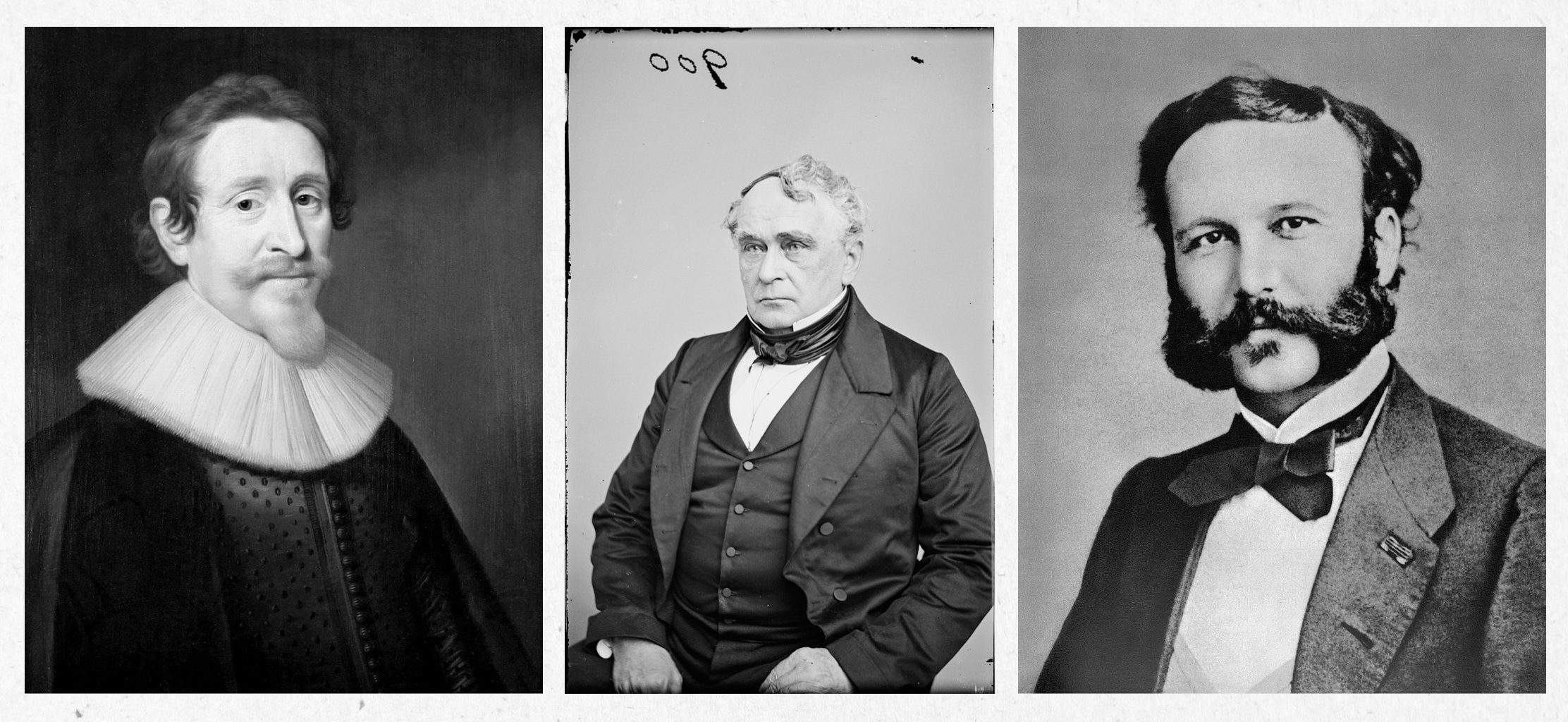
Hugo Grotius, Francis Lieber, and Henri Dunant
Part One: The Laws of War
I am not an attorney. I am a historian who spends many hours inside unit documents and court-martial files, in the company of the soldiers and civilians within them. I have learned from years spent inside those records that the law of war is a carefully woven language coinciding with a reality that resists tidiness, and inside that space there is a gap where the full spectrum of humanity - and inhumanity - occurs.
Sometimes justice arrives fast and clean, sometimes it gets buried under endless piles of paperwork or political convenience, and sometimes it never arrives at all. The law is still the law, and its very existence impacts what happens around it even when it does not bring a hoped-for result.
The following is, of course, an oversimplification. The full history of how the laws of war came to be is the work of dozens of philosophers, jurists, soldiers, doctors, statesmen, conventions, and commissions across four centuries, and to give each of them their due attention would be its own book. What follows is the story of three of those people who shaped what we now call international humanitarian law.
The laws of conduct in war as we know them today originated with three men: a Dutch jurist writing in exile in 1625, a Prussian-American legal scholar who lost a son to the Civil War, and a Swiss businessman who arrived at the wrong field at the wrong moment and was surrounded by thousands of dying men. None of them set out to build the foundation of laws that we now stand upon, but they did so nevertheless.
Learning about the men behind the foundations of the laws has been illuminating, and somehow gives the laws they set in motion more humanity than the laws themselves try to lock into place.
Hugo Grotius
Hugo Grotius is forty-two years old in 1625. Sentenced to life imprisonment for the wrong politics, he has spent years in exile in Paris, having escaped from the Dutch fortress of Loevestein hidden inside a chest of books that his wife Maria Reigersberg smuggles past the guards in March of 1621. He is writing in a borrowed apartment, in a country not his own, while the Thirty Years' War devastates the German states a few hundred miles to the east, and while European armies are destroying civilian populations with a thoroughness that horrifies even contemporary observers.
He is writing the book that will be published that year in three volumes, De Jure Belli ac Pacis, On the Law of War and Peace, the book that will argue that armed conflict must answer to natural law, and that some acts ought to be prohibited because of what human beings owe each other, treaty or no treaty, on one basic premise: a humane humanity.
He writes:
Throughout the Christian world, I observed a lack of restraint in relation to war, such as even barbarous races should be ashamed of; I observed that men rush to arms for slight causes or no cause at all, and that when arms have once been taken up, there is no longer any respect for the law, divine or human; it is as if, in accordance with a general decree, frenzy had openly been let loose for the committing of all crimes.
The armies of his day ignore him almost entirely. His argument persists anyway, waiting for the century when it can finally be heard.
Two hundred years and many wars later, the grief of a man who had fought through one war and watched his sons march into another broke open the next layer of what the law would eventually require of armies.
Francis Lieber
Francis Lieber is sixty-three years old in 1862, a Prussian-American legal scholar at Columbia College in New York. Three of his sons are fighting in the American Civil War. One of them, Oscar Montgomery Lieber, is fighting for the Confederacy. The other two, Hamilton and Norman, are wearing Union blue. Hamilton has already lost an arm at Fort Donelson in February of 1862. Lieber himself is a veteran of the Prussian army's closing campaigns against Napoleon, having been wounded so severely at the assault on Namur in June of 1815, at the age of sixteen, that his comrades left him on the field for dead. Strangers carried him to a military hospital at Huy where he also nearly died of typhus. The body that lectures on political philosophy at Columbia forty-seven years later is a body that knows the worst of what war can bring.
His son Oscar is mortally wounded in the Peninsula Campaign in early May of 1862 and dies of his wounds in Richmond. The grief enters Lieber's accumulating thinking about the laws of war, about what they should be and who should write them, about what an army at the scale of the Union army needs in writing if its conduct is to be governed at all. Across the rest of that year, Lieber corresponds with his friend Henry Halleck, who that July is named general-in-chief of the Union army. Halleck commissions Lieber first to write a paper on the problem of guerrilla warfare, and from that smaller commission grows the larger one: by the end of 1862, Lieber is at work on the full code.
The articles are made official by the War Department in April of 1863 inside General Orders No. 100. The first modern codification of the laws of war anywhere in the world, they draw a line through the conduct of the Union army that has found its place inside every body of international humanitarian law since.
Henri Dunant
On the morning of June 25, 1859, the day after the Battle of Solferino in northern Italy, Henri Dunant arrives at the village of Castiglione delle Stiviere. He is thirty-one years old and wearing a white tropical suit. He has come from Geneva, where he runs a business, and he has not come to this village with the intention of finding a battlefield, but to meet with Emperor Napoleon III to secure a permit for a water rights venture in French Algeria.
What he meets instead is the aftermath of a battle in which three hundred thousand men collided across a stretch of countryside the previous day. Forty thousand of them now lie wounded or dying across the surrounding fields. The medical corps of the French, Sardinian, and Austrian armies are overwhelmed. The June light is high on the dust of the road. The flies have already found the wounded, and the smell rising from the field is the smell every soldier knows. The local women have been walking out to the wounded to offer whatever relief they can. To the women, the men are not enemies and they are not allies; they are wounded and dying men who need help, comfort, and care. They call out the same phrase to one another while they work, in Italian, and while they wash the wounds of Frenchmen and Austrians and Italians without distinction.
Tutti fratelli.
All brothers.
Dunant stays three days and organizes the women, writes letters to families on behalf of dying men, and pays out of his own pocket for medical supplies. He returns to Geneva with what he found on that field still on him, and in him.
Three years later, in 1862, he publishes Un Souvenir de Solférino, a small book that will shake Europe. In February of 1863, four other men of Geneva join him at a meeting that founded the International Committee of the Red Cross. By August of 1864, twelve nations sign the first Geneva Convention. The protective category has been written into international law for the first time in human history and the symbol of a red cross on a white field begins its slow accumulation of meaning across battlefields and decades.
Dunant's business failings lead to bankruptcy in 1867. The Crédit Genevois collapses around the Algerian venture that has failed, and he is effectively ostracized from the Geneva society that had celebrated him only four years earlier. He spends the next thirty years in poverty.
In 1895, the Swiss journalist Georg Baumberger finds Dunant in a hospice in the village of Heiden, alive but forgotten at sixty-seven years old. Baumberger writes a story that spreads, and in 1901, Dunant receives the very first Nobel Peace Prize, shared with the French economist Frédéric Passy. When he dies on October 30, 1910, he is buried in Zurich, by his own request, without ceremony, an old man whose life's work is already protecting men he will never meet, and their children, and their grandchildren.
These three men shared, throughout centuries and circumstances, a refusal to look away from what they had seen. Grotius watched Christian armies destroying Christian populations and refused to accept that frenzy was the natural state of armed conflict. Lieber buried a son and refused to accept that the conduct of war should be left ungoverned by the men who command it. Dunant walked through a field of forty thousand wounded and dying men and refused to accept the current status quo, that no organized function existed to help them. Each of them did the same thing, though in a different century. They refused to turn from what they had witnessed; they named it, wrote it down, and shared it near and far. They built, from grief and from refusal, something that could carry their belief forward into the world they were leaving behind.
What they built is the ground we are on now.
Every Geneva Convention since 1864 traces back to Dunant's three days at Castiglione. Every international tribunal since Nuremberg stands inside the inheritance Lieber began on the day his 157 articles arrived on Lincoln's desk. Every argument that natural law binds even unconquered rulers reaches back four hundred years to Grotius writing in his rented Paris apartment after hiding in a chest.
The body of international humanitarian law is, at its origin, the accumulation of specific human refusals, written down by people who had every reason to look away, shrug their shoulders, and ignore their conscience.
It is true that the law of war does not always protect those it was built to protect, and it does not always punish those who break it. Power will often protect itself, and selective enforcement is a real obstacle to justice. None of this erases what these men, and those after them, built. The existence of the law creates a possibility of correction.
The law gives victims a category and a definition of the violation, and a place to stand inside a framework that the rest of the world has signed on to. It says: what happened to you was a violation, and the violation was named - even if no one was ever held accountable for it. That is a real thing to stand on, and for many, it is the only solid ground available.
Every person who has come out of a war, soldier or civilian, and sought justice, has been standing on the framework these three men built, and with them every jurist, doctor, statesman, convention and commission who worked beside them. Every Geneva claim, every tribunal indictment, every survivor whose suffering has been named inside a body of law, stands on the ground these three men began.
The foundation that these three men built, one by one, will be tested in a wood-paneled courtroom in the rubble of a destroyed city, thirty-five years after Dunant died and three hundred twenty years after Grotius wrote his book in exile.
The Laws of War is a four-part series.
Next in the series: Nuremberg and the War Crimes Trials.