
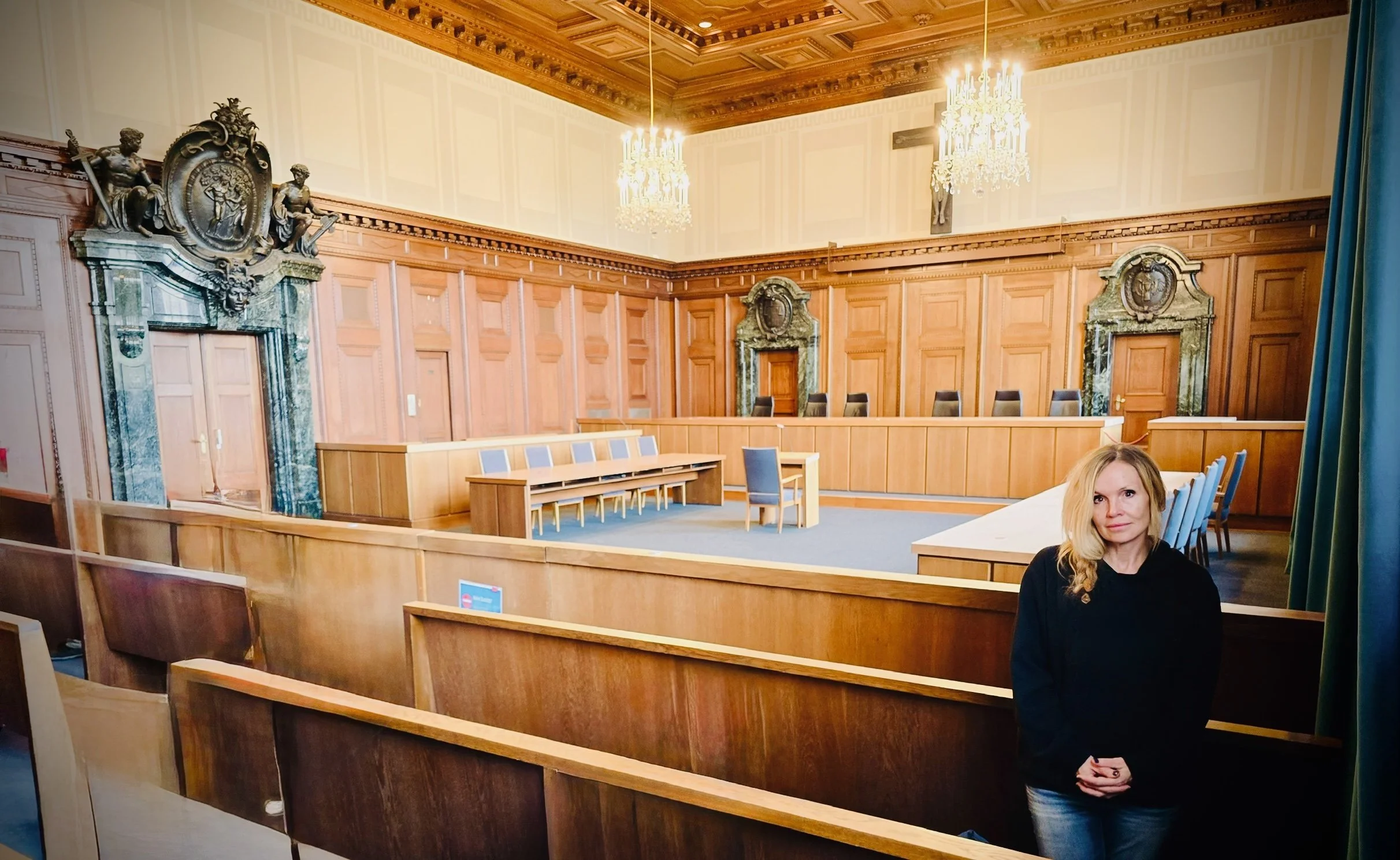
Courtroom 600, Palace of Justice, Nuremberg and Erin Faith Allen © Tom Breen
Laws of War: Part Two
Courtroom 600 at the Palace of Justice in Nuremberg feels smaller than I expected. The wood-paneled walls, tall windows, and heavy blue drapes are still there. The raised dock, where twenty-one accused men sat for ten months and 216 sessions, remains in place. The room seems to hold its history, much like old wood keeps the smell of smoke long after a fire.
I have also visited massacre sites and walked through concentration camps, seeing their barracks and brothels. I have met survivors, both men and women, and I have read and spoken with women who endured a specific kind of brutality from the Allies in the final days of the war, the kind of violence that women commonly face in war zones.
If you study war, you end up studying war crimes. That’s just the reality.
Nuremberg is where these ideas reached a turning point, brought in by three men from earlier centuries whose influence was felt in Courtroom 600 before the defendants even entered. There was the Dutch jurist who escaped prison hidden in a chest of books, the Prussian-American legal scholar who lost a Confederate son, and the Swiss businessman who showed up in a white tropical suit at a battlefield where forty thousand men were dying. Though they have been gone for centuries or decades, the ideas they left behind filled the room before anyone else.
On the morning of November 20, 1945, the defendants walked one by one through a tunnel about seventy meters long, connecting the Nuremberg prison cells directly to the courtroom dock. They moved into the glare of cameras, each chair set with headphones and a microphone labeled in English, French, Russian, and German. The translation equipment buzzed as four languages played at once, a technical achievement spread across the desks. The whole world was about to listen.
By the end of the prosecution’s opening statements, the twenty-one men in the dock had heard themselves accused, in four languages at once, of crimes that had only just been defined in law the previous summer.
Hermann Göring was the first to sit down, taking the front row’s first chair. His Luftwaffe uniform no longer had any insignia. He had lost a lot of weight during six months in detention, as his interrogators had gradually taken him off the paracodeine pills he used to take by the handful. After sitting, he put on his dark glasses and passed notes to the men next to him. He had decided to lead the defense as he once led the Luftwaffe, confident that he understood what was happening.
He completely misunderstood what these proceedings were really about.
The prosecutors’ case, and what Göring did not yet realize he was being judged by, had been put together during the summer of 1945 in negotiations at Church House in central London. The four Allied powers had agreed that those responsible for the war would face trial.
Robert Jackson led the American delegation. Sir David Maxwell Fyfe led the British. General I. T. Nikitchenko led the Soviet. Robert Falco led the French. The document they produced, the London Charter, was signed on August 8, 1945, and named three categories of crime.
Crimes against peace included planning and starting aggressive wars. This was a new idea, since no earlier laws had treated the decision to go to war itself as a crime.
War crimes included breaking the laws and customs of war, such as murdering and mistreating civilians, killing hostages, looting occupied areas, and destroying cities without reason. These charges reflected the work of Lieber, Dunant, and the Hague drafters, whose ideas finally became part of an indictment.
Crimes against humanity included murder, extermination, enslavement, deportation, and persecution based on race, religion, or politics, committed against any civilian group, before or during the war. This was a truly new category, since it did not require a link to war between countries. A government could be guilty of crimes against humanity against its own citizens. The Holocaust made it necessary to create this new legal category, which was added in the months between the Allied victory and the start of the trial.
Robert Jackson, an Associate Justice of the United States Supreme Court, rises in Courtroom 600 to give the opening statement for the prosecution. He has been working on it for weeks. He stands at the lectern and speaks, and everyone in the room hangs onto his words:
The wrongs which we seek to condemn and punish have been so calculated, so malignant, and so devastating that civilization cannot tolerate their being ignored, because it cannot survive their being repeated.
Eight days later, on the afternoon of November 29, 1945, the prosecution showed documentary footage filmed after the concentration camps were liberated. The film was made from material gathered by Allied military film units at Bergen-Belsen, Dachau, Buchenwald, and other camps. It lasted about an hour and was called Nazi Concentration Camps. The lights lowered, and the screen above the dock came to life.
The events of the next hour in the courtroom were recorded by the prison psychologist, Gustave Gilbert, who sat where he could see every defendant’s face. Funk wept openly. Sauckel sat frozen. Hans Frank covered his eyes with one hand and kept it there. Rudolf Hess watched with a blank expression. Hermann Göring watched through his dark glasses as images of naked, skeletal corpses filled the screen.
Two months after the screening, on January 28, 1946, Marie-Claude Vaillant-Couturier takes the witness stand. A French Resistance courier deported on the convoy of two hundred and thirty women, of whom only forty-nine survived, she testifies for most of the day to the selections at the ramp, the experiments at Birkenau, the chambers, and what came out of them. The men in the dock listen through their headphones. A month later, on February 27, Seweryna Szmaglewska of Auschwitz-Birkenau testifies to what was done to the children at the camp, and Samuel Rajzman, one of the few survivors of Treblinka to reach the witness stand at Nuremberg, names a killing process most of its prisoners did not live to describe.
A few months later, Göring told Gilbert in his cell, speaking as if he were merely stating a simple fact:
The victor will always be the judge, and the vanquished the accused.
Göring did not think he was on trial for his actions. He believed he was there only because Germany had lost the war.
By the end, some of the men beside him understood what they were facing. Hans Frank, who was the Governor-General of occupied Poland during the years when the Polish Jewish population was murdered, said before his execution:
A thousand years will pass, and still this guilt of Germany will not be erased.
Wilhelm Keitel, the field marshal who had signed orders for executing prisoners of war and killing political officers behind German lines on the Eastern Front, used the same defense as many others in the dock. He claimed he was just a soldier following orders and that military duty required it. The Tribunal rejected this argument and, for the first time in international law, made it clear that following orders is not a valid defense. It had never been, but no court before had the authority to say so.
Just hours before he was to be executed, on October 15, 1946, Hermann Göring took a cyanide capsule. By doing so, he denied the court the final word and denied closure to the victims of Nazi war crimes.
Standing in that room now, so many years later, I think about the difference between what Göring thought he was being judged for and what the court was really meant to judge. He believed he was on trial because Germany lost. In reality, he was there because the ideas of three men, developed over four centuries, had finally found a courtroom, and this court chose to act on them.
Grotius, Lieber, and Dunant, who took the first steps toward ethical rules in war, could never have imagined Nuremberg. But the categories the court listed in the fall of 1945: protecting civilians, banning certain treatment of prisoners, stopping needless destruction, and preventing persecution based on race or religion, were all based on the code of conduct these three men started. Grotius said natural law applies even to rulers. Lieber described the protections soldiers owe to civilians and prisoners. Dunant spoke about protecting the wounded. The Charter’s categories were the result of their work, built up slowly and painfully over three centuries.
There have been laws about war for centuries, but for most of that time, those who broke them expected they would not be enforced. Justice is not always served, and those in power often protect themselves. The definition of a war crime can change, depending on who is in charge and what they have to lose.
But the work I do, and the documents I hold, do not forget.
Within the quiet reading room at the National Archives, on paper that is eighty years old, the truth remains, in first-hand accounts, in witness testimony, and in the steady collection of evidence, no matter how tedious it might seem.
These pages last longer than those who tried their hardest to hide the accusations they contain.
This is what the wood-paneled walls of Courtroom 600 mean to me:
They hold the truth of everyone who survived terrible crimes, and they show that the search for justice can outlast even those most determined to stop it. These walls stand for the rules of law and the idea of justice, and that both survive long after those who wanted to evade or erase them.
Göring thought the victors were the judges.
He could not see that time itself is one of the harshest judges of all.
Earlier in the series: Three Men Who Built the Laws of War.
Next in the series: The Dachau Trials.