
Douglas MacArthur and the 42nd “Rainbow” Division in World War I
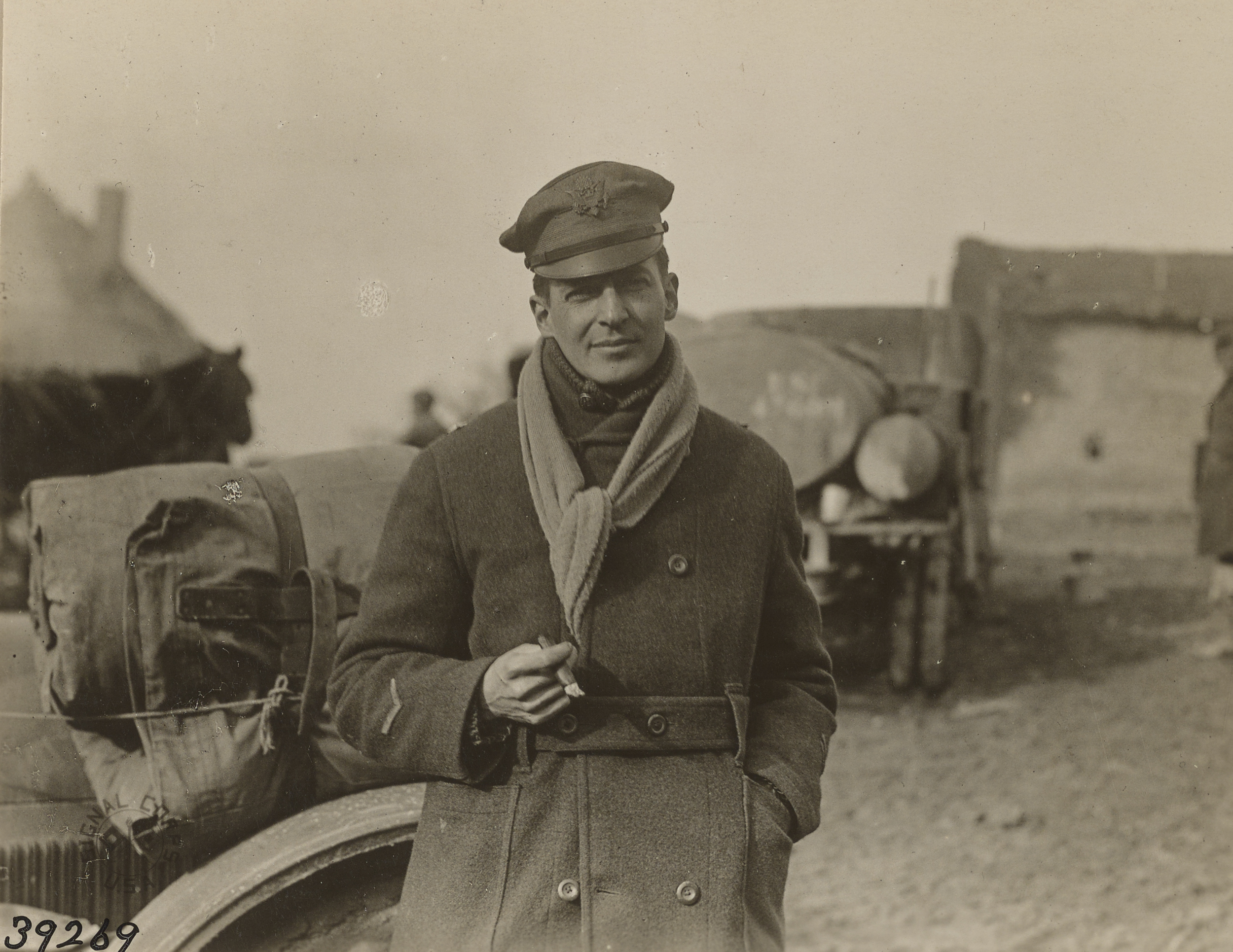
Colonel Douglas MacArthur photographed in France in 1918 during his service with the 42nd "Rainbow" Division in World War I.
I have spent a decade inside the history of the 42nd Division, which means I have written, spoken, and thought the word "Rainbow" more times than I can count. Each time the word enters my mind and is given voice, I am repeating a metaphor, and a legacy, that a young officer reached for in a War Department meeting in 1917. He named the Rainbow Division before it even existed.
Before Douglas MacArthur was the General who waded ashore at Leyte, before the Japanese surrender on the deck of the USS Missouri, before Korea and the Senate testimony and the ticker tape coming down over Broadway, he was a Major on the War Department staff with a single uncomplicated idea. The Army needed divisions in France fast, and no governor wanted his National Guard left behind, and MacArthur's answer to a complicated political question was to create one composite division pulled from twenty-six states and the District of Columbia. He told Secretary of War Newton Baker that it “would stretch over the whole country like a rainbow.”
The phrase could have died in the room, because most things said in a staff meeting are gone within the hour. The phrase held, and by the time the Division gathered at Camp Mills on Long Island that summer, the men already knew who, and what, they were. They were the Rainbow. MacArthur was promoted to Colonel and made the Division's first Chief of Staff, skipping lieutenant colonel, and he had not yet turned thirty-eight.
I have told another story of that naming, and of the patch the men carried from France to the painted walls of Germany, in a shorter, earlier piece, "The Day Douglas MacArthur Named the Rainbow Division." This writing is to explore the story of the man who named the Rainbow.
He went to that war in a uniform he had remade to his own taste. He had pulled the wire grommet out of his officer's cap so it sat soft and crushed on his head, the cap the world would know on him decades later in the Pacific and in Korea. He wore a turtleneck sweater and a long muffler his mother had knitted him, he carried a riding crop and no pistol, and was known to go forward without the steel helmet and the gas mask he made every man under him carry. The French called him the d'Artagnan of the American Expeditionary Force. His own men called him the Fighting Dude. A “dude” in 1918 was a dandy, a man who made a show of how he dressed. A d'Artagnan, after Dumas, was a swashbuckler, a man who made a show of how he fought. Both names settled around the personality and character of a young MacArthur.
This can easily be described as an inheritance. His father, Arthur MacArthur, had carried the colors to the crest of Missionary Ridge during the Civil War at the age of eighteen and was awarded the Medal of Honor. He had risen to lieutenant general, and a man who knew them both said he had never met anyone so flamboyantly egotistical as the father until he met the son. Remarkably, Douglas would win his own Medal of Honor in 1942, for the defense of the Philippines, and the two became the first father and son to hold such distinction.
In 1917 all of that was still far ahead of him. He was a young Colonel with a divisional metaphor and a handmade redesign of his cap.
He came to France behind a desk, and his destiny was that by the time he left it he was leading infantry.
The Division sailed on the eighteenth of October 1917 and trained through the winter, and in December an aging Commander William Mann gave way to Charles Menoher, who would command the Division and stand behind MacArthur the rest of the war. In February 1918 the Rainbow entered the line in the quiet Lunéville sector, and MacArthur went out to find the war. On the twenty-sixth he crossed into no man's land with a French raiding party, came back with German prisoners, and had the Croix de Guerre pinned to his chest by General de Bazelaire, the first Croix de Guerre given to any American in the war.
On the ninth of March he went over again with a company of the 168th Infantry, in three raids on the German trenches at the Salient du Feys, and the Army gave him the Distinguished Service Cross. Days later he was gassed, because he kept everyone's discipline about the masks but his own, but he was back on his feet in time to walk Secretary Baker down the line on the nineteenth.
On the twenty-sixth of June they made him a Brigadier General, the youngest in the Expeditionary Forces, thirty-eight years old, and he held that distinction until October. That summer the Division moved to Châlons to meet the German offensive in Champagne, where General Gouraud held his front line thin on purpose and let the attack break on the ground behind it, and MacArthur came out of the defense and the counter-offensive with a second and a third Silver Star. At the end of July, Menoher gave him the 84th Infantry Brigade.
On the second of August he heard the Germans had pulled back in front of him, and before dawn he went out to see for himself. He moved from outpost to outpost across what had been no man's land, runners passing him forward through the dark, and the dead lay so thick the men stumbled over them. The smell of death coated his throat. Broken artillery and abandoned machine guns lay among the bodies. Sniper fire followed him the whole way. He read the insignia of six of the best German divisions off the dead, and he came back at first light and reported that the enemy was gone. It brought him a fourth Silver Star, a second Croix de Guerre, and the Légion d'honneur, and a line from Gouraud, who called him one of the bravest officers he had ever served beside.
He took the 84th into the Battle of Saint-Mihiel on the twelfth of September and earned a fifth Silver Star, and a sixth for a night raid two weeks after. The Division moved north and relieved the 1st in the Argonne on the night of the eleventh of October, and the next day, out on reconnaissance, he was gassed a second time. On the fourteenth the Rainbow went into the Meuse-Argonne, where General Summerall demanded that the height called the Côte de Châtillon be taken inside a day. A photograph from the air showed a gap in the German wire, and later that same night MacArthur crawled out into no man's land to find it. The German guns opened on the patrol, artillery and machine guns at once, and by his own account he was the only man who came back. He had found the gap, and the height was taken. Summerall put him in for the Medal of Honor and a second star, and he got neither, but the Army gave him a second Distinguished Service Cross.
The last time the Rainbow went up to the line, for the early November push toward Sedan, the advance fell into such confusion that MacArthur's own army took him prisoner. Men of the 1st Division saw the riding crop and the soft cap and the muffler and they took him, and held him, as a German general until it was sorted out. He came out of it with a seventh Silver Star. On the tenth of November, one day before the guns went quiet, Menoher made him acting Commander of the 42nd Division. He held the command for twelve days, until the Army sent him back to his Brigade and gave the Rainbow to another man for the march into Germany. He had come to France to staff this Division, and at the end he commanded it.
When he returned home he carried the rank of Brigadier General, and held two Distinguished Service Crosses, seven Silver Stars, two French Croix de Guerre, the Légion d'honneur, and a wound chevron for each gassing. He was one of only three American generals wounded in action in the whole war, and the only one who held a general's rank when it happened. His time in this war gave him a thorough understanding of warfare, what he and the infantry could handle, and his continuing habit to move forward under fire. What began in the mud of Champagne and the stone of Saint-Mihiel became a habit that ran through every command he ever held, and it enraged his superiors and saved his men in nearly equal measure.
The 42nd Division saw 164 days of combat in the First World War, more than every American division but two, the 1st and the 26th. It lost 14,683 men, killed and wounded. MacArthur wore the Rainbow patch through all of it, from the staff room where he named it to the Rhine.
He became one of the largest and most argued-over soldiers this country has produced, and the scale of his later years and their accomplishments can dwarf his younger years. For those of us who follow the Rainbow, those early years when he named the Division, then spent a year in France earning the right to stand in front of it, the early years can dwarf the later ones.
The 42nd Division stretches like a rainbow from one end of America to the other.
From the moment of its inception and the utterance of the word Rainbow from the same throat coated with the death and gas of France, the name became a story, and in its own way, a legend.
Erin Faith Allen is an investigative war historian and the founder of Fortitude Research, specializing in WWII archival research, wartime reconstruction, Holocaust documentation, and the recovery of women's wartime histories. She is a leading authority on the 42nd "Rainbow" Infantry Division, inluding their liberation of Dachau concentration camp. Her family-commissioned book, One Day Over the Rhine, was published in 2026.
All original photographs and written work published on this site are copyright Erin Faith Allen. Historical and archival images are used where they exist in the public domain.
```