
The Dachau Trials: “A Cog in this Machine of Extermination”
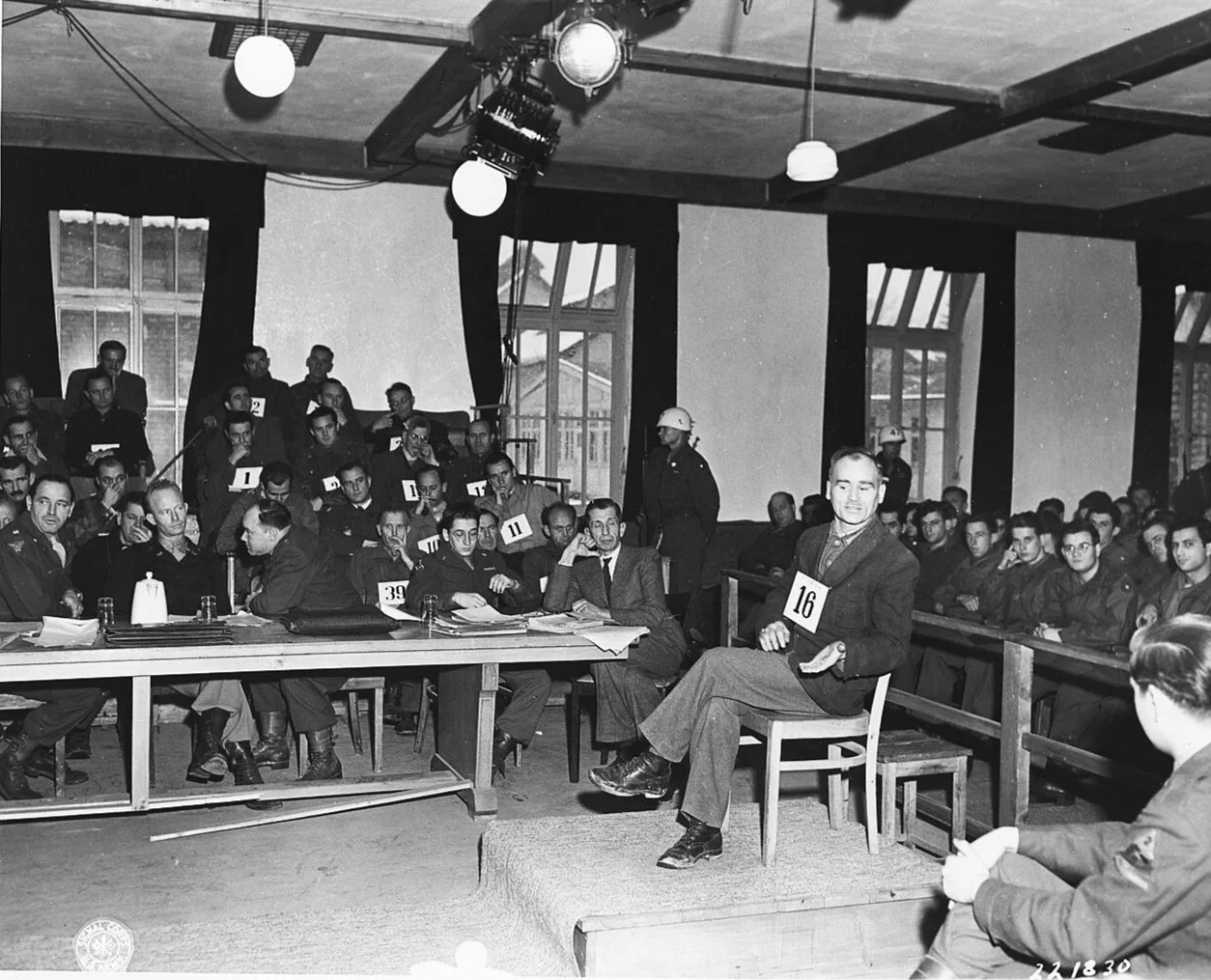
At the Dachau War Crimes trial, defendant Christof Ludwig Knoll, a political prisoner and block leader, testifies. Dachau, Germany. 12/7/46.
Laws of War: Part Three
On April 29, 1945, in the first hours after Dachau was opened, Lieutenant Colonel Donald E. Downard reached into one of the death train cars and pulled out a living survivor.
The death train had arrived at the camp that morning, a freight convoy carrying prisoners transferred from Buchenwald as the Reich collapsed, hundreds of them dead in the cars from starvation, cold, and the violence of their guards. The stench reached the men on the road before the gate did, and some told themselves it had to be a farm, a slaughterhouse, anything but what it was. When American soldiers of the 42nd Rainbow Infantry Division and the 45th Thunderbird Division entered Dachau and found what was in those cars, what was inside the camp, what had been done to the people who had been there, it changed everyone who witnessed it. Some spent the rest of their lives trying to find language for what they saw, and some never found it at all.
Six months later, a courthouse in Nuremberg was trying to build a law around it all.
The International Military Tribunal proceedings at Nuremberg are the ones history remembers, but a similar set of trials happened down in Bavaria.
Beginning in November 1945, American military commissions convened at Dachau, inside the very facility that had just been liberated, and began the systematic prosecution of war criminals in what became one of the largest series of military trials in American history. The proceedings ran for nearly three years, until August 1948, and by the time they closed, the Dachau Trials had prosecuted 1,672 defendants across 489 separate cases, reaching the administration of the camps, the murder of downed Allied airmen, the systematic starvation of prisoners, and the individual acts of brutality recorded in the chaos of the war's final months.
I have stood in the room where it all happened, the very room you see in this photograph. The court the Army used was, and is, a one-story building inside the camp, with ordinary windows and an ordinary ceiling, smaller than you expect a room like that to be. It looks like nothing. The wartime photographs line up exactly with what is still there, and the room gives up its story only when you know what occurred here. Just across the way is the coal yard, where SS guards were killed in the disorder of the liberation. In one place, men were tried under the law. In the other, men were killed without it.
The man who carried the trials in that room was thirty-two years old. William Denson had grown up in Alabama, gone to West Point and then Harvard Law, practiced civil law alongside his father, and taught law at West Point until the Army sent him to Europe as a judge advocate in 1945. He had almost no trial experience when he was made chief prosecutor of the camp cases. He made a lawyer's decision early on that molded everything that followed. Rather than charge the staff with crimes against humanity, the frame the tribunal at Nuremberg was still assembling, he charged them under the laws of war already on the books, the Hague and Geneva Conventions, where the evidence was overwhelming and a conviction would be harder to overturn on appeal. The theory he ran was common design: everyone who took part in operating a camp shared in the plan to commit the crimes the camp existed to commit.
His first case set the pattern for everything after it. United States of America v. Martin Gottfried Weiss and others brought forty members of the Dachau staff before the court between November 15 and December 13, 1945. Denson opened it by telling the court that a scheme of extermination had been in process at Dachau, that its victims had been "subjected to experiments like guinea pigs, starved to death," and that each man in the dock "constituted a cog in this machine of extermination." The commandant, Martin Gottfried Weiss, sat among them, and so did Dr. Klaus Schilling, the tropical-medicine specialist who had infected more than a thousand prisoners with malaria in his search for a vaccine and watched hundreds of them die of it. All forty were convicted, thirty-six of them sentenced to death, Weiss and Schilling among the condemned, and Schilling was hanged at Landsberg the following May. The case became the parent of more than a hundred subsequent trials because the common template it established could be carried from one courtroom to the next. The men who had operated the machinery of Dachau were tried, in the end, inside the walls they had built.
The cases were built on the lives and deaths of the people who had lived and died here. A panel of American officers sat at the bench, and at a table to the side, interpreters turned each answer from German into English and back, so the room heard every horror twice. The forty defendants sat in the dock in their uniforms, a numbered card hung around each neck so a witness could point and say which man had done what. One witness bent over a wooden block in front of them all to show the court the position the SS had forced on a prisoner for the whip. To take the stand was to stand a few feet from the people who had starved and beaten and worked you, and to name it aloud while they looked back at you.
Dr. Franz Blaha did exactly this. A Czech physician, he had spent four years inside Dachau, forced by the SS to perform the autopsies, to open the bodies of men who had been shot and beaten and starved, and to write down the official cause of death. He had cut into French officers and priests who had been suffocated, and into prisoners starved to fifty and sixty pounds, their organs shrunk to a third of their size. He had kept the camp's record of its own dead under their orders. On the stand, he read the men instead of the bodies, and named more than a dozen of the forty.
Denson took the Dachau docket and then the Mauthausen, Flossenbürg, and Buchenwald cases on top of it. Across them, he prosecuted 177 men, convicted 174, and won 132 death sentences.
The trials hit Denson personally; the strain of it all was making him sick, and yet he refused to stop. He carried the four camps' dockets one after another, convinced the cases had to be brought, until his body gave out. By the end, his weight had fallen to 116 pounds, his wife had divorced him, and he had collapsed from exhaustion.
American military accountability during and after the war operated through a framework most Americans know little about. The Articles of War, the governing statute for American military justice at the time, criminalized murder, manslaughter, rape, and other serious offenses committed by American soldiers in both combat theaters and occupied territories. Investigations were carried out by officers of the Judge Advocate General's Corps. Cases moved through boards of review. Convictions could mean imprisonment, dishonorable discharge, or execution.
The system was real, and it had teeth. The question, always, was whether it would use them, against whom, under what circumstances, and what would happen to the verdict afterward.
The Malmedy massacre is one answer to that question. On December 17, 1944, Waffen-SS troops under the command of Joachim Peiper herded 84 American prisoners of war into a snow-covered field at the Baugnez crossroads near Malmedy, Belgium, and shot them. The case was tried at Dachau in 1946, where seventy-four SS men stood trial, seventy-three were convicted, and forty-three of them were sentenced to death.
None of those sentences was carried out.
The defendants claimed their confessions had been beaten out of them, and a Senate subcommittee took the claims up. A first-term senator named Joseph McCarthy attached himself to the hearings and pressed the SS men's case with the bullying style he would soon make famous against Americans. The subcommittee found the torture allegations without merit, but with the Cold War coming on, the political climate had already turned against executing Germans, and commutations followed, then reductions, then release. Most of the convicted men were free by the early 1950s. Joachim Peiper, convicted for commanding the unit that carried out the massacre, was released from Landsberg Prison in 1956. He lived in France under his own name until 1976, when he was murdered in circumstances that remain disputed.
The same wave reached Denson's convictions. As the Army's priorities shifted from punishing Germans to keeping Germany close, sentences he had won were quietly cut and commuted, and men he had convicted were let out. He fought it, risking his career to keep the verdicts from being undone behind closed doors.
The most notorious of them was Ilse Koch. The wife of Buchenwald's commandant, she had wielded a riding crop through the camp and used it on the prisoners, and the press had named her the Bitch of Buchenwald. She was charged with more than the crop, with singling prisoners out for beating and for death, with inciting the guards against them, and with marking out men whose tattoos she wanted, who were then killed so the skin could be taken. Denson convicted her in 1947, in the Dachau courtroom, under the same common design, and the court sentenced her to life. From the stand, she had called herself a housewife with three children, and told the court, "The operation of the camp didn't concern me." She took the sentence seven months pregnant, and that October she bore a son in a cell at Landsberg. In 1948, General Lucius Clay, the military governor of the American zone, went through the file and reduced her life sentence to four years, finding no convincing proof of the worst of the charges, the lampshades and the tattooed skin. She was out by 1949. West German prosecutors arrested her that same year, and in 1951, a court at Augsburg sentenced her to life. She died in a cell at Aichach in 1967.
The Malmedy case shows something essential about the accountability system: conviction is not the end of the story. The machinery has many moving parts, including the investigation, prosecution, conviction, sentencing, and ultimately the carrying out of that sentence. Each one of them can be interrupted by power, by politics, and by the simple passage of time. Justice rendered is not always justice sustained.
The crimes the system prosecuted were not only Germany's. American soldiers, too, were subject to military law before, during, and after the shooting stopped.
The occupation of Germany and Austria created conditions that produced crimes alongside the ordinary work of reconstruction: men far from home, far from community accountability, armed, in a country that had been their enemy, in a population that had no recourse. Not all of them behaved well, and the law continued to apply to them even after the war ended.
Floyd Craver was a paratrooper of the 506th Parachute Infantry Regiment, 101st Airborne Division, and on the night of May 27, 1945, three weeks after the German surrender, he got drunk near Zell am See, in the American occupation zone of Austria. When the car he was riding in ran out of gas, he stopped a passing vehicle and demanded the pistol of its driver, a German captain named Eduard Altacher, and shot him dead as the man tried to drive away. A British officer, Major Martin Watkin, stopped to help and was killed in an alleyway minutes later. Between the two killings, Craver turned his pistol on a man from his own army, Staff Sergeant Charles Grant of the same regiment, and shot him in the forehead, and Grant, against all odds, lived. Craver went absent, was caught in France that September, and was tried, not by the war crimes commissions but by an American general court-martial under the Articles of War. The court convicted him of two murders, the attempted murder of Grant, and desertion, and sentenced him to confinement for life at the United States Penitentiary in Lewisburg, Pennsylvania, a sentence the Board of Review affirmed in May of 1946. He did not serve it out. When and why he was let go is not plain in the record, and he lived the rest of his life a free man.
But Craver's case is notable precisely because it entered the record at all. For every prosecution, there were crimes that never reached the record, investigations that stalled, witnesses who recanted, commanding officers who preferred a quiet resolution rather than accountability, and files that were simply never created. Silences and endings in the documentation trail are ultimately decisions made by individuals who held authority over what got written down and what did not, or what was tried and what was not.
As Dachau was liberated on the afternoon of April 29, SS men were killed in the confusion. Some were shot in the capture by soldiers of both the 42nd and the 45th. Others were shot in the coal yard after they had surrendered. And the prisoners, suddenly free, fell on the guards and killed them too. The Seventh Army's Inspector General investigated the shootings. The evidence was gathered and documented. No American was ever charged.
I do not sit in judgment of these stories. I was not there in the long weeks or years of combat, and I did not walk through that hellscape of Dachau. That afternoon, the men had abruptly encountered the death train and the bodies stacked in the yards. The 45th in particular had been on the line for nearly two years by now. All of the men had already lived through the carnage of combat and were wholly unprepared for this next level of depravity that greeted them at Dachau. The Army investigated the killings and charged no one, the same Army that sent Floyd Craver to Lewisburg for life … and also released him. Without being there, in the rooms where these decisions were made, it can be hard for the mind to sit in the grey areas.
The grey areas are precisely one of the things that keep me curious in the archives. Fewer than 300 million of the National Archives' more than 13.5 billion pages are digitized and online, barely two percent. The vast majority remains unindexed and undescribed at the item level. That means the cases we know about are a fraction of the cases that exist in the documentary record, let alone the fraction that represent what actually happened. Every case file I open is an insight into a decision someone made about what to pursue and what to let go. Every missing file is a decision of a different kind. And the grey areas persist as much in the fully documented files as in the uncataloged and unindexed files.
The perpetrators who moved through these systems, who were prosecuted or weren't, who served their sentences or had them commuted, who died in prison or lived out long lives in ordinary towns, grasped the power structures. They knew who could protect them, who controlled the files, and which organizations had the institutional incentive to let things go quiet. What decided their fate, in the end, was rarely the gravity of what they had done. It was whether the system chose to pursue them or chose to look away.
It comes out inside the quiet of an archival reading room, on paper that is eight decades old, in the gap between what the official record says and what the documents surrounding it reveal.
Some of the men and women walked, on a technicality, on politics, on a preference of officers not to look too closely.
Outside the courtroom, William Denson kept it all to himself for the better part of forty years. Then, late in his life, he began to speak again, to defend the one thing his trials had set down: that a person answers for what he does in war, even under orders.
The law could try the men who ran the camp, or it could let them walk. It could not give back the millions who died in the clutches of the camp system. What it could do was put the survivors in a room with the men and women who had harmed them, and transcribe their courageous and horrible testimony. Convicted or not, the crimes committed against them were recorded.
Earlier in the series: Nuremberg and the War Crimes Trials.
Next in the series: The Last Crime Named: Sexual Violence and the Long Road to International Law.
Erin Faith Allen is an investigative war historian and the founder of Fortitude Research, specializing in WWII archival research, wartime reconstruction, Holocaust documentation, and the recovery of women's wartime histories. She is a leading authority on the 42nd "Rainbow" Infantry Division, inluding their liberation of Dachau concentration camp. Her family-commissioned book, One Day Over the Rhine, was published in 2026.
All original photographs and written work published on this site are copyright Erin Faith Allen. Historical and archival images are used where they exist in the public domain.
```