
On Misunderstanding, War, and the Human Condition
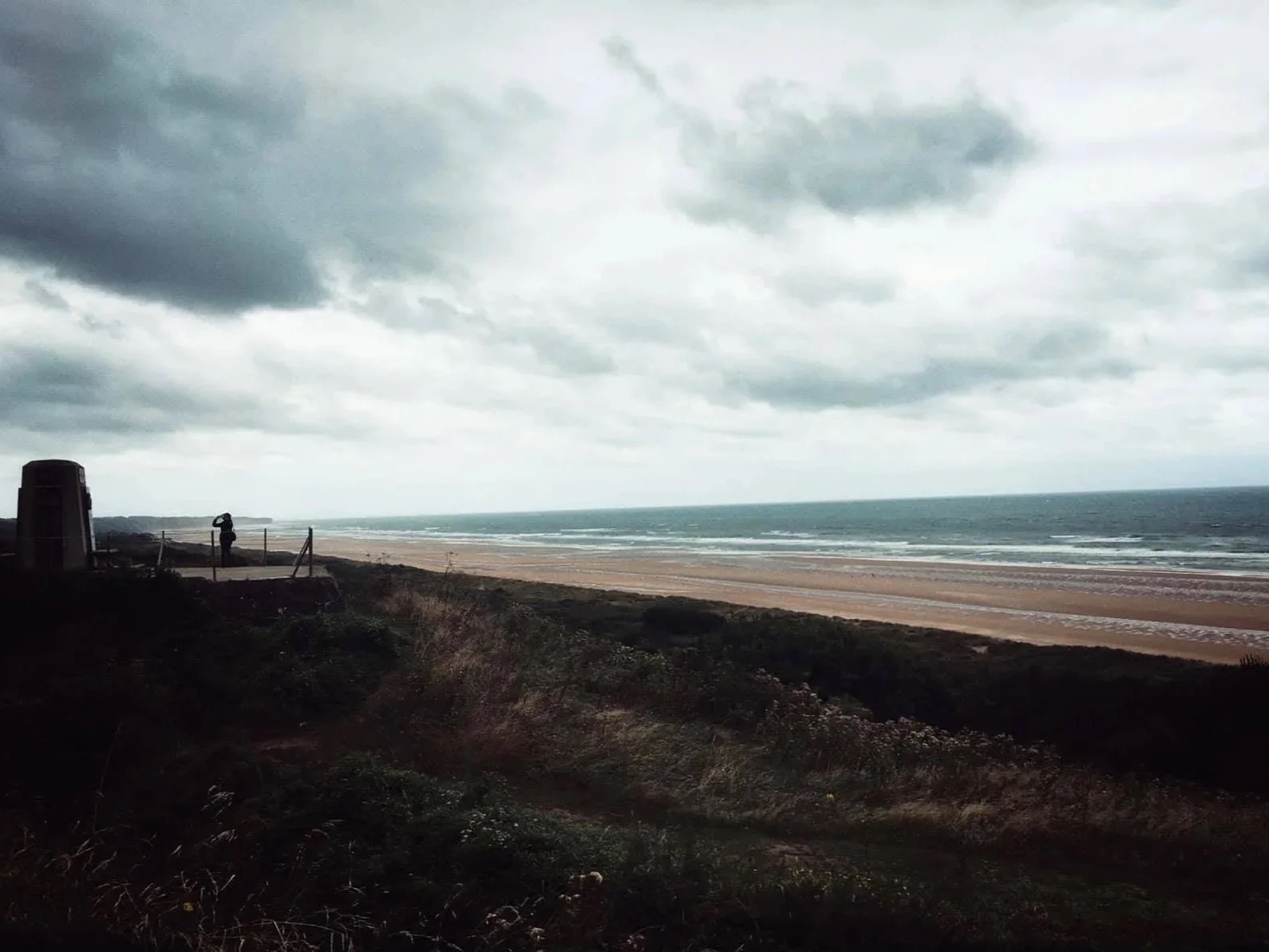
Overlooking Omaha Beach, Normandy, France, 2016 © Erin Faith Allen
My work with war is often misunderstood, and has been for a long time.
That misunderstanding has sharpened my thinking, stretched my approach, and clarified where misunderstanding lives, both within and between people.
People tend to assume I’m interested in the machinery of war. The politics, weapons, and tactics. The precise movements of forces across a map. They assume I’m cataloging battles, representing ideological positions, stacking statistics, glorifying brutality, or embodying whatever stereotype they’ve already decided applies.
None of those things has ever been the point of my work.
I used to feel the urge to get ahead of those presumptions. Not anymore. The performance of authority, so often socially rewarded, has always felt adjacent to war’s underlying logic. Competitive. Hierarchical. Inclined to diminish ways of being that fall outside its frame.
What has always interested me more than positioning is what lives beneath polished structure. In every field, some people carry impressive pedigrees, credentials, or visible markers of legitimacy. What animates them? What motivates their attention, their choices, the way they move through the world? Is it devotion to the work itself, to sustained care for the people, ideas, and histories they are responsible for shaping?
People sometimes categorize me before they’ve had any meaningful interaction with me. Depending on the audience, I’m perceived as too feeling-oriented, too war-adjacent, or not aligned with whatever their idea is of what a historian or artist should be. It’s been a long road, but I’ve stepped away from organizing my work around disproving assumptions that I did not choose. Being on the receiving end of this impulse to categorize based on limited perception isn’t unique to me; it’s a common human experience.
What I’ve come to notice is how secondhand narratives travel. People repeat judgments and perceptions with certainty. Those stories, often rooted in projection and sometimes in deliberate distortion, have a way of circling back. When they do, listening to them is often more revealing about their source than any energy spent correcting them ever could be.
I’m more interested in what that impulse points to: how distortion and subtle dehumanization can emerge as people sort, establish rank, and frame one another through incomplete or imagined information. Reflexes like these, well-documented in social psychology and political history alike, are often the smallest seeds of war. Not war itself, but the conditions that make escalation possible when left unexamined.
I make all of my work from the same place. The same curiosity. The same impulse to understand the roots of the human condition and the patterns of human behavior. How we treat one another. How we react. How and why connection is created or distorted in the space between people.
Every interaction I have with another human being comes through that lens. I enter with curiosity. I observe completely while in it. I leave and I contemplate both sides of the interaction. What just happened, what was said, what wasn’t. Where fear showed up. Where tenderness showed up. Where a power dynamic may exist. I continue to learn from what unfolds in those moments and from the people I encounter. This is a discipline of attention, developed over years of listening to people, families, and archives. It’s a blessing and a curse. But it’s also my greatest resource.
It’s not a finished stance, and it never will be; it’s a practice that keeps changing as I do. It’s where I create my art from. It’s where my words come from. It’s where my thinking takes root and blooms every single day of my life, and always has.
So in a way, it’s no surprise at all that I found myself fascinated with war. War is the epitome of the human condition. It is the most extreme human environment there is. A paradox of compressed and amplified versions of everything we do to one another in ordinary life. Fear. Dominance. Misunderstanding. Wounding. Loyalty. Camaraderie. Fight or flight. All of it, intensified and stripped of pretense, filters, and platitudes. In war, the distance between who we imagine ourselves to be and how we actually behave collapses.
What I’m interested in is speaking to the truth of war. And by that I mean the soul of war. What it does to men and women and families and communities. What it does beneath the surface, eroding away the psyche, the social fabric, and the body itself long after the fighting stops. War fractures time. It collapses past and present in the nervous system. It teaches the body to live as if danger is always imminent, even decades later.
I’m interested in collective wounds, collective psychological wounds. The kind that don’t end with armistice or surrender. The kind that lodge themselves in nervous systems, family structures, institutions, and cultural norms. The kind that get passed down quietly, without language, without intention. Often through silence, through absence, through what cannot be said or recorded. Silence itself is data, and it is overlooked, always.
Germany, a country I am deeply connected to, is a clear and powerful example of invisible inheritance. The shame that settled over the country between and after the world wars didn’t just punish. It shaped future generations. It shaped identity, restraint, fear, ethics, education, policy, and the decisions people make from that internal landscape. Shame doesn’t just silence, it constrains imagination. It creates hyper-vigilance. It changes how a society relates to power, to anger, to responsibility, to memory. That long psychological shadow, visible in family dynamics and institutional behavior alike, interests me far more than any weapon system ever could.
And this isn’t about singling out one country or one people. These dynamics exist on all sides of war. On the victor’s side, the wounds simply wear different disguises. Trauma wrapped in bravado or righteousness. Silence framed as stoicism or stiff upper lips. Stories that remain electrically charged because they sit on top of unprocessed moral injury. Families inherit that too, even when they inherit no stories at all.
I’m not drawn to guns. I’m not drawn to the size of artillery shells, the caliber of bullets, or which version of a tank fought in which battle.
I’m drawn to what happens inside bodies and brains. What settles into the bones of people who survive war. The people who carry the scars, visible and invisible. Every single microsecond of their experience in a war zone. Not just the moments of impact, but the waiting, the anticipation, the sensory saturation, the moral ruptures.
Every. Single. One.
Anyone I’ve worked with on their family history or research will tell you that. They might even say I’m relentless in my pursuit of detail. Nothing is ever enough, and my tenacity is deliberate. I do my work to keep the human story from flattening, or becoming inflated.
That includes soldiers and civilians. Perpetrators and bystanders. Winners and losers. War does not respect categories the way history books like to make us believe it does. Those distinctions often dissolve on the ground and linger uneasily in memory.
War isn’t just something that happens and then ends. It becomes a condition. It continues to live inside people as hyper-vigilance, emotional distance, rigidity, compulsive control, or a strange inability to rest. It shows up in how people parent. How they argue. How they relate to authority. How they imagine the future. Children grow up inside those patterns without knowing where they came from. Then those children grow up and shape institutions, policies, and cultures.
I care about the vagaries of war. The moral mess. The places where good and evil stop being clean abstractions and become lived, embodied realities people carry for decades. I care about the moments where certainty collapses and all that’s left is proximity to suffering and the potent acceptance that things cannot be fixed by polarizing.
After more than a decade of studying war, what I’ve learned is this. War doesn’t begin with weapons alone. Weapons are the final instruments, not the origin. War begins with assumptions. With categorizing people. With rigid thinking. With the erosion of critical thought and the consumption of propaganda. With the quiet psychological permission to decide that someone else is lesser, wrong, dangerous, and must be fought or dominated.
When we strip it back far enough, there’s no real difference in structure between judging a human in a conversation and the mindset that eventually escalates into full blown war. The scale changes, the machinery changes, but the pattern does not.
I’ve spent years tracing those patterns from where they’re planted to where they erupt into open conflict, across history, families, and institutions. The current underlying conditions are familiar because nothing has actually changed. That realization unsettles me, and not because I want to be right, but because recognition carries responsibility.
I’m tired of being misunderstood. Truly. But I also understand that misunderstanding is part of the human condition. We sort, categorize, assume, reduce, judge, shame, and break off into sides. That common reflex is one of the primary things my work with war has taught me to recognize, not just in history, but in everyday life.
And once you see that, you can’t unsee it.
Erin Faith Allen is an investigative war historian and the founder of Fortitude Research, specializing in WWII archival research, wartime reconstruction, Holocaust documentation, and the recovery of women's wartime histories. She is a leading authority on the 42nd "Rainbow" Infantry Division, inluding their liberation of Dachau concentration camp. Her family-commissioned book, One Day Over the Rhine, was published in 2026.
All original photographs and written work published on this site are copyright Erin Faith Allen. Historical and archival images are used where they exist in the public domain.
```