
Returning to Ravensbrück Concentration Camp for Women
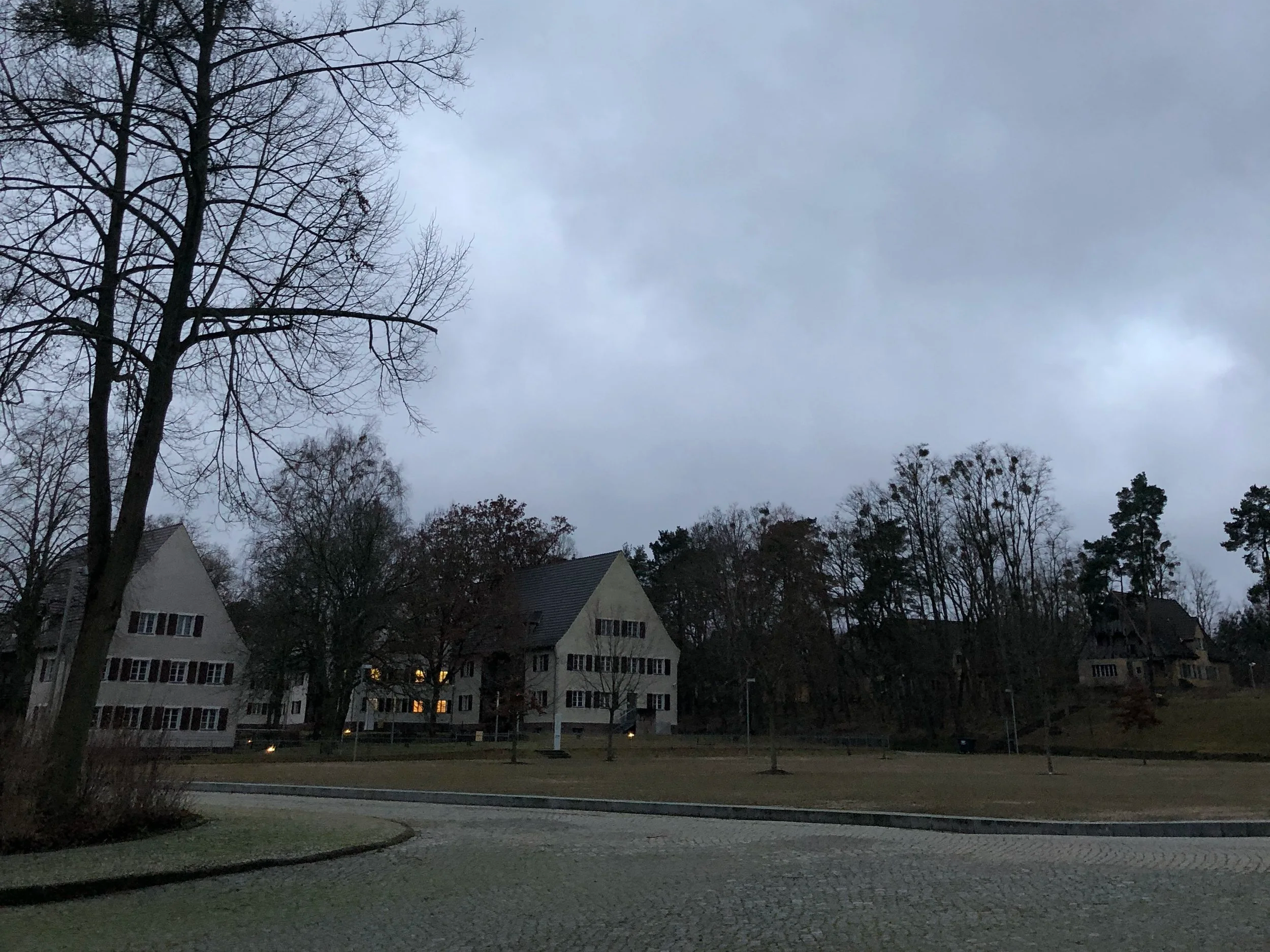
Ravensbrück concentration camp in December 2017 © Erin Faith Allen
We drive north from Sachsenhausen, through the pleasant little town of Fürstenberg and along the road that winds beside the Schwedtsee, the lake Fürstenberg shares with Ravensbrück. We turn right at the KZ Ravensbrück sign and go up the road until a fork splits off. We take another right. There the road turns to cobbles that bump and jiggle your body as you drive over them.
The bump and jiggle are dark souvenirs of a road laid in winter by bare-fingered women. They were among the first prisoners who arrived at Ravensbrück in 1939, months before Germany began its invasions of other countries. Thick walls of trees rise as we pass the Soviet tank on the left, positioned as a memorial for the liberators of the camp and a stoic reminder of the scope of world war. Fragile remains of pitch-roofed SS barracks are nearly swallowed by overgrowth. And still, the bump and jiggle.
Ravensbrück is a feeling to me, a feeling encompassed by a few surviving structures and personal memories, but it's the women who haunt me. I've done extensive reading and spent hours speaking with historians about life at Ravensbrück, and at times it seems I hold those stories closer to my chest than my own heartbeat.
My first exposure to Ravensbrück came when I was nine years old and read The Hiding Place by Corrie ten Boom. There was no television in our house, and I was an avid reader who, bored by children's books, regularly gobbled up the piles of books on my mother's shelves. There I sat, curled up on our cream-and-brown-plaid sofa in Northern California with a brightly colored blanket pulled up to my chin, eyes bulging over the words about life under Nazi rule and the author's time in captivity here. Striped uniforms. Starvation. Barbed wire. Snarling dogs. Brutal female guards wielding power, each like a villainess from hell.
I remember the images seared into my mind, and the feeling of a question forming that I still haven't found the words for. I have spent my life's work trying to define it clearly enough to finally find the answer.
Ravensbrück is a place I keep returning to. I spent a week here this past summer. I am back again now, in December, in the almost-dark.
Ravensbrück began as a prison camp for undesirables long before the Final Solution was even a thing. German women could be arrested and imprisoned for a variety of crimes including being a lesbian, listening to jazz music, being too outspoken, having or giving an abortion, having sex with a Jew or a foreigner, providing assistance to a Jewish neighbor, being a Jehovah's Witness, an artist or musician whose creations challenged the status quo, a communist, or drinking too much.
Just up the road stood the Uckermark, a jugendlager, a youth camp. Young girls were imprisoned there for any and all of the above.
After 1933, when Hitler rose to power, it was not a good time to be female in Germany.
As the war grew, political enemies, resistance fighters, and hostages from every country occupied by the Third Reich joined the Germans already imprisoned here, swelling Ravensbrück's population until it overflowed beyond capacity with women from all over Europe and every walk of life.
At Ravensbrück, they didn't have guns. Himmler believed women were more frightened by dogs than by firearms, so the guards had trained attack dogs at their sides. There were no guard towers around the perimeter. Instead, the dogs roamed the camp freely at night. The women were not expected to attempt escape under the watchful eyes of animals trained to maul and kill.
Here I stand, a handful of decades later, alone on the lagerstrasse, the main camp road. During Ravensbrück's years of operation, the women's wooden barracks lined both sides of the lagerstrasse. Now it's a stretch of flatness lined by looming trees, with dark gravel and slight indentations marking where the barracks used to be.
My friend, Dr Robert Sommer, walks ahead of me with a groundskeeper who is gesticulating off toward the right side of the camp, where the women once trudged to slave labor at the Siemens factory just down the way and beyond the camp walls. I stop and let them walk ahead, the crunch of their feet on the gravel fading into the distance toward the textile factory.
Like clockwork, my stomach has fully risen into my throat by the time I arrive at the large dirt square. Opposite me, the hulking SS administration building holds court like a flat-faced, beige god of tyranny. My ears try to block out the lingering echoes of shuffling wooden clogs on the cobblestones. My eyes absorb winter in Ravensbrück for the first time. My heart pulls back and moves forward.
That's what Ravensbrück does to me. I want to rush out and hold it all, but it hurts.
Inside the camp, the appellplatz was the site of daily roll call, which was in practice a form of Russian roulette. What surrounded it: the paralysis of terror and how it slows the brain until it barely functions, while the survival instinct simultaneously drives the nervous system into overdrive. Every move controlled. Identity stripped. Shaved head. Filthy clothing. No hygiene. No news of your family or your child. The hunger, the cold, the flea-infested bodies, the dysentery, the typhoid, the smell of burning flesh, the work marches, the shouts of the SS guards, the rotten soup, the stale bread. The infighting. The lifesaving. The treachery. The altruism.
Some survivors have said the Schwedtsee was used as a dumping ground for the ashes from the crematorium. There are historians who dispute that claim, saying that couldn't have been a regular occurrence because the wind constantly blows everything back to the western edge, where Ravensbrück sprawls, and the ashes would have blown right back onto the thrower and returned to the shore. Either way, an estimated fifty thousand women died at Ravensbrück, often at the hands of the female guards, and many of their bodies were burned in the crematorium. After the war, a pit of ash was discovered just a short walk from the shore of the Schwedtsee, in front of the camp wall. It has been turned into a bed of roses in memoriam.
When they arrived at Ravensbrück, the women would form or fall into networks based on allegiance, usually based on nationality. The strong Polish alliance. The communist women. The Jehovah's Witnesses, the most tight-knit group of all. The powers that be allowed these divisions because they believed they would keep the prisoners distracted from any possibility of uniting and overpowering the guards. Divide and conquer. It is among the oldest tactics available to those who hold power over others, and it works reliably in wartime as in peacetime, in a camp as in a country.
Just down the lagerstrasse, beyond the flat stretch where the women's barracks once stood, is the Siemens textile factory. Within its walls the women labored, tired and starving and sick, under brutal overseers. And within those same walls, in the bonds of shared suffering, came human connection of extraordinary dimension. Women saved lives. Women betrayed lives. The full gamut of human possibilities occurred within these camp walls. The same fundamental human possibilities that exist everywhere existed here, under the worst possible conditions, which is perhaps the most clarifying thing that can be said about human nature.
I turn in a circle and take in the deepening darkness of Ravensbrück. I watch the indigo richness of the sky begin to fall like a curtain behind the textile factory. The white exterior begins to absorb shades of blue as night quickly spreads itself over this hallowed horrorscape. Hallowed because of extinguished lives that I solemnly remember. Horror because of all that they endured.
The sun begins to slide at three in the afternoon in December.
The indigo sky pulls itself like a curtain behind the factory.
The white exterior absorbs the blue of nightfall.
The windows of the SS barracks glow.
The lagerstrasse goes dark.
This piece was originally written for The In Between, my first book, published in 2018. It was my earliest public record of work I had been carrying privately for years, and written at the beginning of what has since developed into a decade of intensive historical research. The core experience described here is real and remains unchanged. The original writing has been reshaped in the years since, informed by wisdom I have gained.
Erin Faith Allen is an investigative war historian and the founder of Fortitude Research, specializing in WWII archival research, wartime reconstruction, Holocaust documentation, and the recovery of women's wartime histories. She is a leading authority on the 42nd "Rainbow" Infantry Division, inluding their liberation of Dachau concentration camp. Her family-commissioned book, One Day Over the Rhine, was published in 2026.
All original photographs and written work published on this site are copyright Erin Faith Allen. Historical and archival images are used where they exist in the public domain.
```