
Mauthausen: The Quarry, the View, and the Weight of Two Hundred Thousand
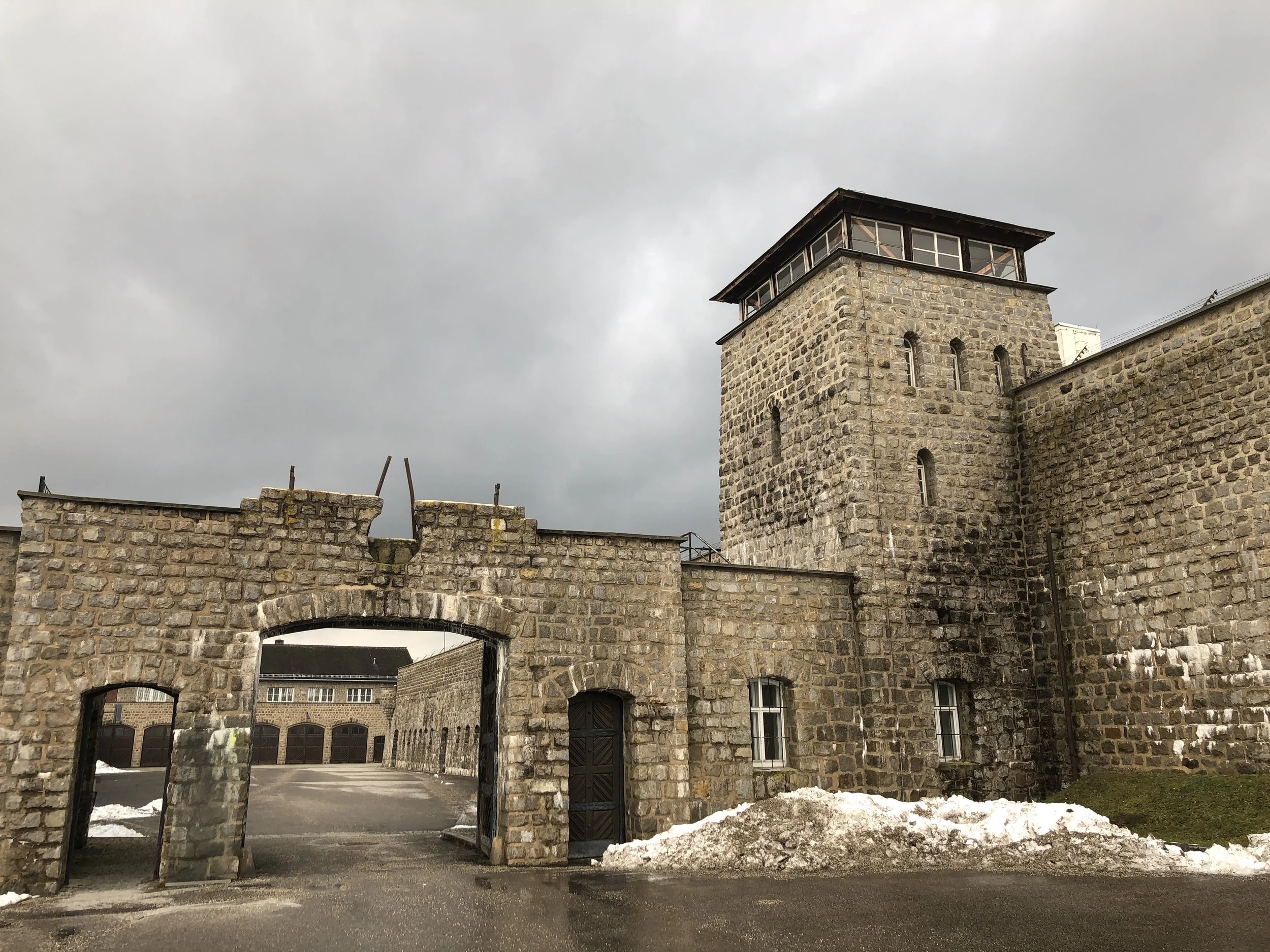
The stone walls of Mauthausen concentration camp in Austria, 2017 © Erin Faith Allen
While the driver bringing me to Mauthausen wipes the dampness from the windshield and fusses with the defroster on the dashboard, he asks, "What is your interest in Mauthausen?" It is early and I am not feeling very friendly, so I shrug and say, "I don't know, really. It's just a place I want to see."
We exit the A1 at St. Valentin. Signs point the way to KZ Mauthausen. We go through roundabouts and over bridges, drive along the Danube.
....................
I know very little about Mauthausen except that, like all the other camps, saying its name invokes a chill that permeates your spine by the time the second syllable rolls off your tongue.
When I was around eighteen, I rode along to a university with my mother, who was working toward a degree. She'd go to class, and I'd go to the stacks, as they were called, in the library. I would check out piles of books on Nazi Germany and the concentration camps and read them obsessively. Even then, I was trying to unpeel the layers of how and why. I lived in a small town in the middle of nowhere. Walking home from a friend's house on a dimly lit street one night, a car drove past. My first thought: the Gestapo. That was when I decided to stop reading about the Nazis. But it’s years later, and here I am.
It was then that I had first read about Mauthausen and the long, steep stone stairway in the quarry called the Stairs of Death. The prisoners would have to carry heavy stones up and down the 186 steps, up and down on their backs, under the most unimaginable circumstances, during twelve-hour shifts. Sometimes, they made it to the top only to be forced to jump off the high cliff. Sometimes they were pushed. Those kinds of things happened everywhere. It's what the Nazis did.
That's the only thing I knew about this camp, really. The Stairs of Death and the quarry. The stones from this quarry were used to pave the streets of Vienna years before the Nazis rolled into town, the same streets the Jews were then forced to scrub with bleeding fingers, on hands and knees, taunted by leering soldiers and cheering crowds.
I don't study the camps specifically before I go. I just pick up the bits that come my way. It happens after my feet touch the places where their feet walked, and I listen to the plaintive wind-whipped murmurs of the trees, and my body absorbs the dull throb of heartbeats roaming through the spaces left behind. That's when I pluck all the books off every shelf I can find.
....................
Now we're driving away, the hulking stone wall of Mauthausen fading in the rear-view mirror.
I've been to many camps. They are all horrible. Mauthausen is a particular shriek of horror so shrill that my throat feels coated with the taste of pure evil. The malignancy of the air brushed against my lips, trembling with the movement of nearly two hundred thousand souls elbowing their way toward me, needing to be heard. Beating fists of ash on my ribcage, demanding my attention. It feels like my solar plexus has been blown apart by dynamite.
If I had been a prisoner, it might have been the view that tortured me most. A nearly panoramic view of the most lush landscape you've ever seen, from high on top of a hill. They too might have looked across this same expanse as their feet crunched along the road, past the towering camp wall, on the way to the quarry. Sighing, climbing, descending, dying. Dragging their bodies toward a new day of slave labor, surrounded by sunsets, sunrises, the first snow, flocks of birds, cars moving to and fro on the road below. Freedom, out there. From one of the most unfree places a soul could ever know.
This piece was originally written for The In Between, published in 2018. It was my earliest public record of work I had been carrying privately for years, and written at the beginning of what has since developed into a decade of intensive historical research. The core experience described here is real and remains unchanged. The original writing has been reshaped in the years since, informed by wisdom I have gained.
Erin Faith Allen is an investigative war historian and the founder of Fortitude Research, specializing in WWII archival research, wartime reconstruction, Holocaust documentation, and the recovery of women's wartime histories. She is a leading authority on the 42nd "Rainbow" Infantry Division, inluding their liberation of Dachau concentration camp. Her family-commissioned book, One Day Over the Rhine, was published in 2026.
All original photographs and written work published on this site are copyright Erin Faith Allen. Historical and archival images are used where they exist in the public domain.
```