
Walking in His Father's Footsteps: A Son Retraces His Father's Path with the 42nd Rainbow Division
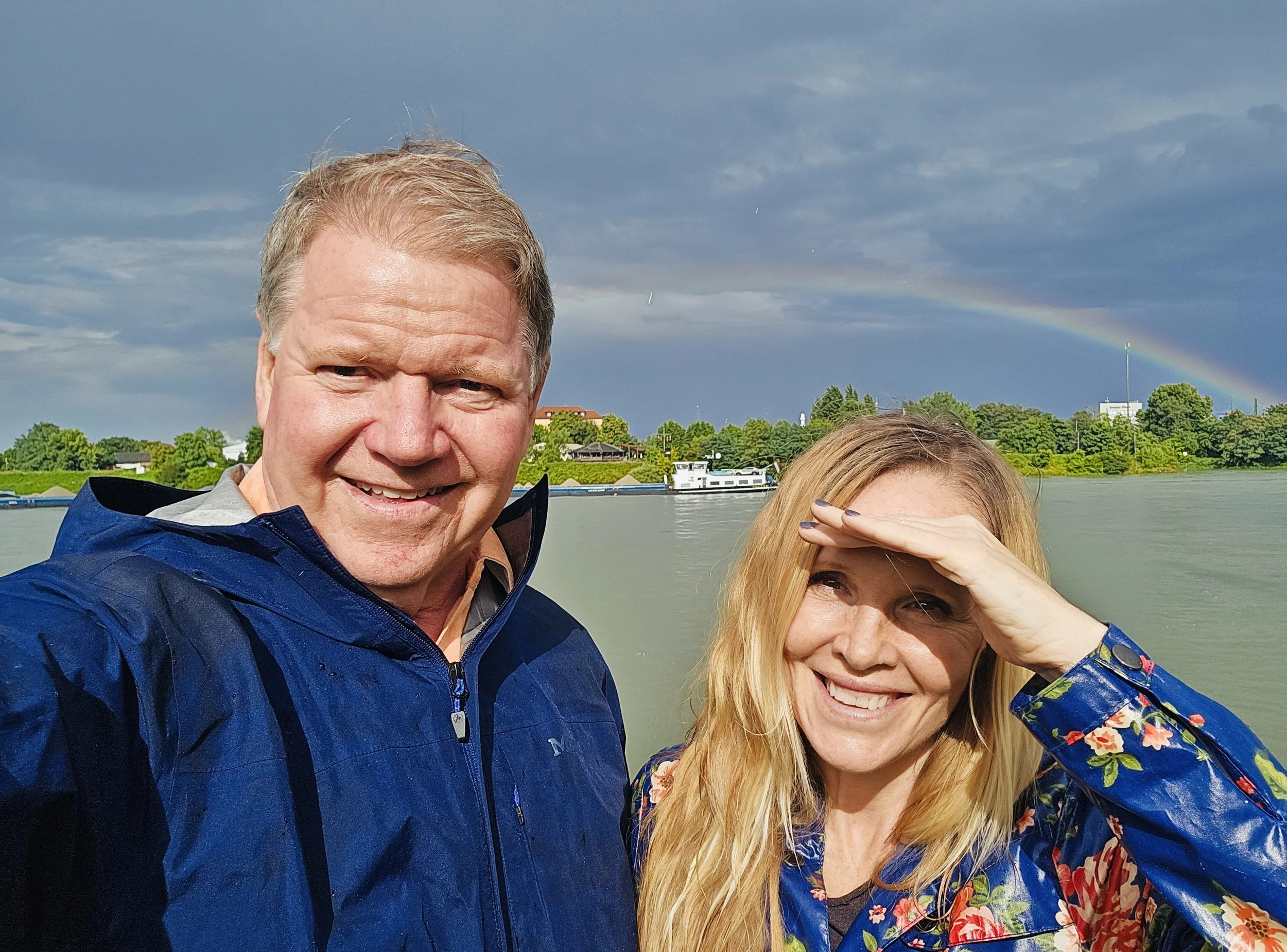
Erin and Tom beneath a rainbow over the Rhine in Strasbourg, retracing the WWII path of 222nd Infantry Regiment veteran Sergeant Vernon Breen, 42nd ‘Rainbow Division’.
There are moments in this work when the archive steps aside and something else takes over entirely. The Breen pilgrimage was one of those moments.
Tom Breen's father, Sergeant Vernon Breen, served with Headquarters Company, 3rd Battalion, 222nd Infantry Regiment, 42nd "Rainbow" Infantry Division. He came home from the war, raised a family, and carried his stories the way so many veterans of his generation carried them: carefully, selectively, in fragments offered to the people he trusted most. Tom grew up with those fragments. He knew the names, the places, the near-misses. He knew his father had stood at the gates of Dachau on April 29, 1945. He knew about the wall in Neubourg, and the crossroads, and the 88 shell that changed direction by inches and left his father alive to come home and become his father.
What Tom did not yet have was the ground beneath those stories. This past month, we went to explore it together. Here are a few of the highlights.
The Rhine and the Rainbow
We began in Strasbourg, on the banks of the Rhine, where Vernon had first come under fire in December 1944. In 1969, when Tom was eleven years old, his father had brought him to this same stretch of river and pointed across the water at the German positions. There is a photograph from that day of father and son, the Rhine behind them, a story passing from one generation to the next without either of them fully knowing it.
Fifty-six years later, and nearly 82 years after Vernon encountered the Germans, Tom and I stood in a rainstorm and combed that riverbank until we could match the old photograph to the modern landscape. The curvature of the river was the same, and eventually the geography gave itself up and we found the spot.
And then we turned toward the water, and the sky opened, and a massive rainbow arced across the Rhine.
We screamed. We hugged. Tom said it felt like his father, and the whole division, were letting us know they were right there at the opening of the journey. I have been doing this work for a decade and I have learned not to discount those moments when they arrive. Documentation is one kind of truth. That rainbow over the Rhine was another.
Into Alsace: Operation Nordwind Country
Moving into the Alsatian villages, we were joined by local historians Materne Schaerlinger and Boris Suss, who led us through the landscape of Operation Nordwind in restored Army jeeps. In Dauendorf, where Vernon's company had established their command post during the brutal fighting of January 1945, the mayor greeted Tom with champagne and thanked him personally on behalf of the village for the liberation. These villages remember. They have not forgotten what the men of the Rainbow did in the frozen winter of 1945, and they do not let their visitors forget either.
In Neubourg, we found the wall.
Vernon had told this story to his family: he had been sprinting toward a crossroads to report on German movements when an 88mm shell screamed past his head and struck a plaster wall beside him. "If that wall had been made of stone," he always said, "I wouldn't be here." Piecing together multiple firsthand accounts and the official unit records I have been working with for years, I was thrilled to bring Tom to that exact location. The shrapnel pockmarks are still there, carved into the side of the building, exactly where Vernon said they would be.
A story Tom had heard dozens of times was no longer a story. It was an actual, living landmark, and evidence; his family's history made physical and permanent and real.
This is what archival reconstruction does when it works the way it is supposed to work. The document points to the ground. The ground confirms the document. And the family finally has something they can stand in front of and touch.
Würzburg
In Würzburg, Tom visited the rathaus where Vernon had been ordered to locate the burgermeister in April 1945. When Vernon entered the building, the sitting mayor had just taken his own life and blood was still pooling around his head.
Within hours of that discovery, Vernon learned that his closest friend, Private First Class Curtice Mathews, had been killed at the Würzburger Brewery when a grenade landed in his jeep. Vernon's promotion to sergeant came in the same breath as the news of Curtice's death. Earlier in our journey, Tom had visited Curtice's grave at the St. Avold American Cemetery in France. At the Würzburger Brewery - still in operation today - Tom and I raised a beer to Curt. Since Curtice was an only child, Tom said quietly, he couldn't help but wonder if they were the first people to visit these places in his honor.
Dachau
On April 29, 1945, Vernon Breen had stood guard at the Arbeit Macht Frei gate at Dachau concentration camp and witnessed the Death Train, the railcars filled with prisoners transported from other camps as the Reich collapsed, arriving at Dachau with nowhere left to go.
Tom and I spent the day at the Dachau Memorial with my colleague Maximillian Lütgens of the Dachau Education Department, walking the grounds where his father had stood on the day of liberation.
Vernon never forgot what he saw at that gate and Tom will not forget walking the same ground.
Vienna
The final stop was Vienna, where the Rainbow Division had served occupation duty in the months after the German surrender. Vernon had photographed the city in 1945, and had returned with Tom in 1969 to stand before the same apartment house where he had billeted. Using that 1969 photograph, we found the building again. Tom stood in front of it and took a third photograph of the same building, in the same city, now with three generations of memory compressed into a single frame.
Traveling with us in Vienna was Max, who arranged for Tom and I to meet with Dachau survivor Erich Finches. When Tom entered the room, Finches looked at him and said: "I am grateful to your father. It is because of men like him that men like me survived and live free."
What This Journey Was
Over ten days and more than 1,400 miles, Tom Breen retraced his father's exact path through Strasbourg, Alsace, through the Hardt Mountains and the Siegfried Line, Würzburg, Fürth, Nuremberg, Munich, Dachau, and Vienna. He stood at every significant site. He touched the wall that saved his father's life. He raised a glass to his father’s best friend who never came home. He met a survivor who is alive because of what Vernon and the men of the 222nd Infantry Regiment did in the spring of 1945.
This is what Rainbow Division archival research makes possible. Not just the retrieval of records, but the reconstruction of a path that can be walked again, and by the families who deserve to walk it, in the places where it actually happened, with the documentation that confirms every step.
Vernon Breen's wartime journey is now highlighted, documented as one individual inside the permanent Rainbow Division record, and his son was able to explore every mile of it.
And somewhere on the banks of the Rhine, in the rain, the rainbow told us we were in exactly the right place, at exactly the right time.
Erin Faith Allen is an investigative war historian and the founder of Fortitude Research, specializing in WWII archival research, wartime reconstruction, Holocaust documentation, and the recovery of women's wartime histories. She is a leading authority on the 42nd "Rainbow" Infantry Division, inluding their liberation of Dachau concentration camp. Her family-commissioned book, One Day Over the Rhine, was published in 2026.
All original photographs and written work published on this site are copyright Erin Faith Allen. Historical and archival images are used where they exist in the public domain.
```