
Ben Lesser, Dachau Survivor: The Day His Life Began Again
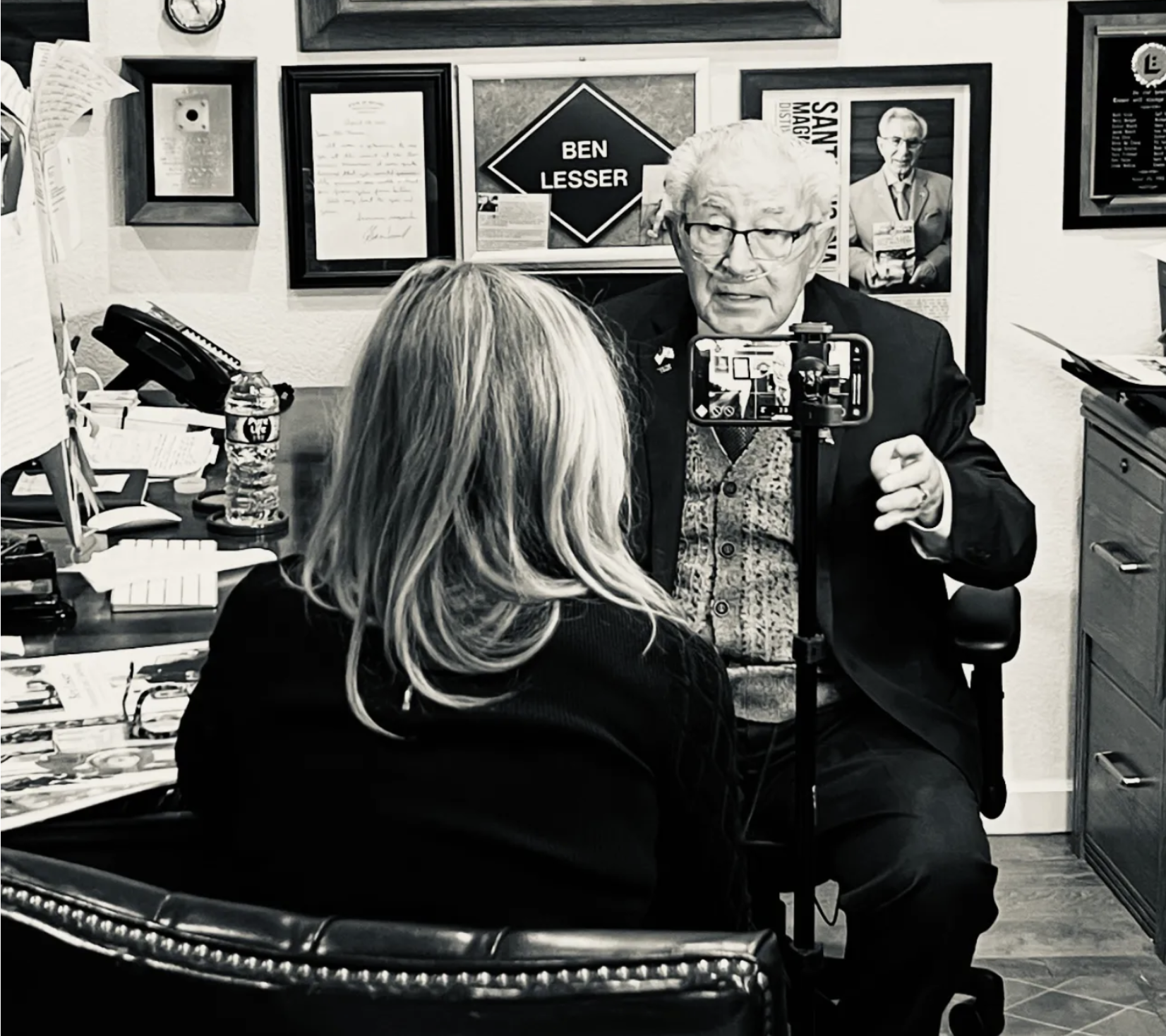
Erin Faith Allen interviews Holocaust survivor Ben Lesser © Erin Faith Allen
The following was originally published in the Rainbow Reveille, the 42nd Infantry Division's newspaper, in continuous publication since 1917. It is always an honor to contribute to the preservation of the Rainbow Division's legacy, and the stories of those they liberated.
Ben Lesser's life began again on April 29, 1945.
That is the day elements of the 42nd Rainbow Division entered Dachau concentration camp and liberated thousands of prisoners. Ben was sixteen years old. He had arrived at Dachau just days before, a passenger on the infamous death train from Buchenwald that had delivered a fresh cargo of tortured souls into the camp. Most were dead on arrival. A few emaciated men were able to crawl from the train. Ben and his cousin Isaac were two of them.
Ben had already survived the ghetto in Poland and the camps of Auschwitz, Durnhau, and Buchenwald. By the time he arrived at Dachau, the endless stacks of bodies, the last gasps of dying men, and the multitude of people like him clinging to survival had become the texture of daily life.
What happened on April 29 was not familiar. It was the most welcome sight he had ever seen, announced by four syllables spreading through the camp like lightning under a dense grey sky.
Americans.
The GIs who entered Dachau were greeted by those cries and by something they were not prepared for: thousands of skeletal prisoners in grey stripes and their desperate gratitude for the men in olive fatigues.
"They were like gods to us," Ben says, describing the moment he saw the GIs for the first time. His eyes widen as he says the words with hushed awe.
Two of those soldiers approached Ben and Isaac and handed them a can of Spam, with the best of intentions. Isaac's malnourished body could not survive it. He died in Ben's arms that evening.
Ben had already watched his family be pistol-whipped by Nazis. He had been separated from his parents in Poland. He had lost siblings to the ramp at Auschwitz and to Dr. Mengele. This final loss was something else entirely. He held Isaac as long as he could before Isaac was taken away to be buried.
Shortly after, Ben fell into a coma that lasted three months. When he woke, he was reunited with his sister Lola, the only other surviving member of his immediate family.
The life that followed has been full and never taken for granted. Ben eventually came to America, met his soul mate Jean, built a family, and founded a successful real estate company. Upon retiring in 1995 he established the Zachor Foundation, dedicated to honoring, educating, and remembering. His memoir is called Living a Life That Matters.
It is exactly the right title.
Ben's story, like all stories of survival against impossible odds, offers perspective on what actually matters. Through his courageous retelling of everything he lost, witnessed, and endured, he demonstrates what it means to hold memory with both tenacity and reverence, and to build a future that does not let the past define who you are.
To learn more about Ben's work and order his memoir, visit the Zachor Foundation at zachorfoundation.org.
Erin Faith Allen is an investigative war historian and the founder of Fortitude Research, specializing in WWII archival research, wartime reconstruction, Holocaust documentation, and the recovery of women's wartime histories. She is a leading authority on the 42nd "Rainbow" Infantry Division and the liberation of Dachau concentration camp. Her forthcoming book, One Day Over the Rhine, is in active development.
All original photographs and written work published on this site are copyright Erin Faith Allen. Historical and archival images are used where they exist in the public domain.
```