
The Day Douglas MacArthur Named the Rainbow Division
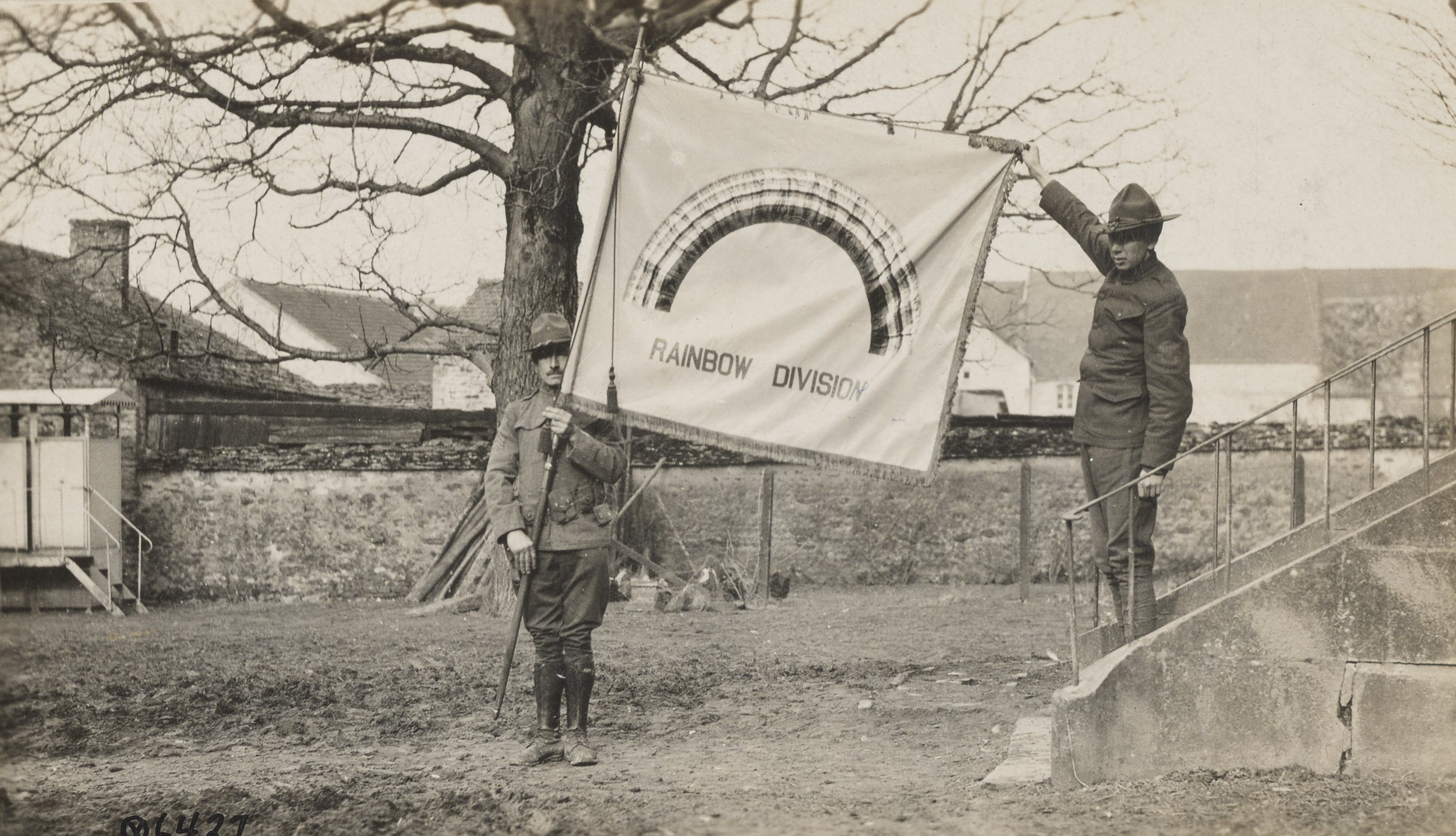
The Rainbow Division flag of World War I
Every military infantry division needs a name.
Most get numbers, and some have nicknames. The 42nd Infantry Division got a rainbow.
The story of how is one of the most interesting origin stories in American military history.
In the summer of 1917, as the United States mobilized for its entry into the First World War, the Army faced a problem that was as much political as military. Individual states were competing to send their National Guard units to France first, a scramble for honor that threatened to create both military imbalance and domestic resentment. The solution was a composite division, drawn from the National Guard units of twenty-six states and the District of Columbia, deliberately assembled to represent the nation as a whole rather than any single region.
The man assigned to help assemble it was a young major named Douglas MacArthur, serving as chief of staff to the division's first commander, Major General William Mann. When MacArthur described what this new division was, its scope, its reach, its deliberate representation of the entire country, he reached for a metaphor. In the end, that metaphor stuck, and still defines the division to this day.
Secretary of War Newton Baker recalled MacArthur saying that such an organization would “stretch over the whole country like a rainbow”.
The division became the 42nd and the 42nd became the Rainbow.
On August 1, 1917, the War Department directed the formation of the composite National Guard division, comprising units from 26 states and the District of Columbia. Men arrived from Alabama and New York, from Ohio and California, from Iowa and Georgia, all National Guardsmen who had trained in their home states, whose military culture had been shaped by their home communities, who were now being asked to become something larger than any of those communities alone.
They were being asked to become America.
The patch that would come to represent the division has its own story, quieter than MacArthur's declaration but, in some ways, more revealing about what the division became.
Division lore tells a story that Charles T. Menoher, division commander, saw a rainbow shortly before a battle, and therefore approved of the nickname and the patch after deciding this real, live rainbow was a surely an auspicious indicator. The original version of the patch symbolized a half arc rainbow and contained thin bands in multiple colors.
The colors settled into the red, yellow, and blue that the division carries to this day. The arc of the rainbow became the emblem that soldiers wore on their shoulders across France in WWI and, a generation later, across France, Germany, and Austria.
Visitors to torn, battered Germany reported that one could follow the path of the fighting 42nd by keeping an eye out for rainbows painted on the sides of buildings. An element of the division would halt for a moment and some GI, paint brush in hand, would splash the red, gold and blue of the rainbow for all to see.
This is a fighting division that knew who it was, and left its mark literally on everything it passed through.
MacArthur gave them their name in 1917 …. and by 1945 and two world wars they made it entirely their own.
Erin Faith Allen is an investigative war historian and the founder of Fortitude Research, specializing in WWII archival research, wartime reconstruction, Holocaust documentation, and the recovery of women's wartime histories. She is a leading authority on the 42nd "Rainbow" Infantry Division and the liberation of Dachau concentration camp. Her forthcoming book, One Day Over the Rhine, is in active development.
All original photographs and written work published on this site are copyright Erin Faith Allen. Historical and archival images are used where they exist in the public domain.
```