
What the Camera Doesn't Say: A German Soldier's Photograph, Eastern Europe, 1941
© Erin Faith Allen
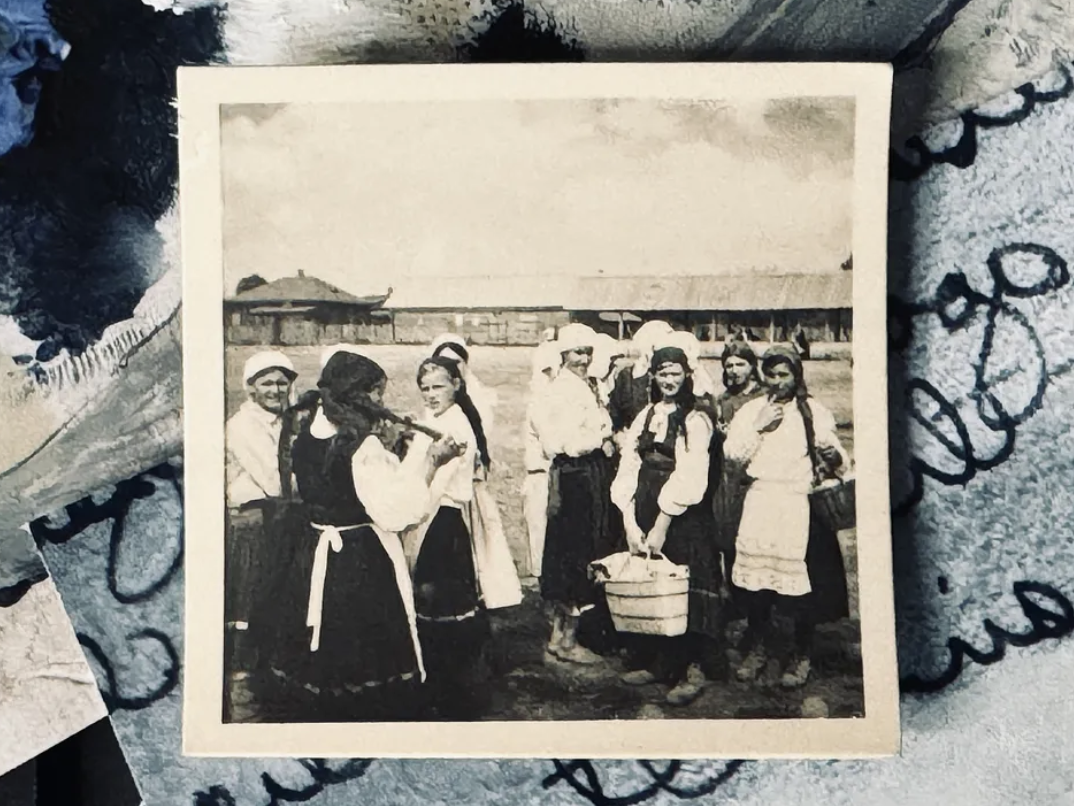
A German soldier took this photograph. That is all I know for certain.
The flat open landscape behind these women, the low buildings, the quality of the light, it all looks like the eastern steppe. Ukraine, perhaps. Possibly Belarus. The timing may have been the summer of 1941, when Operation Barbarossa sent three million German soldiers east in the largest military invasion in human history, and their cameras came with them.
The Wehrmacht photographed everything. Soldiers carried personal cameras the way soldiers today carry phones, and they documented their war with a casualness that is itself a kind of document. Villages. Roads. Landscapes. People. Each other. The photographs exist in enormous numbers, floating through archives and estate sales and private collections, turning up in attic boxes and antique markets across Europe and America. Most of them have no captions, names, or location. Just an image and a resounding silence that surrounds it.
This photograph stops me every time.
The women are wearing traditional Slavic folk dress. White embroidered blouses, dark skirts, headscarves. The embroidery and cut suggest Ukrainian or Belarusian peasant dress, though it could be Polish, could be Romanian. One woman holds a wooden pail. They are standing in what may be a village square, or a farmyard, or simply an open stretch of ground that may no longer exist in any form we would recognize.
Several of them are looking directly into the camera.
They do not know yet what he represents for them. Or perhaps they are beginning to understand, or do understand, and the look is something else entirely.
What the photograph also does not tell us is what happened to them after it was taken. We can speculate. We know what Barbarossa meant for the civilian populations of the occupied eastern territories. We know what it meant to be a woman in a village that German soldiers passed through. We know the statistics, the documented patterns of what occurred in these territories between 1941 and 1944. The numbers are so large they become abstract, which is precisely the problem.
These women are not abstract.
This photograph is what I mean when I try to describe why I do this work. The official record is full of numbers and statistics. The archive is full of faces. My job is to hold both at once and refuse to let either one collapse into the other.
I do not know their names. I do not know if they survived. I do not know which village this was, or what the soldier who took this picture did before or after he raised his camera.
A photograph is an act of freezing time into one instant. Light hits silver and the moment becomes permanent.
The soldier who raised this camera was documenting his war. What he actually captured was the faces of these women, watching him move through their village.
He may have held the camera, capturing a moment that for one reason or another, he wanted to see again.
But eighty years later, it is not his war I am looking at.
It is theirs.
And I cannot look away.
When I do, they stay.
Erin Faith Allen is an investigative war historian and the founder of Fortitude Research, specializing in WWII archival research, wartime reconstruction, Holocaust documentation, and the recovery of women's wartime histories. She is a leading authority on the 42nd "Rainbow" Infantry Division and the liberation of Dachau concentration camp. Her forthcoming book, One Day Over the Rhine, is in active development.
All original photographs and written work published on this site are copyright Erin Faith Allen. Historical and archival images are used where they exist in the public domain.
```