
What PTSD Actually Looked Like in 1945 Before We Had the Word For It
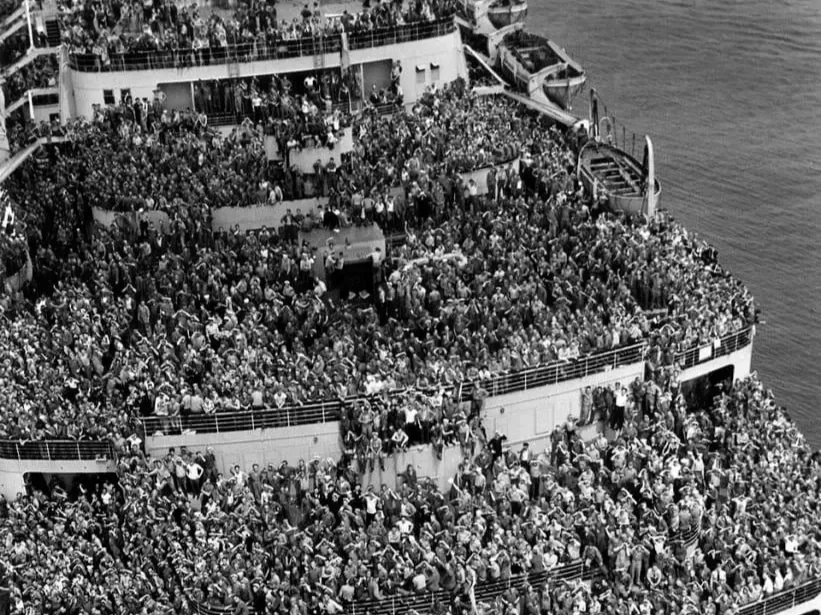
Men return from WWII on a troop ship.
The diagnosis did not exist, but the damage did.
Post-traumatic stress disorder was not in the diagnostic vocabulary in 1945. It would not be formally recognized by the American Psychiatric Association until 1980, thirty-five years after the end of the Second World War, following the sustained advocacy of Vietnam veterans and the mental health professionals who treated them.
But the condition existed. It has always existed. The specific psychological damage produced by exposure to extreme violence and mortal threat has been part of the human experience of war for as long as there has been war. It was called different things at different times, first shell shock in the First World War, then battle fatigue and combat exhaustion in the Second, and it was understood with varying degrees of accuracy and treated with varying degrees of effectiveness. What it was called and how it was understood shaped what happened to the people who had it, and what happened to the families they came home to.
The Second World War's institutional response to psychological casualties was more sophisticated than the First War's. The word sophisticated is used carefully here, because the baseline was very low.
Shell shock in the First World War had been treated with a combination of rest, electricity, and shame. The men who broke down were frequently treated as cowards, as malingerers, as men who lacked the fundamental quality of character that warfare required. The electric shock treatments administered to shell-shocked soldiers in some contexts were not primarily therapeutic. They were punitive, designed to make the symptoms sufficiently unpleasant that the soldier would choose to return to the front rather than continue experiencing them.
By the Second World War this approach had been partially revised. Combat exhaustion, the term the Army used for what we would now call acute PTSD, was recognized as a real condition with real causes. Forward psychiatry units were established near the front lines to treat soldiers before the acute state became chronic. The principle was proximity, immediacy, and expectancy: treat the soldier close to the front, treat him quickly, expect him to return to duty.
This was more humane than electricity and shame. It was also not treatment in any serious therapeutic sense. The goal was return to duty, not recovery. The psychological damage was managed sufficiently to produce a functional soldier, not addressed in ways that would have produced a healthy person.
What the men brought home is documented fragmentarily, incompletely, in the medical records and the VA files and the clinical notes of psychiatrists who were seeing patients they did not have adequate frameworks to treat.
Nightmares. Hypervigilance. The inability to tolerate loud noises or sudden movements. Emotional numbness alternating with explosive anger. Difficulty with intimacy. The specific inability to talk about what had happened - and not because the men were choosing to be stoic but because they did not have language for it, and the people around them did not have frameworks to receive it.
These symptoms were real. They were also, in the cultural context of 1945 and the years that followed, largely invisible. No one had words for what they were sensing, experiencing, and seeing.
The wife who learned to read her husband's silences like weather. Who knew, before he crossed the threshold, what kind of night it would be. Who built a life around the shape of what he could not say.
The children who understood that certain subjects could not be raised, that certain sounds or smells could shift the atmosphere of the house in ways they learned to navigate before they had words for what they were navigating.
The grandchildren who carry something in their nervous systems they can feel but not locate. Science has now documented this as the transmission of trauma across generations, and memory held in the body without any knowledge of the original event.
The diagnosis that didn't exist in 1945 lived in these families anyway. It moved through them as unnamed weather, as family mythology, as the texture of ordinary days in households where a man was managing something he could not name and they could not fully see.
The available frameworks back then said: the war is over. The world watched as the men came home. It was decided that they need time, work, family, the ordinary rhythms of civilian life, and any symptoms will resolve as the distance from the war increases. For some men, some of the time, this was true in varying degrees. For many, the symptoms did not resolve. They became structural, built into the architecture of a life and a family in ways that the family understood as personality rather than injury, and as character rather than damage.
This is what I carry into the archive with me.
When I reconstruct what a soldier experienced and what his unit was doing on specific days, what the casualty rates were, what the operational conditions were in the theater he served in, I am also reconstructing the conditions for what he came home carrying.
The documents don't file the aftermath. The morning reports move on.
The discharge papers record the date the man left the Army, not the date the Army left the man.
But the aftermath is there. It is in the families. It is in the gaps and silences and behavioral patterns that descendants describe when they tell me about the father or grandfather they never quite knew. It is in the question marks that people carry for decades before they think to ask whether the archive might help them understand what they have been living with.
The war ended in 1945. For the families, all of the unanswered questions are still open.
Erin Faith Allen is an investigative war historian and the founder of Fortitude Research, specializing in WWII archival research, wartime reconstruction, Holocaust documentation, and the recovery of women's wartime histories. She is a leading authority on the 42nd "Rainbow" Infantry Division and the liberation of Dachau concentration camp. Her forthcoming book, One Day Over the Rhine, is in active development.
All original photographs and written work published on this site are copyright Erin Faith Allen. Historical and archival images are used where they exist in the public domain.
```