
The Problem With "Greatest Generation" Mythology
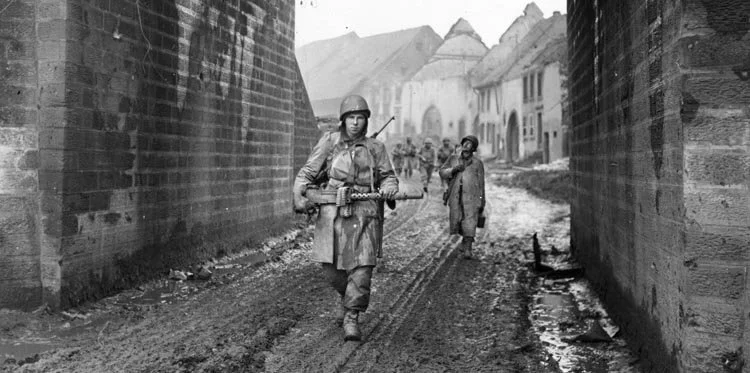
American infantrymen advance through a French village and beneath a railroad overpass west of Lemberg. US Signal Corps.
The term "Greatest Generation" was meant as tribute. Tom Brokaw coined it in 1998 to honor the men and women who lived through the Depression and fought World War II, a generation defined, in his framing, by sacrifice, duty, and an absence of self-pity.
The tribute was sincere. The mythology it produced has been quietly costly.
What the Mythology Does
Mythology, by definition, simplifies. It takes the full complexity of human experience and distills it into a story clean enough to repeat, to teach, to put on a monument.
The Greatest Generation myth does this with a particular kind of compression: it takes millions of individual human beings, each shaped by specific circumstances, specific trauma, specific choices made under impossible pressure, and turns them into a unified symbol of American virtue.
The symbol itself is not useless; all symbols serve purposes. But when the symbol becomes the primary lens through which we understand a generation, something essential gets lost.
What gets lost is the cost.
The Cost That Doesn't Fit the Myth
The men who came home from World War II came home changed. This is not a controversial statement. It is documented in divorce rates, in addiction statistics, in the VA hospital records of the postwar decades, in the clinical literature on what was then called combat fatigue and shell shock and is now called PTSD.
They came home to a culture that had no framework for what they were carrying and no particular interest in developing one. The dominant cultural message, the one the Greatest Generation myth both reflected and reinforced, was that strong men did not discuss what they had seen. They came home. They got to work. They did not burden their families with the interior weight of what they had lived through.
Although some may have chosen to do this, this was not stoicism, it was suppression. And suppression does not make things disappear. It makes them migrate, into bodies, into behavior, into the emotional atmosphere of families who had no idea what they were living inside.
The Greatest Generation myth honors the sacrifice, and it honors it with respect and dignity. We must ask ourselves, does it leave room for what the sacrifice actually cost, and where that cost went?
What It Costs the Families
As a WWII archival historian, I have spent years sitting with the downstream consequences of this myth. With families who grew up knowing that something was present in their homes that was never named. With adult children trying to understand fathers who were loving and also unreachable. With grandchildren carrying anxiety or anger or a particular kind of vigilance that they can't account for in the terms of their own lives.
When the cultural narrative around a generation is one of unambiguous strength and virtue, it becomes very difficult for families to name what they actually experienced. To say: he came back and something was gone. To say: there was a silence in our house that shaped all of us. To say: I love him and I also never knew him.
The myth makes this hard to say. It can feel like a betrayal of someone who sacrificed enormously. Like an ingratitude.
It isn't. Two things can exist at the same time. And, it's the truth. And the truth is what allows healing.
Honoring Without Flattening
None of this is to be taken as an argument against honoring the generation. The sacrifice was real, and it was huge. The accolades are deserved because the courage this generation displayed was enormous. The collective effort that ended fascism in Europe was one of the defining moral achievements of the twentieth century.
But real honor requires seeing the full person. Not just the uniform. Not just the medal. The man who wore the uniform and what wearing it cost him, and what that cost became in the rooms where he lived for the next fifty, sixty, or seventy years.
That is a more complicated story than the myth allows. It is also a truer one.
And true stories are the only ones that actually help anybody.
Erin Faith Allen is an investigative war historian and the founder of Fortitude Research, specializing in WWII archival research, wartime reconstruction, Holocaust documentation, and the recovery of women's wartime histories. She is a leading authority on the 42nd "Rainbow" Infantry Division and the liberation of Dachau concentration camp. Her forthcoming book, One Day Over the Rhine, is in active development.
All original photographs and written work published on this site are copyright Erin Faith Allen. Historical and archival images are used where they exist in the public domain.
```