
Brigitte’s Story: Germany, 1945
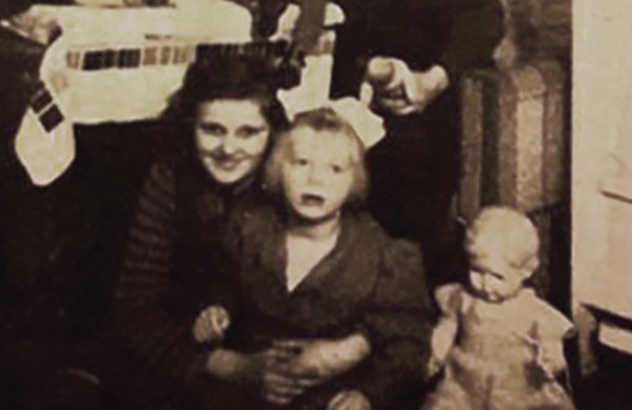
Brigitte, to the left of her doll.
As soon as I pull the letter out of my mailbox, I know who it is from. The cursive is the careful, rounded script of a woman who learned to write in another country, and another century.
The letter is from Brigitte, my friend Mark's mother. Between them, they have shared their family's war with me, in anecdotes over a kitchen table in France and now in pages that arrive in the post from Germany, trusting me with the kind of thing most families fold away and never say aloud again. A photograph came with the letter. In it, a small girl sits next to her doll and stares at the camera, as if she is in mid-sentence, saying something in excitement to the photographer. The photograph was taken some time before the stories I am about to tell you.
Brigitte was seven years old in the winter of 1945 in Breslau, the German city in Silesia that is now the Polish city of Wrocław. When the Red Army came through, the soldiers the family called Cossacks, she was made to watch as they assaulted her mother, Hildegard. The same thing was happening in the houses up and down the street, again and again, to women whose names never reached a courtroom or any other form of justice. The documents call this the fall of the eastern provinces, and most of the laws in 1945 declined to call it anything at all. For Brigitte it was her mother, and the room, and the men, and the fact that she was small and could do nothing but see, and would carry the seeing the rest of her life.
Eventually Hildegard got the children out of the Soviet sector and west toward the Americans, to a Bavarian town called Rugendorf. Everyone knew the Americans were the safer bet, though safety is a word that bends in a war, and on the road their refugee column was strafed by an American plane. In Rugendorf, Hildegard washed American uniforms in exchange for food. She had been assaulted in her own city and driven out of her own house, and now she bent over a basin and scrubbed the dirt out of the laundry of the army whose plane had fired on her children, because that was what kept them fed. People survive in the ways left to them.
Brigitte's father, Rudolf, was there for none of it. He was a gunner in the Wehrmacht and a veteran of Stalingrad, one of the few who came out of that alive. According to the family story, the International Red Cross had sent him home with dysentery, which may be the only reason he lived at all. He told his family that at Stalingrad he had watched Death go down the line and take his comrades one by one. Once, starving, his unit found a chicken. The machine gun was the only weapon they had left between them, so he fired it, and the chicken came apart into nothing, and grown men held one another and wept over the food that had been there and was gone. The cold was such that a man learned to shield himself with an empty ammunition tube when he relieved himself, so the exposed flesh would not freeze. To keep the dysentery from killing him, Rudolf burned whatever bread he could find black in the fire before he ate it, because the char bound his stomach and bought him one more day.
He was sent back to the front, then the Red Army captured him and he went into a Soviet prison camp, and he stayed there for seven years. Seven years is long enough for a family to give a man up for dead. Hildegard waited, and waited, past the point where waiting made any sense and the family needed to survive. She lost hope and took up with another man, and Brigitte's sister was conceived. And then Rudolf came home, against every reasonable expectation, one more time a survivor among the few who survived a thing that killed nearly everyone. He came back to a household that had been forced to learn to live without him, with a new child who was not his.
He stayed a Nazi to the end of his life. None of what he had suffered moved him off it. He kept a guesthouse in Hof, and up in the attic was a room where the men would gather and revisit the glory days, the old certainties intact, the war revised in their own minds into something they could be proud of. The man who burned his bread black to stay alive in the worst place on earth came home and spent his evenings polishing the myth of the cause that had sent him there. Both things are true, and the family lived inside both of them.
And then the doll. In the photograph it sits beside Brigitte, and it is the most expensive thing in the frame. Hildegard had traded a full set of bedsheets for it, which in that time and place was a fortune, because she wanted her daughter to have one thing that was only hers. Hildegard had traded a full set of bedsheets for it, which in that time and place was a fortune, because she wanted her daughter to have one thing that was only hers. When the Cossacks forced the family out of the house, in the panic of leaving, Brigitte left the doll behind. When she realized it was gone, Hildegard went back for it, to the house they had just been driven from, and to the men who had assaulted her. She looked through the kitchen window, saw it inside, and reached her arm in to take it back. A Cossack standing in the kitchen saw the arm come through the window and brought the butt of his rifle down on it. Twice Hildegard was assaulted. Once for her body, and once for a doll.
Brigitte ended her letter to me with a brief line about her mother. With my mother's strength and faith, we all made it. My mother will always be my hero.
What happened to Hildegard was not rare, nor was it only at the hands of the Red Army. Sexual violence against civilian women was carried out by more than one army across every theater, and what documentation exists is staggering. The most cited estimate puts the number of German women assaulted by Soviet soldiers across Germany and the occupied east at roughly two million, and the true figure will never be known. Some historians argue that parts of the record were amplified, first by a Nazi propaganda machine that needed an enemy more bestial than itself, and later by Cold War politics that found the Red Army's crimes useful. I asked Mark what he made of the scholars who put the documented crimes against women down to propaganda:
Ask my mother. Ask her neighbors. Even one is too many.
Another question always comes up in conversations like this one, about the crimes done to the women of Germany. The country was guilty, and the reasoning can slide from the country, its leadership, and the people who believed in that leadership, over onto the woman, and then onto all of them at once. Whatever Germany was and whatever it did, was any of it Hildegard's to answer for with her body? And the two million women like her? Can anyone say what each of them did for the Reich, or whether she did anything at all? Is the flag a woman is born under a debt she must pay, with her body, against her will, for what her country did? These are questions that must be asked.
How a whole nation heals from this, from the war they began and the war that finished them, has no clean answer. A family does not inherit resolution when the crime is left unspoken. What it inherits is the weight of what could not be said, carried quietly into the next generation, and the one after, reshaping the people in it from the inside while no one can name where the heaviness came from. Brigitte and Mark hold the shame of Rudolf's choices in one hand and the grief of what was done to their family in the other. Mark carries his mother and his grandmother. Now, in a smaller way, so do I.
Erin Faith Allen is an investigative war historian and the founder of Fortitude Research, specializing in WWII archival research, wartime reconstruction, Holocaust documentation, and the recovery of women's wartime histories. She is a leading authority on the 42nd "Rainbow" Infantry Division, inluding their liberation of Dachau concentration camp. Her family-commissioned book, One Day Over the Rhine, was published in 2026.
All original photographs and written work published on this site are copyright Erin Faith Allen. Historical and archival images are used where they exist in the public domain.
```