
War Widows and the Grief That Went Underground: Women in WWII
Part three of three in the series Women in World War II: The Home Front
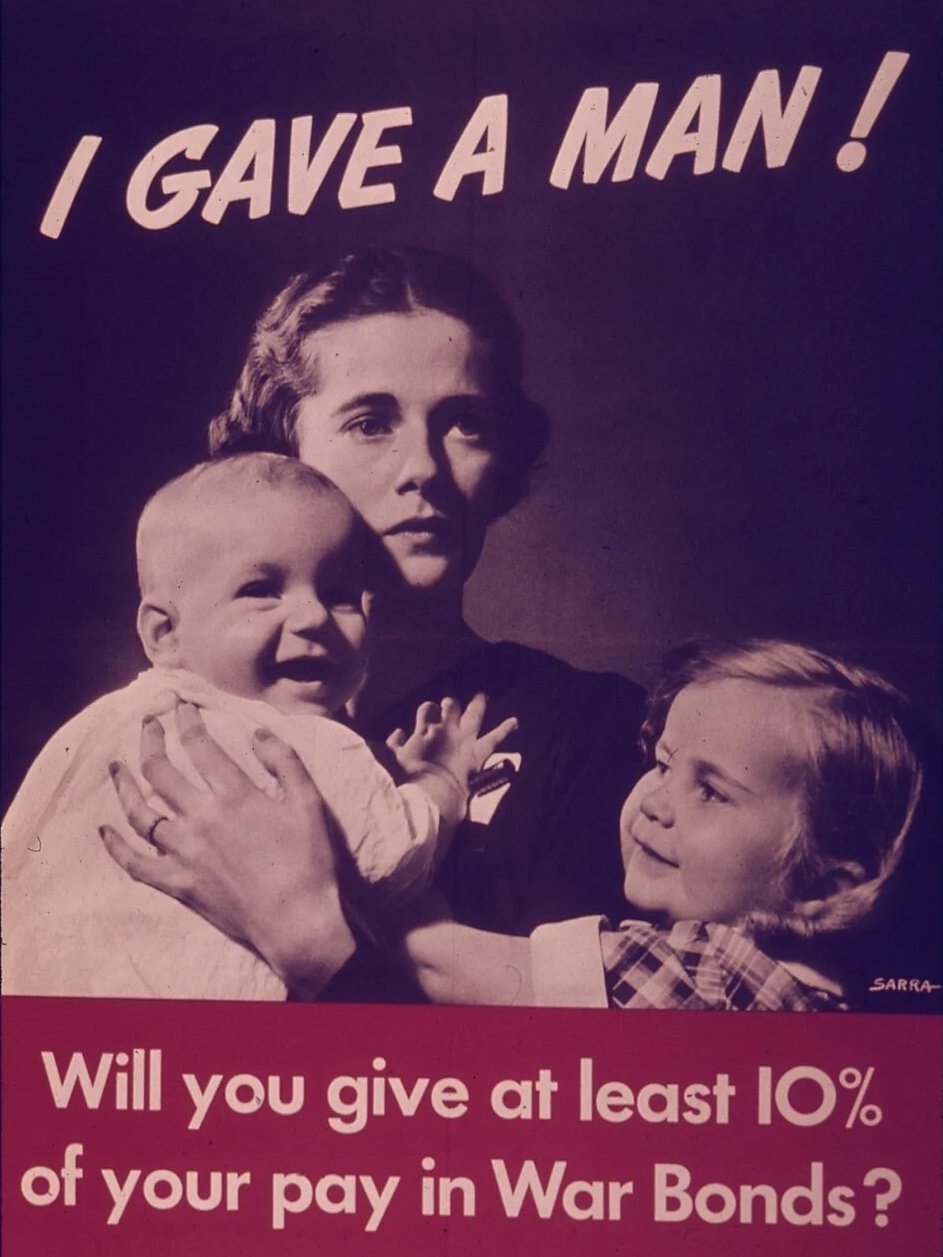
Office of War Information. Domestic Operations Branch. Bureau of Special Services. US National Archives.
There is a drawer in a house somewhere in America, and inside it are the letters.
The children find it after she dies. They are adults now, some of them grandparents themselves, and they are sorting through decades of accumulated life, the Christmas ornaments and the tax returns and the good china nobody used, and then one of them opens a drawer they have never opened before, because it was always her drawer, and they find the letters.
The letters are folded, and with them is a dog-eared photograph of a man they do not recognize. The handwriting is young. The paper is thin, the kind the military issued, folded along creases so old the creases have gone soft as fabric. A young man in uniform, maybe twenty-two, smiling at the camera. There is a telegram, folded along a single crease. There is a medal, and there is an aura of loss.
The children sit on the floor of their dead mother’s bedroom and they understand, sometimes for the first time in their lives, that the woman who raised them carried parts of herself close and small.
This is the reality that lives in drawers across America, and across the globe.
…………………
Roughly 183,000 American women lost their husbands in World War II. The number is approximate because the categories are messy, because some marriages were not registered, because some deaths were missing in action and remained that way for years, and because the bureaucracy of grief was never equal to the volume of grief it was asked to process.
A young widow in the 1940s received a death gratuity, typically six months of her husband’s base pay. She might receive a modest monthly pension. She also received a telegram or letter from the War Department, a folded flag, his medals, any belongings retrieved, and, if she was fortunate, a visit from a chaplain or an officer who had known him.
She did not receive a career. She did not receive a detailed survival plan for single motherhood in a culture that had no category for her. She did not receive, in most cases, enough money to live on.
What she did receive was a cultural expectation that she would, in a reasonable amount of time, remarry. It was a silent expectation, and it was a necessity.
And most of them did remarry. The remarriage rates for young war widows in the late 1940s were extraordinarily high, driven by economic necessity, social pressure, the presence of returning servicemen looking for wives, and the absolute absence of an option for raising children alone in postwar America. The pressure was enormous and the timeline was short.
She remarried. Often within a year, sometimes within months. She did not make this choice because her grief was finished. The grief had barely had time to process in a whole world clamoring to survive. She remarried because there were children to feed and a mortgage to carry and a country that was collectively moving on.
So her first husband went into a drawer.
…………………
The story of the second marriage should not be reduced only to a story of suppression. Many of those marriages were real, and tender. Many of the second husbands were good men who loved her and loved her children and built something durable alongside her for the rest of their lives.
But the first husband was still in the drawer.
She may not have felt able to speak about him to the second husband, who would not have known where to put the information, and who in many cases was himself a veteran with his own silences and drawers he would not open. And, she may not have spoken about him to the children of the second marriage, who grew up in a house that contained something they could feel but could not name.
And tragically, in many cases, she would not speak of their father to the children of the first marriage.
These are the children I have encountered often in my work. They are in their eighties now. They were three years old, or five, or not yet born, when the telegram came. They grew up in houses where a new father taught them to ride bicycles and walked them down aisles and signed their report cards, and they loved him, and he was theirs, and their birth father became a name they stopped saying out loud because saying it made their mother go quiet in a way that frightened them.
They learned to protect her. I have sat across from enough of these now-grown children to understand what they carried, and how early they began carrying it. They may have been too young, or not yet born, to remember when the telegraph came, but they learned, at four and five and six years old, to read the weather in their mother’s face and atmosphere, and to adjust themselves accordingly. They learned that some questions made her freeze up. They learned that certain anniversaries needed quiet. They learned to protect her fragility because her fragility was the structure they lived inside, and if it collapsed, they understood without being told, everything else would collapse with it.
So they did not ask, ever, as children, when they knew asking would hurt her. They didn’t ask as teenagers, when other things at home and in the world were louder. And they didn’t ask as adults, when the habit of not asking had become deeply grooved.
They carried their own grief for a father they did not remember, and they carried it in the same silence she had taught them by example, and they carried it for their entire lives. A grief that had never been spoken aloud, for a man whose face they knew only from a photograph kept in a drawer they were not supposed to open, fathered a specific kind of identity. An absence at the center of the self, a hole inside them where a father should have been.
They tell me about it now, these children in their eighties. They tell me in careful voices, often for the first time, that they spent their lives not knowing him and also not not knowing him. They learned to hold the hole of him open without any of the information needed to understand, and to process the loss they did not choose. They tell me they wish they had asked. They tell me they are glad they did not ask. They tell me both things in the same conversation and do not notice the contradiction, because the contradiction is the truth of what they lived.
…………………
There is a term in the contemporary bereavement literature for what these women were experiencing, and what their children inherited. It is called disenfranchised grief, and it describes loss that a culture does not grant permission to mourn openly. Grief that has no ritual, no acknowledged timeline, and no socially sanctioned place to go.
The American war widow who remarried within a year was, by almost any modern clinical definition, disenfranchised. Her grief was real and it was enormous and it was also, in the cultural logic of the late 1940s, finished. She remarried and she moved on and that was that. She had done the thing the country needed her to do, which was to fold the casualty back into the continuity of American life, and not make a scene about it.
She did not make a scene. Almost none of them did. They folded the grief the way they had folded the telegram, along a single crease, and they put it away.
But grief does not go away because you put it away. Unspoken grief goes somewhere. It does not evaporate. It tunnels. It finds the places in the body where the culture is not looking and it builds a room there, and it lives in that room for the rest of the life it has been given.
It goes into the bones. Into the tight shoulders and the headaches that had no medical explanation. Into the insomnia that lasted for decades. Into the sudden quiet that came over her when a certain song played on the radio, into the specific way she watched the evening news during Vietnam and every subsequent war, as though she were watching something personal.
It went into her body because her body was the only place left to put it.
And some of it, inevitably, went into her children.
…………………
The archive holds these women, but it holds them obliquely. Their stories do not live in government military paperwork. They live in personal archives, in the drawers and attics and shoeboxes of private homes.
What surfaces, when it surfaces, surfaces late. A descendant brings a box. A granddaughter finds a bundle of letters in an attic in Ohio and does not know who the young man is. An adult child, sorting through a house after a funeral, opens the drawer.
I have sat with what comes out of those drawers. The letters are always the same and always different. A young man writing from training. A young man writing from England. A young man writing from France in the autumn of 1944 about how he misses her cooking and how he will be home by Christmas.
He was not home by Christmas.
And she kept this letter close, but far, for years.
………………
Erin Faith Allen is an investigative war historian and the founder of Fortitude Research, specializing in WWII archival research, wartime reconstruction, Holocaust documentation, and the recovery of women's wartime histories. She is a leading authority on the 42nd "Rainbow" Infantry Division, inluding their liberation of Dachau concentration camp. Her family-commissioned book, One Day Over the Rhine, was published in 2026.
All original photographs and written work published on this site are copyright Erin Faith Allen. Historical and archival images are used where they exist in the public domain.
```