
There Is No Poster for These Women: Women in WWII
Part two of three in the series Women in World War II: The Home Front
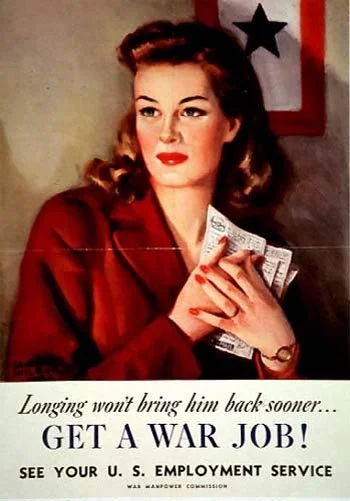
Get a War Job. Lawrence Wilbur, 1944. War Manpower Commission. Public domain
There is no poster for these women.
When you go looking for one, what you find is a ration book, a victory garden pamphlet, or a war bond drive. What you find, if you look long enough, is this 1944 War Manpower Commission poster of a woman holding her husband's letters. She is well-dressed. Her nails are done. She is looking downward at the paper in her hands, and the government's message printed above her reads: Longing Won't Bring Him Back Sooner. Get a War Job.
That is the closest the propaganda apparatus came to seeing her. And what it saw was not a woman managing a household alone, not a woman feeding children on a soldier's monthly allotment check, not a woman lying awake at 3 in the morning calculating whether the money would hold and whether he was still alive. What it saw was inefficiency, longing as a resource to be redirected, and grief as something that could be converted, with the right messaging, into factory output.
The woman who was left behind did not get a poster; she got a reprimand.
…………………
The home front has been documented extensively, but it has been documented largely in the category of productivity. Women managed households alone, often for the first time, on a soldier's monthly allotment and whatever they could stretch it into. They rationed food and fuel, grew victory gardens, bought war bonds, volunteered with the Red Cross.
In a nation at war, everyone did their bit. The record of what they did is substantial, admirable, and deserves to be celebrated. The record of what it cost them is nearly invisible.
This is not an accident. We have always told the war as a story of what was won. The cost is in there somewhere, acknowledged in the broad strokes, but the emphasis is never on what it took out of the specific human bodies that carried it.
The sacrifice lived in the body of every woman who went to bed not knowing and woke up not knowing and went through the entire schedule of an ordinary day, feeding children, managing money, doing the work that needed doing, while carrying in the background a fear so constant it stopped registering as fear and became instead a kind of weather.
It was the weather they dressed the children in. It was the weather they made coffee inside of. It was the weather they learned to stop naming because naming it every morning would have been a second full-time job, and they already had the first one, and the second one, and the one the men had left behind.
Psychologists now have language for what chronic stress and anticipatory grief do to a nervous system over time. The women of the home front didn't have that language.
What they did have was the societal expectation that they would manage, in a whole world of everyone doing just that: managing a version of life they did not ask for.
…………………
There is another cost that the poster version of the home front almost never addresses: the cost of the marriage that survived the war.
We have a story about that too. It ends with the headlines of Victory in Europe, then Japan and the whole world exhaling at once. What happens the morning after the exhale, and the morning after that, and the years of mornings after that, is not part of the story we tell.
What happens is that a woman who has been running a household alone for three years sets a fourth place at the table and watches a man she used to know try to remember how to fit back into the family he left when he was sent off to fight. What happens is that the body next to hers in bed is home and also not home, and she does not yet have the vocabulary for that, and will not for decades, and in some cases will not at all.
The women who waited brought their husbands home into lives they had rebuilt, often substantially, around absence. They had made decisions, developed competencies, assumed roles that the prewar version of their marriage had not included. And then the men came back changed in ways that were not always visible and not always speakable, and the marriage had to be renegotiated from the inside out without any available framework for how to do that.
Many of them held, and held through the good old-fashioned power of love, which is its own kind of war-medicine. Many of them held at considerable personal cost, suppressing what they had become in the years of absence, contracting back into domestic roles that no longer fit the same way, absorbing the aftermath of their husbands' war without anyone asking what they themselves were carrying.
Many of them also broke. The divorce rate in the years immediately following the war spiked.
Neither the holding nor the breaking was simple. Both were the consequence of something real that no poster has ever shown: the full human cost of waiting, and what it produces in a person over years, and what happens when the waiting finally ends and the new reality begins.
…………………
I think about these women often, and not as symbols of national resilience, though they were that. They were specific human beings who were handed an impossible situation and navigated it with the tools they had, which were sometimes sufficient and sometimes weren't.
They are present in the archive and I hold traces of them regularly. Their letters remain, their names are in ration books and volunteer logs and the occasional diary. They are harder to find than the soldiers' stories, because women's records were kept less systematically, preserved less consistently, and considered less historically significant by the institutions that decided what was worth keeping.
But they are there. A grocery list in a hand that grew steadier or shakier as the war went on. A letter folded and refolded until the creases went soft. A name signed at the bottom of a Red Cross log on a Tuesday in 1943, by a woman who had not heard from her husband in eleven weeks and still showed up to roll bandages because what else was there to do with her hands.
Part three of this series is here.
Erin Faith Allen is an investigative war historian and the founder of Fortitude Research, specializing in WWII archival research, wartime reconstruction, Holocaust documentation, and the recovery of women's wartime histories. She is a leading authority on the 42nd "Rainbow" Infantry Division, inluding their liberation of Dachau concentration camp. Her family-commissioned book, One Day Over the Rhine, was published in 2026.
All original photographs and written work published on this site are copyright Erin Faith Allen. Historical and archival images are used where they exist in the public domain.
```