
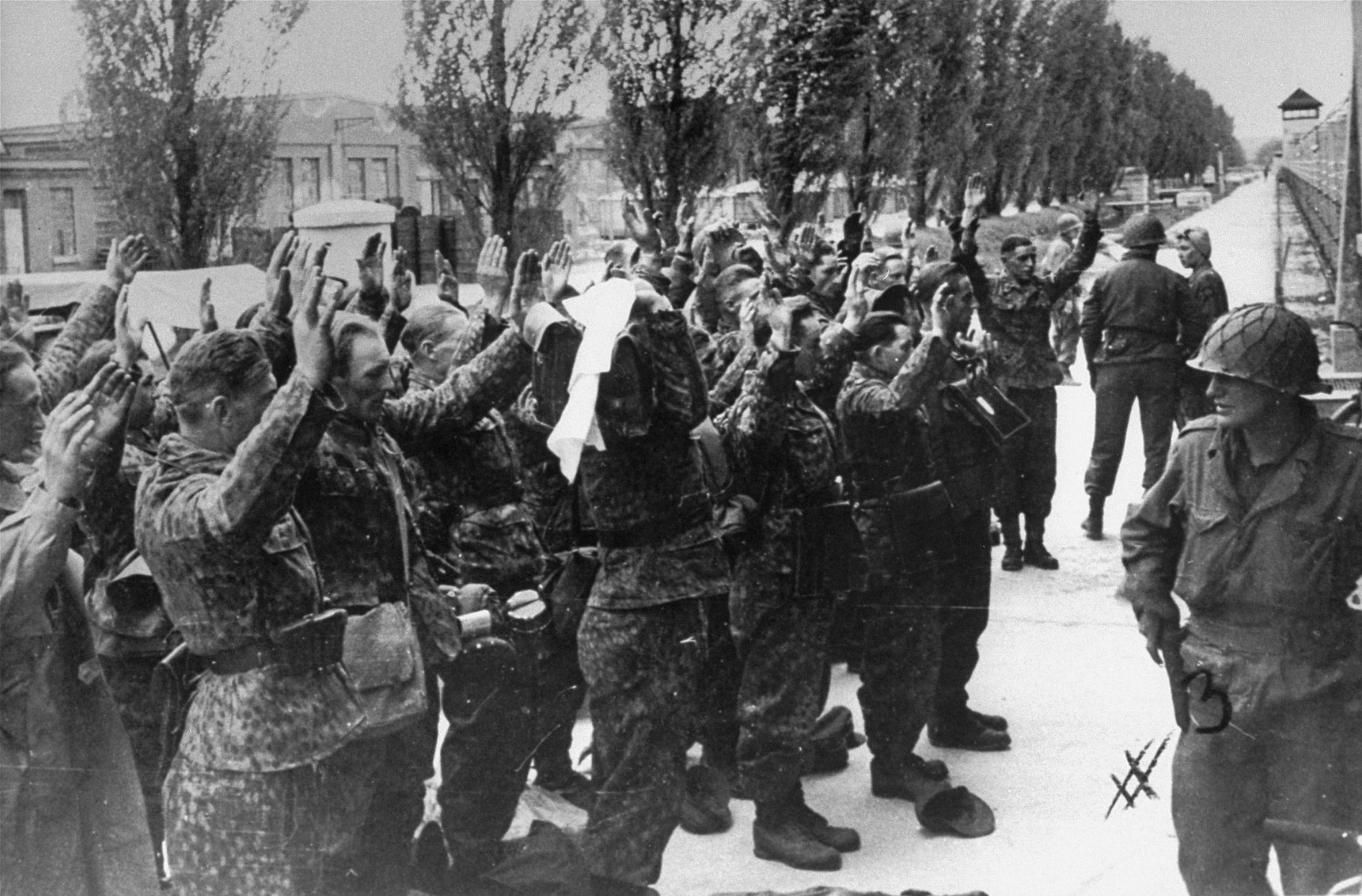
Surrendering Waffen-SS troops guarded by Rainbow Division soldiers. In the background to the right is Marguerite Higgins, the famous WWII journalist, speaking with Lt. Colonel Walter Fellenz, of the 222nd Infantry Regiment, 42nd Rainbow Infantry division. © United States Holocaust Memorial Museum, Provenance: Sol Feingold
There is a photograph in the collections of the United States Holocaust Memorial Museum, taken at Dachau on April 29, 1945. Surrendering SS troops stand under guard by soldiers of the 42nd 'Rainbow' Division. To the right, a step back from the center of the frame, a woman is talking with Lieutenant Colonel Walter Fellenz of the 222nd Infantry Regiment.
The woman is Marguerite Higgins.
She had arrived that afternoon in a jeep with soldiers of the 42nd. She was twenty-four years old. She had written for the New York Herald Tribune for less than a year, and she had come to Europe for exactly this, for the days that would decide what the war was and what it had done to the people caught inside it. April 29, 1945 was one of those days, in a way no briefing and no operational summary could have readied her for, or readied anyone for.
She walked in through the southern entrance with the men of the Rainbow, and she saw what they saw.
………….
The dispatch she filed to the Herald Tribune that night is one of the primary documents of the liberation. It opened without ceremony:
"Troops of the United States 7th Army liberated 33,000 prisoners this afternoon at this first and largest of the Nazi concentration camps."
Her dispatch continues, and tells of her entrance through the Jourhaus gate, with Arbeit Macht Frei worked into the iron:
"a jangled barrage of 'Are you Americans?' in about 16 languages came from the barracks 200 yards from the gate."
From there she stayed inside what she had seen. The barracks that carried the stench of death and sickness she had first met at Buchenwald and knew again here. The dead lying on the concrete walks outside the quarters. The living so reduced by starvation and disease that it seemed impossible a heart still beat inside them. The cattle cars standing below the camp, still holding the people brought from Buchenwald, most of them dead by the time the train arrived.
What she found that day needed a witness who could stay inside the description instead of retreating to a summary. Higgins was that witness. She was twenty-four years old, she had just walked through Dachau, and she went back to her typewriter and shared what she saw with the world.
………….
Several units reached the camp from different directions that same afternoon. The 42nd came in from the south, through the main enclosure. The 45th was still fighting through the SS barracks to the north.
What the record holds, across photographs and dispatches and military files and the USHMM collections, is that Higgins arrived with the 42nd, entered through the southern gate, was present for the formal surrender of the camp to General Henning Linden, and was talking with a Rainbow officer in the compound when the Signal Corps photographer found her.
………….
The Rainbow Division and Marguerite Higgins are bound together in history. She belongs to the Division's story because she rode in the jeeps that came through the southern gate on the afternoon of April 29. The Division belongs to hers because it was the unit she was moving with when she walked into the thing that would shape what she understood about the war.
The photograph shows something quieter than drama. A correspondent came in with the jeeps, walked the compound, asked her questions, and wrote down what she saw. For her the attention was ordinary, built across years of going toward the things most people turn from. She was there because the story was there, and for her that was the only place to be.
In the frame, a correspondent and a colonel stand talking in the compound of a concentration camp on the afternoon it stopped operating, surrendering SS troops in front of them and Rainbow soldiers on guard. Each was doing work that took everything they had, on a day neither would leave behind.