
We Can Do It! The Women Who Built the War: Women in WWII
Part one of three in the series Women in World War II: The Home Front
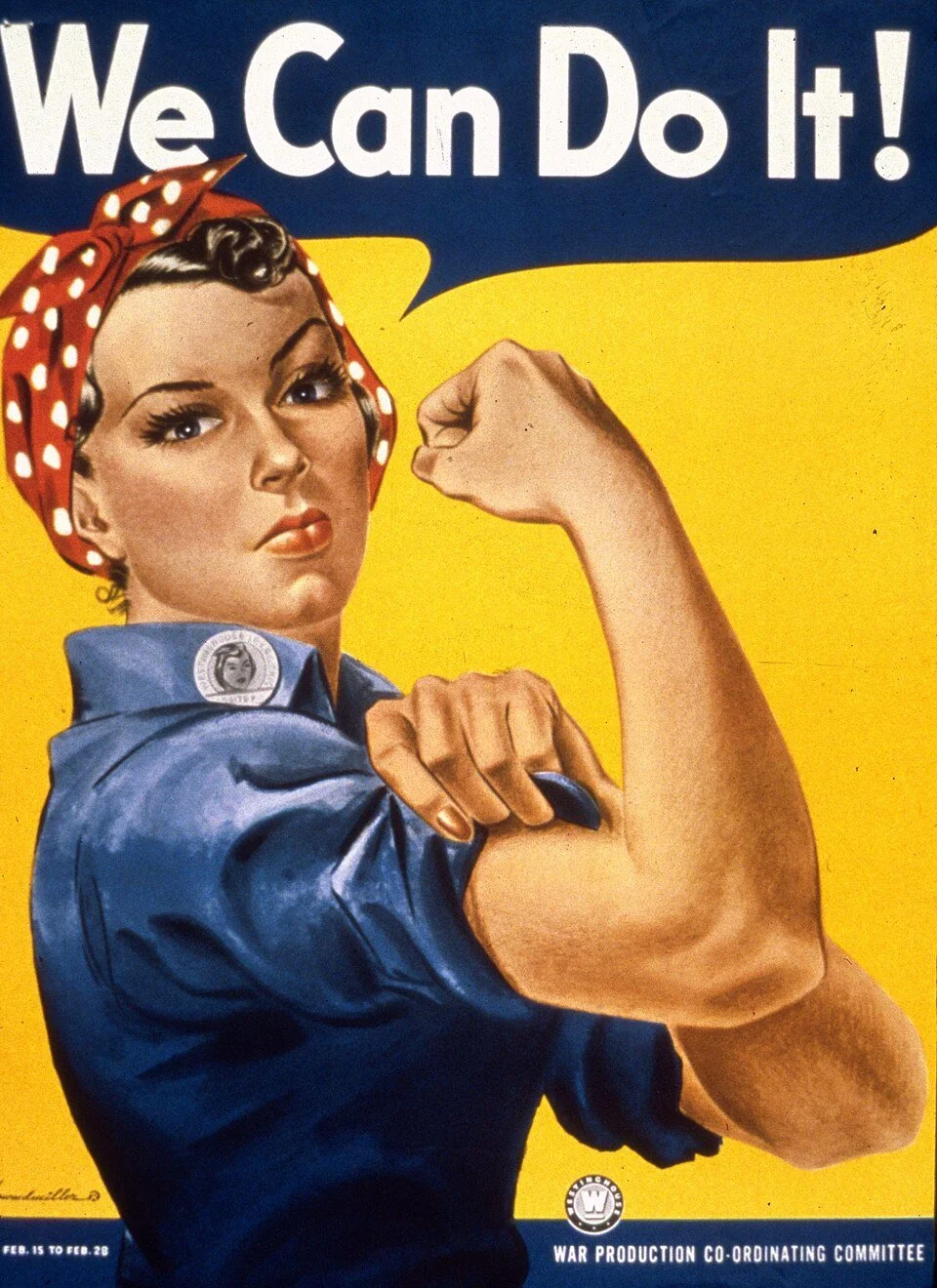
The 1943 We Can Do It poster by J. Howard Miller, produced for the Westinghouse Electric Company, public domain.
There is a poster for them.
Red polka dot bandana. Rolled sleeve. Flexed bicep. We Can Do It. It became, in the decades after the war, the most recognizable image of American women in World War II. Clean, bright, iconic. A bicep raised in the direction of formidable female history.
What most people do not know is that almost no one saw this poster during the war.
J. Howard Miller made it in 1943 for the Westinghouse Electric Company. It was displayed for two weeks on a factory floor in the Midwest, seen by the workers it was made for, and then put into storage. The women it depicted did not call themselves Rosie the Riveter. That name belonged to a different image entirely, Norman Rockwell's Saturday Evening Post cover from May 1943. The poster we now call the icon of female wartime labor spent nearly forty years in a filing cabinet before it was rediscovered in the early 1980s, reframed as a feminist symbol, and projected backward onto a war it had barely touched while it was actually happening.
None of this makes the mythology wrong, only incomplete.
Because the women it has come to represent were real, and their story is considerably larger than a bicep.
…………………
I have had the privilege, at various WWII commemorations and veteran events over the years, of meeting some of these women. Those remaining are in their late nineties now. One of them told me about climbing up onto aircraft turrets to drive in bolts the size of her fist. She said it matter of factly, the way people describe work they did because it needed doing. She was not performing modesty. She had simply never been given a particular reason to consider it remarkable. All of these women just did what they did, to do their part, and to survive.
That is the thing about these women that the famous poster, even now, does not quite capture.
They were not posing, they were simply working.
…………………
Before the war, a working married woman was considered, in many sectors of society, a problem to be solved.
The Depression had made female employment a social threat. With a quarter of Americans out of work, women who held jobs were understood to be taking them from men who needed them more. In 1932, the federal government formally prohibited more than one family member from holding a federal job, a policy aimed specifically at married women. The New York Commissioner of Labor described the woman who worked when she did not strictly have to as a menace to society. This was not a fringe position. It was mainstream, codified, and enforced through social pressure as much as through policy.
Less than a decade later, the same government that had spent years pushing women out of the workforce was recruiting them back in with everything it had. Posters. Radio campaigns. Magazine spreads. The message had inverted completely: working was no longer selfish. It was patriotic. It was necessary. It was, the propaganda insisted, what the men at the front were counting on.
And the women showed up, by the millions. Six million of them entered the American industrial workforce between 1941 and 1945. They built ships and aircraft and tanks and ammunition. They welded and riveted and operated machinery that had never been designed with their hands in mind. They passed physical fitness tests and learned technical skills and worked shifts that ran through the night.
They did not need that poster to tell them they could do it.
Because they were already doing it.
…………………
What the histories of this period sometimes miss, in their focus on what these women produced, is what the work gave them in return.
For many of them, the factory was the first place they had ever earned their own money. The first place they had been evaluated on their output rather than their domestic usefulness. The first place the question of what a woman could do had been answered not by social convention but by the work itself. The identity that opened up inside that experience did not close when the shift ended. It went home with them, and it was in their letters they sent to the front lines.
And those letters mattered more than history has sometimes acknowledged.
The men in Europe and the Pacific were not sustained only by supply lines and ammunition. They were sustained by correspondence. By the specific knowledge that someone at home was holding, that the life they had left was still there, tended and real and waiting. The letters these women wrote, on their lunch breaks and after their shifts and late at night when the children were asleep, traveled across oceans and into foxholes and kept men human in conditions that were anything but. I have seen the letters the men sent in response, detailed acknowledgments of what had been shared of the life at home. I have held them, and have reconstructed histories with them.
The woman at the factory bench and the man in the foxhole were not living separate wars. They were living the same war from opposite ends of it, held together by the thin thread of the written word. This is the connective tissue the partial history loses. Not the factory output, which has always been counted and celebrated. The human web underneath it. Every piece of it mattered, none of it was peripheral or insignificant.
…………………
When the war ended, the factories were returned to the men who came home.
This happened quickly and without much ceremony. Women were thanked for their service and returned to domestic life, often losing jobs they had held with distinction, sometimes on the same day the armistice was announced. The overall percentage of women in the workforce fell from thirty-six percent in 1944 to twenty-eight percent by 1947. The government that had told them working was their patriotic duty now told them, with equal conviction, that going home was.
The poster that had never really been theirs during the war was retrieved from storage, reframed, and handed back to them decades later, retrieved and recast in hindsight as a symbol of what they had been. By then most of them were grandmothers. Some of them saw themselves in it. Some of them did not quite recognize the image as the work they remembered, which was less triumphant and more grinding, and which had ended not with celebration but with a pink slip and a suggestion that they just go back home now.
The sense of betrayal some felt is real and it belongs in the history, but it is not the end of the story.
…………………
The women who worked the factories between 1941 and 1945 did not come back from the experience unchanged. The identity that the work had opened could not be fully closed again, even when the job itself was gone. It lived in them quietly through the 1950s, underneath the mythology of the contented housewife, showing up in the choices they made for their daughters, in the expectations they carried about what a woman was capable of, in the specific way they watched the world begin to shift in the decade that followed.
The changes that exploded in the 1960s did not arrive from nowhere. They arrived, in part, from the factory floors of the 1940s. They arrived, in part, from the factory floors of the 1940s, from the women who had learned what they could do and had not entirely forgotten it, even when the culture asked them to.
Part two of this series is here.
Erin Faith Allen is an investigative war historian and the founder of Fortitude Research, specializing in WWII archival research, wartime reconstruction, Holocaust documentation, and the recovery of women's wartime histories. She is a leading authority on the 42nd "Rainbow" Infantry Division, inluding their liberation of Dachau concentration camp. Her family-commissioned book, One Day Over the Rhine, was published in 2026.
All original photographs and written work published on this site are copyright Erin Faith Allen. Historical and archival images are used where they exist in the public domain.
```