
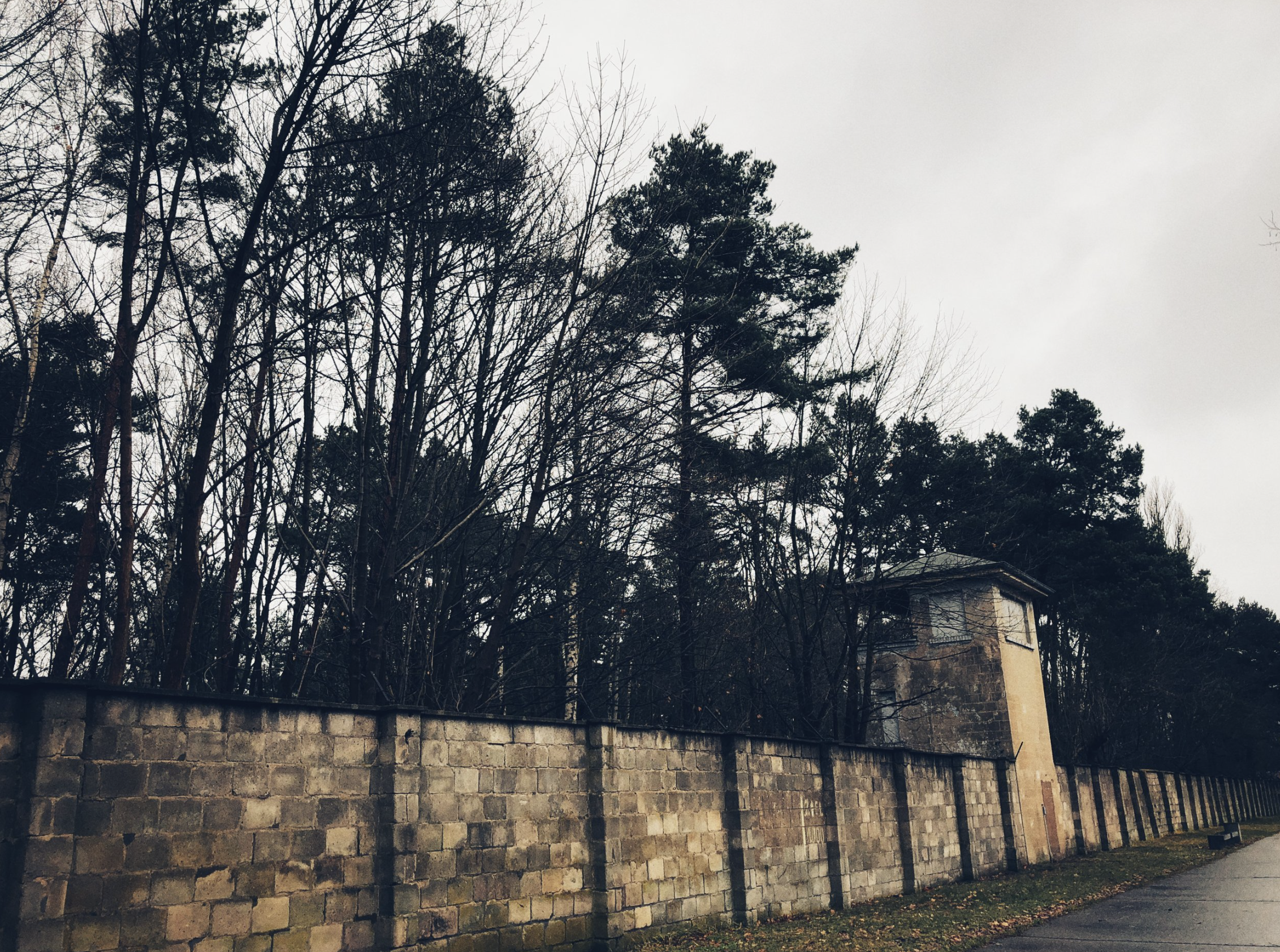
The perimeter wall and guard tower of Sachsenhausen, 2017 © Erin Faith Allen
Around thirty thousand humans stopped living here.
I use the words stopped living because we have grown somewhat immune to words like died and murdered. The repetition of atrocity has a numbing effect, which is its own moral problem.
In the SS barracks, the guards would slumber at the end of a long day, heads on pillows, bellies full. What they had spent the day doing was the last thing they thought about before closing their eyes, or it was the first thing they forgot.
At Sachsenhausen, life was stopped in the following ways.
A shot to the back of the neck. Gasping for air in a gas chamber. Torture in the prison block. Hanging. Beating or bludgeoning. Drowning in the latrine, head forced under. Disease. Starvation. Medical experimentation. Exhaustion from forced marches of around twenty miles per day, testing shoes for the German military.
Or perhaps you ran into the electrical fence surrounding the perimeter. Before you could reach it, the guards would probably shoot you dead first. They received special rewards for that.
That is how life stopped for thousands of homosexuals, Roma, artists, political prisoners, POWs, Jews, fathers, brothers, sons. Humans with heartbeats and memories of freedom and lungs that gave and received the breath of life.
Until they didn't.
I walk these grounds with Dr. Robert Sommer, historian and Holocaust scholar, who knows every corner of this place. He has spent years inside its documentation, inside its survivor testimony, inside the specific and merciless record of what happened here. His words make everything come alive, the camp wall, the guard towers, the quick left turn into the main gates, the kommandant's house. He tells me about the townspeople of Oranienburg, who watched as prisoners were led in forced marches from the train station to the camp. Some of them threw rocks. They had been fed a deliberate array of reasons why these people were subhuman and deserved to starve, struggle, and not survive. The propaganda was large and in charge, a well-oiled machine, and we know how well it did its job.
But some of the townspeople risked death to smuggle bits of bread into the hands of the passing prisoners. In that moment the tradeoff was hand to hand and completely legible: a free person pressing a chunk of bread into a passing palm was willing to trade their own life for a few more minutes of someone else's. They did not swallow the propaganda whole. They saw past it and they staked their lives on adding minutes to a life.
I think about these people often. The ones who threw rocks and the ones who passed bread, standing in the same street watching the same column of prisoners march by. The difference between them is not a matter of good people and bad people in any simple sense. It is a matter of what they chose to believe, and how hard they were willing to look at what was directly in front of them.
People often ask me how I can stand to immerse myself in this. They say they don't understand how those terrible things happened.
I tell them it starts with the individual. That it could happen again. That people haven't really changed.
That is when the eyes glaze over and the subject gets changed. Every time.
I understand the impulse. But I have stood in the places where the bread was passed, and I have stood in the places where the rocks were thrown. And I know that really, it does all start with each individual, and the choices that are and are not made.
This piece was originally written for The In Between, published in 2018. It was my earliest public record of work I had been carrying privately for years, and written at the beginning of what has since developed into a decade of intensive historical research. The core experience described here is real and remains unchanged. The original writing has been reshaped in the years since, informed by wisdom I have gained.