
Inside the Archive: Research Trips to the National Archives
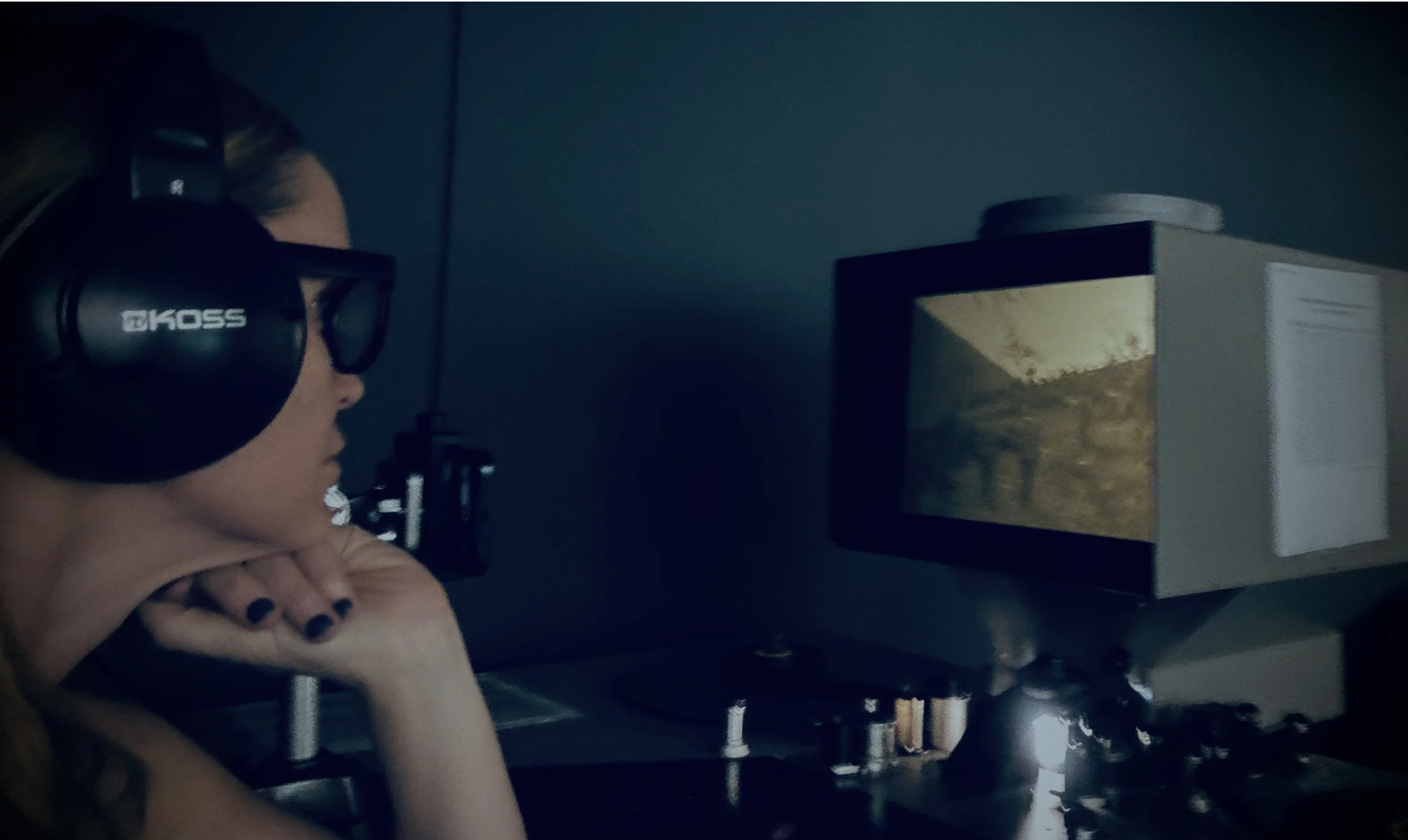
Reviewing footage of the 42nd “Rainbow” Division © Erin Faith Allen
My great-grandmother was the first female film projectionist in Chicago.
I did not fully understand what that meant until I was alone in a room at the National Archives in College Park, spooling a roll of film onto a projector, listening to the click-clack as it whirred and shuddered into motion. The shivers that moved through me in that moment were not just historical. They were cellular.
On the monitor in front of me, soldiers of the 42nd Rainbow Division came to life. Scratchy flicks of time marked the film. Everything moved slightly faster than it should, the way old film does. I had headphones on. The projector looked like something from the 1960s. Outside that room the world was digital and accelerated and loud, and in that room it was 1945, and the men were marching, and I was watching them through my great-grandmother's hands.
There are volumes and volumes of film reels waiting, and I have barely touched them though I wish to touch them all.
This is what the archive actually is, a living gateways to the past where the dead are still moving, still speaking, still marching across old monitors in rooms that smell like preservation and time.
I make regular research trips to two National Archives facilities. The National Personnel Records Center in St. Louis holds military personnel files, the ones that survived the catastrophic 1973 fire that destroyed an estimated eighty percent of Army records from World War II. What remains in St. Louis are morning reports, a relatively small number of OMPFs, hospital admission reports and other such fragmented glimpses of a life in service on microfilm. For a researcher who knows how to read them, such fragments are enough.
The main research facility in College Park, Maryland holds everything else. Unit journals. Operational records. Maps. Photographs. Official correspondence. Film reels. This labyrinth of paper does not have an end and every trip yields something new, which leads to yet another trail to follow.
On a recent trip I was able to solve several cases that families had long considered impossible. One family had spent years trying to understand what their father and grandfather had actually done in the war. No one had been able to help them. I found his serial number, pulled his morning reports in St. Louis, and followed those to the unit journals in College Park. What I brought back to that family was hundreds of pages of documentation. Every single day of their grandfather's war, accounted for, in his own unit's words.
I am grateful every time I walk through those doors. I am grateful for the records that survived and honest about the ones that did not. I am grateful for my great-grandmother's hands, which apparently knew something about spooling film long before I did.
And as always, for me the archive is not the past. It is a place where the past is still alive, waiting for someone to come and find it.
Erin Faith Allen is an investigative war historian and the founder of Fortitude Research, specializing in WWII archival research, wartime reconstruction, Holocaust documentation, and the recovery of women's wartime histories. She is a leading authority on the 42nd "Rainbow" Infantry Division and the liberation of Dachau concentration camp. Her forthcoming book, One Day Over the Rhine, is in active development.
All original photographs and written work published on this site are copyright Erin Faith Allen. Historical and archival images are used where they exist in the public domain.
```