
Vito Bertoldo: The Man the Army Didn’t Want
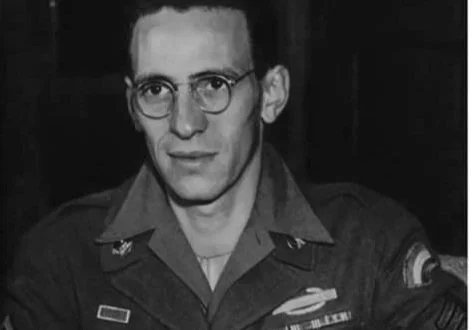
Vito Bertoldo
The United States government looked at Vito Bertoldo and said: not you.
He was 4-F, what the Selective Training and Service Act of 1940 established as unfit for military service. To be 4-F was to be deemed physically, mentally, or morally disqualified from service. For many men this was a welcome reprieve, but for some it was a point of contention, humiliation, and a catalyst for determination.
Vito Bertoldo had nearsightedness so severe that the Army rejected him, and stamped a document saying he was exempt from the draft. The machinery of wartime America, which was consuming men by the millions, looked at this coal miner from Decatur, Illinois, and determined he was not fit for the fight.
He enlisted anyway.
Bertoldo’s story begins in this original refusal, not in the rubble of a French village in January 1945. A man told he is not enough who decides, with quiet tenacity, that he disagrees. The Army relented, and accepted him for limited duty only, first as a military policeman, then, after he appealed, persuaded, and insisted, as an infantryman. No one could have predicted what his determination would produce.
He deployed to France with the 42nd “Rainbow” Division as a cook.
By January 1945, the Rainbow Division was positioned near Strasbourg, green and underequipped, directly in the path of Operation Nordwind which was Hitler's final offensive on the western front. Two German armored divisions, the 25th Panzer Grenadier and the 21st Panzer, descended on the villages of Hatten and Rittershoffen. The 42nd was fighting without its divisional artillery. The battalion's main line of resistance was overrun.
When the battalion staff moved to an alternate position in anticipation of the German assault, Bertoldo volunteered to stay behind and hold the command post alone.
What followed is documented in the language that military commendations use when facts are extraordinary enough to require no embellishment.
He carried his machine gun into the street and remained there for nearly twelve hours. He was fully exposed, in full view of the enemy, while 88-mm shells, machine-gun fire, and small-arms fire worked the ground around him. He was not hiding, and was daring them to come closer.
He moved back inside and strapped the gun to a table. He fired through a window while a German tank sat seventy-five yards away and aimed directly at the building. One shell blasted him across the room.
He returned to his weapon.
At some point during those forty-eight hours, he lost his eyeglasses. The man the Army had deemed too blind to fight even with corrected vision, was now doing it even without corrected vision, concussed, in a collapsing building, against two armored divisions.
When two enemy personnel carriers led by a tank advanced on his position, he waited. He let the infantry dismount. Then, with the tank firing directly at him, he leaned out of the window and eliminated more than twenty of them.
He hurled white phosphorus grenades into the next wave until they broke and ran.
When an 88-mm gun moved its muzzle to within feet of the building and fired into the room, knocking him down and wounding others nearby, an American bazooka team destroyed the gun. Bertoldo got back up. Dazed. He returned to his machine gun and took out several enemy soldiers as they tried to withdraw.
A tank less than fifty yards away eventually destroyed the machine gun entirely and blew him across the room a final time. He picked up a rifle and covered the withdrawal of his fellow soldiers as the post was abandoned.
All around him, the village of Hatten was collapsing under shell fire. Civilians and infantrymen were running, dying, being captured. Bertoldo did not give in.
Forty-eight hours. No rest. No relief. At least forty enemy soldiers killed, many more wounded. His company commander's words after the war were precise: He was a one-man task force they could not defeat.
The 1st Battalion, 242nd Infantry entered the battle at Hatten with 33 officers and 748 enlisted men. Fifty-two hours later, 11 officers and 253 enlisted men remained. The other two-thirds had been killed, wounded, captured, or were missing. German Colonel Hans Von Luck, commanding in the attacking 21st Panzer Division, called it one of the hardest and most costly battles ever fought on the western front.
The Rainbow Division and Vito Bertoldo, without armor, without artillery, without air support, held.
President Harry Truman presented Vito Bertoldo with the Medal of Honor on December 18, 1945. At that same ceremony, he met Army Chief of Staff Dwight D. Eisenhower.
After the war, Bertoldo moved to California. The man the Army didn’t want spent years with the Veterans Administration helping other men recover and reclaim what their war left them holding. With his help disabled veterans navigated bureaucracies, found benefits, and were supported through their recovery from combat. He left in 1958 to run a landscaping business, was diagnosed with cancer in 1966 and died at the VA hospital in Martinez, California. He was forty-nine years old. He is buried at Golden Gate National Cemetery in San Bruno.
His son David, given the middle name Valor, served in the Marine Corps through Vietnam and earned his own Bronze Star. His grandson served in the Army during the Gulf War.
I must have been crazy, Bertoldo told a reporter sometime after his battle. But just the same, I guess I did a great deal of damage by myself.
As it turns out, he could indeed see his way through combat clearly enough.
Vito Bertoldo’s complete Medal of Honor citation can be found at the Congressional Medal of Honor Society.
Erin Faith Allen is an investigative war historian and the founder of Fortitude Research, specializing in WWII archival research, wartime reconstruction, Holocaust documentation, and the recovery of women's wartime histories. She is a leading authority on the 42nd "Rainbow" Infantry Division and the liberation of Dachau concentration camp. Her forthcoming book, One Day Over the Rhine, is in active development.
All original photographs and written work published on this site are copyright Erin Faith Allen. Historical and archival images are used where they exist in the public domain.
```