
The Correspondent Who Came in with the 42nd
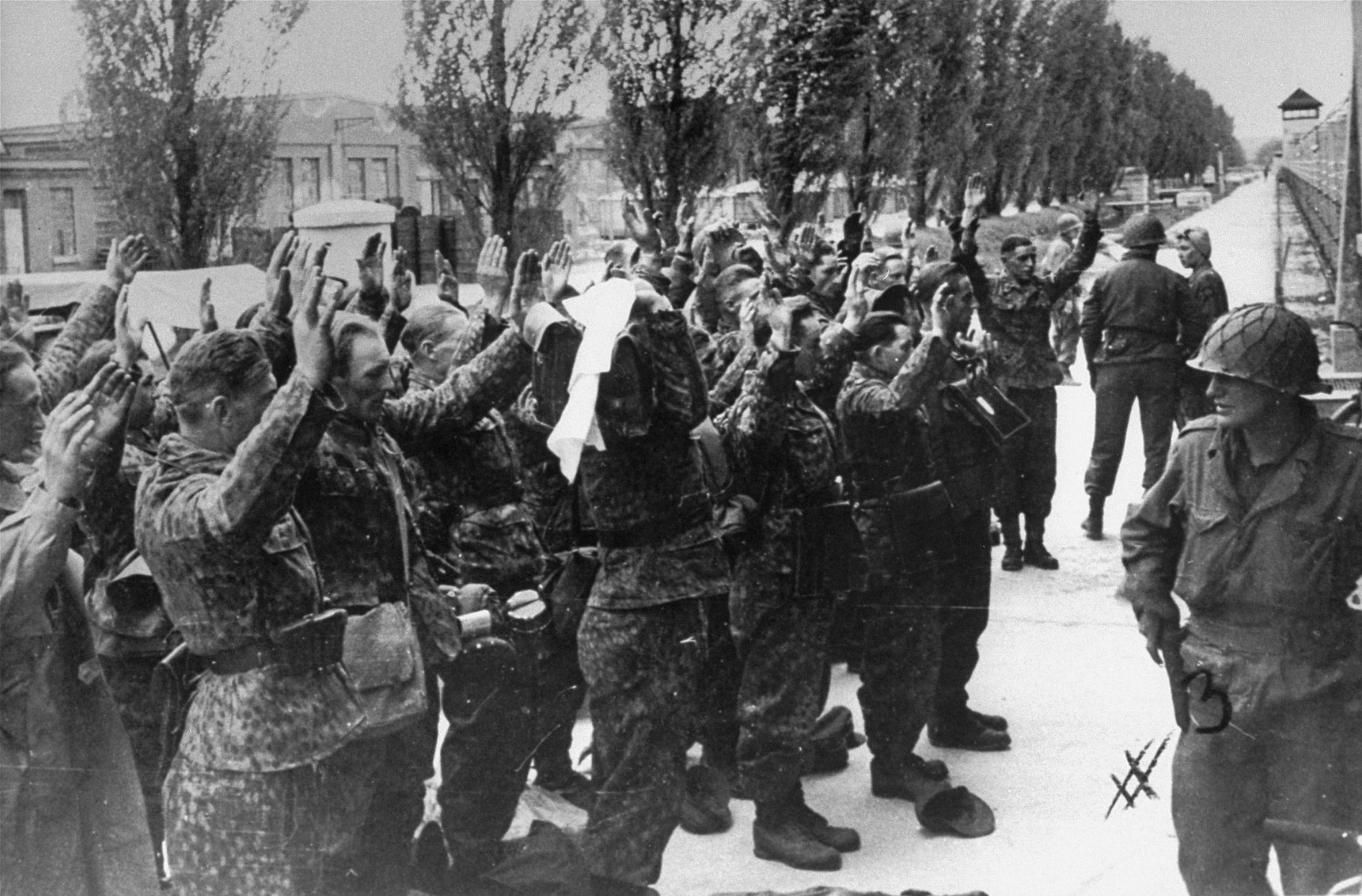
Surrendering Waffen-SS troops guarded by Rainbow Division soldiers. In the background to the right is Marguerite Higgins, the famous WWII journalist, speaking with Lt. Colonel Walter Fellenz, of the 222nd Infantry Regiment, 42nd Rainbow Infantry division. © United States Holocaust Memorial Museum, Provenance: Sol Feingold
There is a photograph in the collections of the United States Holocaust Memorial Museum taken at Dachau on April 29, 1945. In it, surrendering SS troops stand guarded by soldiers of the Rainbow Division. To the right, slightly back from the center of the frame, a woman is speaking with Lieutenant Colonel Walter Fellenz of the 222nd Infantry Regiment, 42nd Rainbow Infantry Division.
The woman is Marguerite Higgins.
She had arrived at Dachau that afternoon in a jeep with soldiers of the 42nd. She was twenty-four years old. She had been a war correspondent for the New York Herald Tribune for less than a year, and she had come to Europe for exactly this: for the days that would define what the war was and what it had done to the humans inside it. April 29, 1945 was one of those days in a way that no briefing and no operational summary could have prepared her for, or prepared anyone for.
She walked in through the southern entrance with the men of the Rainbow and she saw what they saw.
………….
The dispatch she sent to the Herald Tribune from Dachau that night is one of the primary documents of the liberation, and it reads today the way it must have read when it landed on editors' desks in 1945, with the specific weight of a writer who understood that her obligation in that moment was not to manage what the reader felt but to make certain the reader understood what Dachau was. What had been operating there, systematically, for twelve years, while the world acknowledged its existence, but liberation did not come until this day.
She described the southern entrance. The barracks with their stench of death and sickness that she had encountered before, at Buchenwald, and that she recognized here. The dead on the concrete walks outside the quarters. The living who were so far diminished by starvation and illness that it seemed impossible their bodies were still carrying a beating heart. The cattle cars parked below the camp, still holding the prisoners transported from Buchenwald, the ones the SS guards had shot before escaping.
She wrote it because it needed to be written. Because the specific forensic reality of what was in that camp required a witness who would stay inside the description rather than retreating to the summary. She was twenty-four years old and she had just walked through Dachau and she went back to her typewriter and she stayed inside the story.
………….
The day itself was complicated in ways the clean narrative of liberation does not always make room for.
Multiple units arrived at the camp from different directions on the same afternoon. The 42nd came in from the south, through the main enclosure. The 45th was still fighting through SS barracks to the north.
What is documented, across photographs and dispatches and military records and the USHMM collections, is that Higgins arrived with the 42nd, entered through the southern gate, was present for the formal acceptance of the camp's surrender to General Henning Linden, and was standing in the compound speaking with a Rainbow Division officer when the Signal Corps photographer found her.
She was not observing from a careful distance. She was present in the way that her entire career had been present: by being exactly where the story was, doing the work that the moment required, refusing any requirement that said she should be somewhere else.
………….
The Rainbow Division and Marguerite Higgins are connected in history. She is in the division's story because she was in the jeeps that came through the southern gate on the afternoon of April 29th. The division is in her story because it was the unit she was moving with when she walked into the thing that would shape the rest of her understanding of what the war had been.
What I find myself returning to, sitting with that USHMM photograph, is not the drama of the moment, which was real, but the specific quality of the ordinary professional act inside it. She came in with the jeeps. She walked through the compound. She asked her questions and noted what she saw with the quality of attention her training and her particular temperament had developed over years of going toward the things that mattered.
She did not perform her presence. She was simply present, in the place where the story was, because she had always known that was the only place worth being.
The photograph holds all of this in a single frame. A correspondent and a colonel, talking in the compound of a concentration camp on the afternoon it stopped operating, with surrendering SS troops in the foreground and Rainbow Division soldiers standing guard around them.
Both of them in the middle of work that required everything they had.
Both of them standing inside a day that neither of them would ever fully leave behind.
That is what April 29, 1945 was at Dachau.
That is what the Rainbow Division carried out of that camp and into the rest of their lives.
That is what Marguerite Higgins filed that night, before the typewriter had cooled, in the language of someone who understood that the world needed to know exactly what she had seen.
Erin Faith Allen is an investigative war historian and the founder of Fortitude Research, specializing in WWII archival research, wartime reconstruction, Holocaust documentation, and the recovery of women's wartime histories. She is a leading authority on the 42nd "Rainbow" Infantry Division and the liberation of Dachau concentration camp. Her forthcoming book, One Day Over the Rhine, is in active development.
All original photographs and written work published on this site are copyright Erin Faith Allen. Historical and archival images are used where they exist in the public domain.
```