
Wolfsschanze: The Wolf’s Lair
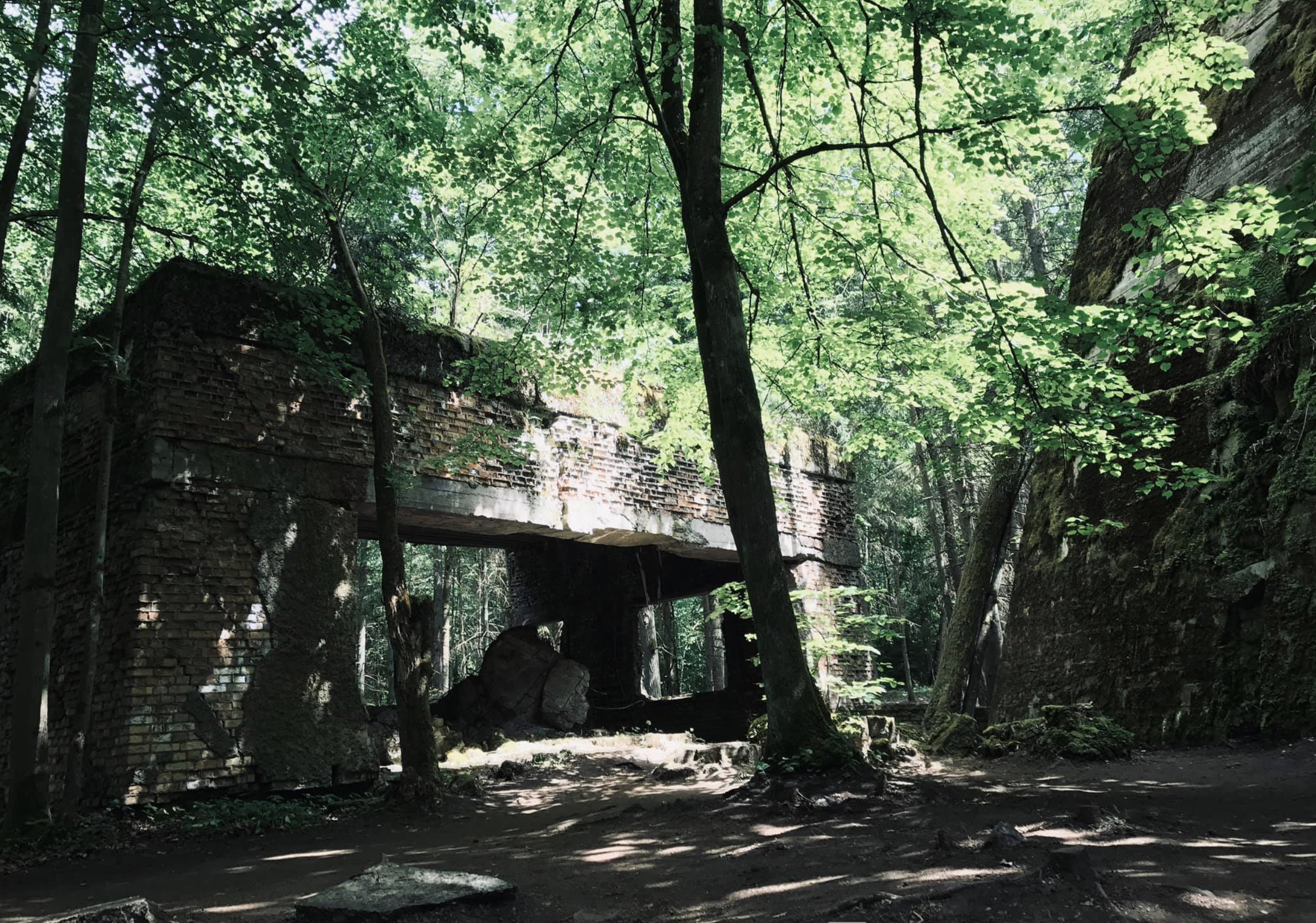
Ruins of the Wolfsschanze, Hitler's Wolf's Lair © Erin Faith Allen
The drive there is half the experience.
Northern Poland unfolds across the windshield in a way that makes you want to pull over and stay. Farmland so pure and open it feels ancient. Villages that sit quietly in the landscape as if they have always been there and always will be. This is a beauty so hushed, so unhurried that it almost hurts. I find myself not wanting to leave before I even arrive.
And then the forest closes around you.
The Wolfsschanze sits deep inside a dense woodland that has had decades to grow back over the ruins. Trees crush in from every direction, their roots threading through horizontal, diagonal, and vertical concrete. Moss covers everything. The forest is reclaiming what was built here, then destroyed here, slowly and without apology. Nature always eventually reclaims the things humans make, then destroy, then make again. You move through these ruins in a particular kind of silence that is not quiet at all.
This was Hitler's primary command center on the Eastern Front. He spent more than 800 days here between 1941 and 1944, deep in the forest of what was then East Prussia, now Poland, directing a war that consumed tens of millions of lives. The reinforced concrete bunkers are still massive even in ruin. The scale of the place communicates something that photographs cannot.
And then there are the ruins of the room.
We all know the story. On July 20, 1944, Colonel Claus von Stauffenberg walked into a conference room in this compound carrying a briefcase. Inside it was a bomb. He placed it under the table as close to Hitler as he could manage, excused himself, and waited. The explosion detonated at 12:42 in the afternoon. Stauffenberg watched the smoke rise from a distance and believed Hitler was dead. He flew back to Berlin to launch Operation Valkyrie, the carefully constructed plan that would have arrested the Nazi leadership and ended the war.
Hitler survived. Another officer moved the briefcase and the heavy oak leg of the conference table absorbed the blast.
Stauffenberg was executed before midnight.
I stood in that place and felt the full weight of what could have been. How thin the margin was. How differently the last months of the war might have gone, how many hundreds of thousands of lives might have been spared, if a briefcase had not been moved a few feet across a floor.
History turns on moments like this, moments that are so small and so catastrophic at once that the mind cannot fully hold them.
I think about propaganda, fear, the surrender of critical thinking, the machinery that produces men willing to burn the world. And the other men, the ones who look at the same machinery and decide to throw themselves into it to make it stop.
Stauffenberg knew he was committing high treason. He did it anyway.
The forest grows over the ruins. The farmland outside is crushingly beautiful.
Life moves on in the villages nearby, and life continues to turn on small moments, as it always has.
Erin Faith Allen is an investigative war historian and the founder of Fortitude Research, specializing in WWII archival research, wartime reconstruction, Holocaust documentation, and the recovery of women's wartime histories. She is a leading authority on the 42nd "Rainbow" Infantry Division and the liberation of Dachau concentration camp. Her forthcoming book, One Day Over the Rhine, is in active development.
All original photographs and written work published on this site are copyright Erin Faith Allen. Historical and archival images are used where they exist in the public domain.
```