
The Liberation of Dachau and the Rainbow Division
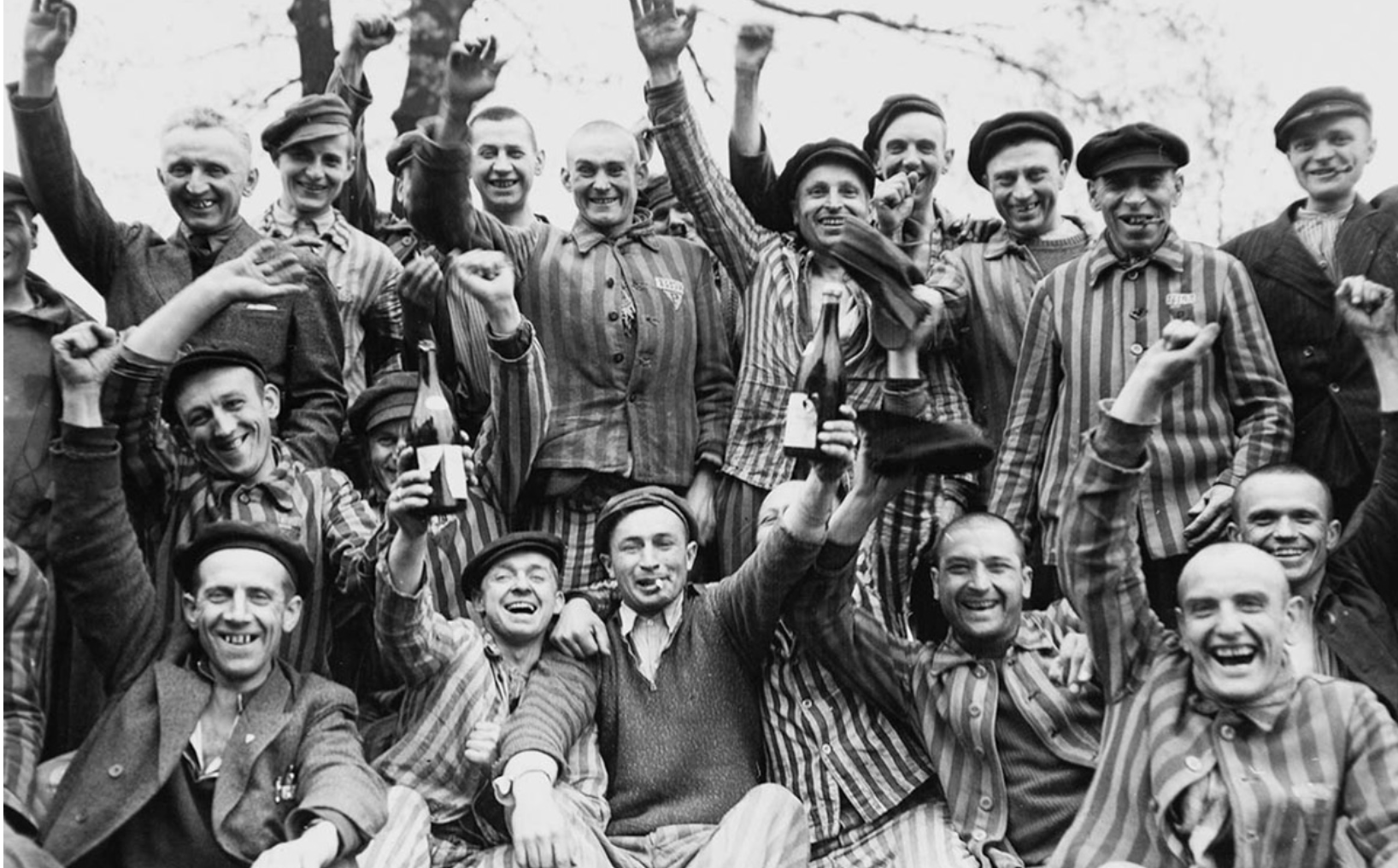
Survivors of Dachau who are able, celebrate. Photo from the National Archives
This year marks the 81st anniversary of the liberation of Dachau. The commemorations are this week. It is always a time for reflection, and this year, as every year, the date arrives with weight for all who remember.
On April 29, 1945, the 42nd “Rainbow” Infantry Division entered Dachau concentration camp.
Three American units converged on the camp that morning: the 42nd Infantry, the 45th Infantry, and the 20th Armored. What they found inside the wire was thirty thousand people in an enclosure designed to hold a fraction of that number, in conditions that the soldiers who entered that day spent the rest of their lives trying to describe, and that the photographic and documentary record preserves with a clarity that no description fully matches.
Dachau had been running since 1933. A first camp established by the regime, with continuous operation by the time the Rainbow Division arrived at its gates.
Just days before liberation, approximately 2,000 inmates had arrived on a death march from Flossenbürg. The day before, on April 28, a train had pulled in: forty railway cars that had left Buchenwald three weeks earlier carrying more than 5,000 prisoners.
The liberation of Dachau is one of the most documented events in the Division's history and one of the most heavily sourced, in terms of what exactly happened in the first hours.
The archive is saturated with what the soldiers found.
They found twelve years of a cruel system that had been running at full capacity with horrors so deep that the guards had no time to conceal what it had been before they fled or surrendered. It confronted the men of the 42nd with evidence that exceeded their preparation and their imagination simultaneously.
The smell reached them before the gates did. Before they understood what they were approaching, they understood that something was wrong.
Private Harold Marowitz said, "The first thing is the shock. And then you cannot believe it, but you can't help yourself going and looking a little further, because it's so hard to believe."
The Division had been fighting for four months by the time it reached Dachau. It had held the line in Alsace during Operation Nordwind in January. It had crossed the Siegfried Line in March. It had fought through Würzburg, Schweinfurt, Nuremberg, and would be the first into Munich on the same day of the Dachau liberation.
And then it was at Dachau. Everything the war had required of the men who wore the half arc on their shoulders, it had led to this morning, these gates, these thirty thousand people who were still alive and the thousands that weren’t.
There are men who were there that day who never spoke about it publicly. There are men who spoke about it immediately and in detail, understanding that the speaking was itself a form of responsibility: that witnessing something of this magnitude became a sort of obligation of testimony.
Division assistant chaplain Major Eli Bohnen, in a letter home dated May 1, 1945: "Nothing you can put in words would adequately describe what I saw there. The human mind refuses to believe what the eyes see. All the stories of Nazi horrors are underestimated rather than exaggerated."
The variation in response is itself part of the historical record. Not every man who liberated Dachau processed the experience the same way, in the same time, with the same resources. What they shared was the fact of having been there. Of having walked through those gates and seen what the 42nd Rainbow Division saw on April 29, 1945.
There is much documentation of that day and it is in the archive, in the photographs, the testimony of the soldiers, the accounts of the survivors. For the Division it is one of the most documented days of the entire war.
Division correspondent James Creasman, also writing on May 1: "The crimes done behind the walls of the worst of Nazi concentration camps now live to only haunt the memories of the Rainbowmen who tore open its gates and first saw its misery."
For the men who were there, it became a day the war became something much larger than what they had understood this war to be.
Erin Faith Allen is an investigative war historian and the founder of Fortitude Research, specializing in WWII archival research, wartime reconstruction, Holocaust documentation, and the recovery of women's wartime histories. She is a leading authority on the 42nd "Rainbow" Infantry Division and the liberation of Dachau concentration camp. Her forthcoming book, One Day Over the Rhine, is in active development.
All original photographs and written work published on this site are copyright Erin Faith Allen. Historical and archival images are used where they exist in the public domain.
```